The Dos and Don’ts of Client Communication in Construction

In the construction industry, communication is more than just exchanging information — it’s the foundation for trust, collaboration, and project success. Whether you’re building residential homes, commercial complexes, or infrastructure projects, how you communicate with clients can make or break the relationship.

Poor communication can lead to cost overruns, project delays, and disputes, while clear and proactive communication fosters transparency, trust, and smoother project delivery. In this blog, we’ll cover the dos and don’ts of client communication in construction, giving you practical strategies to strengthen relationships and deliver projects with confidence.

Why Communication Matters in Construction

Unlike many other industries, construction involves:

  • High financial stakes: Projects represent significant investments for clients.
  • Multiple stakeholders: Architects, engineers, contractors, and subcontractors need to stay aligned.
  • Uncertainty & risks: Weather conditions, supply chain delays, and design changes are common.
  • Long timelines: Communication lapses over months (or years) can cause major misunderstandings.

Strong client communication is therefore not just good practice — it’s essential to managing risk, avoiding disputes, and ensuring client satisfaction.
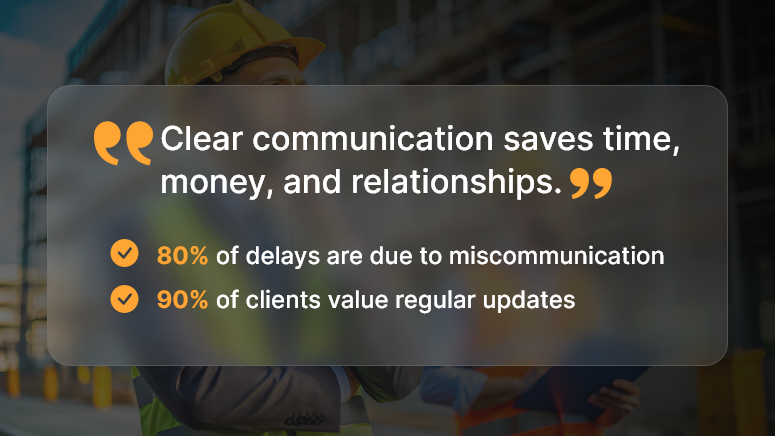
Clear communication saves time

The Dos of Client Communication

1. Do Set Clear Expectations Early

At the project kickoff, align with your client on timelines, budgets, milestones, and communication protocols. Share a project roadmap and clarify who the client’s primary point of contact will be.

Example: Provide a project calendar that highlights key milestones such as foundation completion, structural work, and finishing stages.

2. Do Listen Actively

Construction clients may not always articulate their needs in technical terms. Listen carefully, ask clarifying questions, and restate what you’ve heard to ensure alignment.

Tip: Use phrases like, “So you’d like the living room to have more natural light — does that mean adding a skylight or larger windows?”

3. Do Use Simple Language

Avoid overloading clients with jargon like “M25 concrete mix” or “cantilevered beam.” Instead, explain in plain English and use visuals (drawings, photos, or 3D models) to make complex concepts easy to grasp.

4. Do Provide Regular Updates

Clients get nervous when they don’t hear from you. Even if everything is on track, schedule weekly or biweekly updates with progress photos and site notes.

Best practice: Create a standard project update template that covers completed tasks, current progress, upcoming milestones, and any issues.

5. Do Document Everything

Verbal instructions can cause disputes later. Always follow up with written documentation—whether it’s a change order, cost adjustment, or design decision. Store these in a central repository accessible to the client.

6. Do Be Transparent About Challenges

Delays, budget overruns, and unforeseen site issues are part of construction. Instead of hiding problems, be upfront with clients. Share the issue, its impact, and proposed solutions. Transparency builds trust, even during setbacks.

7. Do Ask for Feedback Regularly

At each milestone (e.g., foundation, structural work, finishing), ask clients for feedback. This avoids late-stage surprises and ensures their vision is being met.

The Don’ts of Client Communication

1. Don’t Overpromise

Promising an unrealistic completion date or underestimating costs may win approval initially, but it creates disappointment later. Be realistic about timelines and budgets to set achievable expectations.

2. Don’t Hide Problems

Avoid the temptation to delay sharing bad news. Hidden issues (like material shortages or failed inspections) only escalate when ignored. Clients appreciate honesty and proactive problem-solving.

3. Don’t Assume Clients Understand Technicalities

Never assume your client can interpret technical drawings or specifications. Break things down, provide visual aids, and confirm understanding.

4. Don’t Communicate Inconsistently

Random updates and sporadic meetings create confusion. Stick to a structured communication schedule and avoid going silent for long stretches.

5. Don’t Get Defensive in Disputes

When a client raises concerns, don’t react emotionally or defensively. Instead, acknowledge their perspective and provide constructive solutions.

6. Don’t Rely on Informal Channels Alone

While WhatsApp or site chats are convenient, important approvals and change requests should never live only in informal messages. Always back them up with documented agreements.

Best Practices for Smooth Communication

  • Leverage Technology: Use project management tools (like Procore, Buildertrend, or Orangescrum) to share updates, files, and progress reports in one place.
  • Centralize Documentation: Store contracts, designs, and reports in shared folders accessible to clients.
  • Use Visual Updates: Photos, progress dashboards, and 3D models make updates clear and engaging.
  • Schedule Site Walkthroughs: Invite clients to see progress firsthand at key milestones.
  • Train Teams: Ensure all site supervisors and project managers know how to communicate professionally with clients.

Conclusion

Client communication in construction is not just about sharing updates — it’s about building trust, managing expectations, and ensuring successful project delivery.

By following the dos — like setting expectations, listening actively, documenting everything, and being transparent—and avoiding the don’ts — like overpromising, hiding issues, or relying only on informal chats — you can strengthen relationships, reduce risks, and deliver projects more smoothly.

In construction, great communication is as critical as great craftsmanship.

FAQs

1. Why is client communication important in construction?

Construction projects involve high costs, long timelines, and multiple stakeholders. Poor communication can lead to delays, cost overruns, and disputes.

2. How often should clients be updated on construction projects?

Weekly or biweekly updates work best. During critical phases, more frequent updates may be necessary.

3. What’s the best way to deliver bad news to a client?

Be transparent and proactive. Explain the issue, its impact, and provide clear solutions or alternatives.

4. Should communication be formal or informal?

Both have their place. Formal communication (emails, reports, contracts) is essential for documentation. Informal chats (calls, site visits) help build rapport.

5. Which tools help with construction communication?

Tools like Procore, Buildertrend, Orangescrum, and even shared Google Drive or Slack channels can centralize communication and improve transparency.
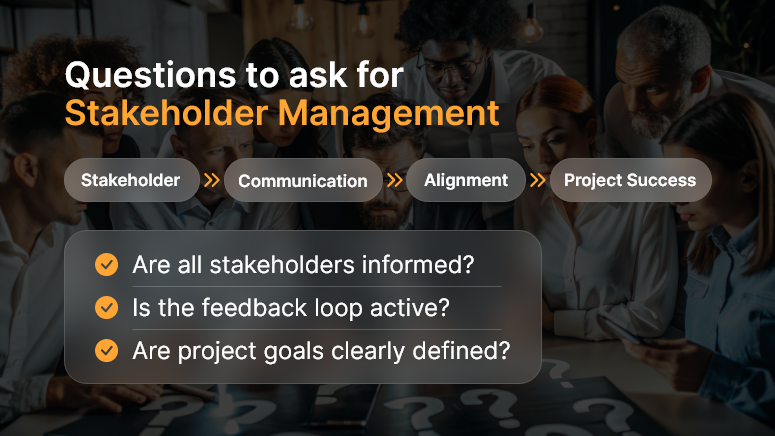
Stakeholder Management: Keeping Everyone on the Same Page

The success or failure of a project often hinges less on technical execution than on how well stakeholders are managed. Stakeholders—whether clients, team members, vendors, local communities, regulatory agencies, or end users—carry expectations, influence, and sometimes conflicting goals.

Stakeholder management is the art and practice of identifying, engaging, communicating with, and aligning all parties so that the project proceeds smoothly, conflict is minimized, and value is delivered.

In this blog, we explore key principles, steps, challenges, and strategies for stakeholder management—so you can keep everyone on the same page throughout the project lifecycle.

Why Stakeholder Management Matters

Let’s start with why stakeholder management is not just “nice to have” but critical:

  • Alignment of expectations: Misaligned expectations lead to scope creep, disputes, or dissatisfaction.
  • Risk mitigation: Unheard stakeholders may raise objections, delays, or resistance midstream.
  • Better decision-making: Stakeholders often hold valuable insights, constraints, or feedback that improve outcomes.
  • Trust and buy-in: When people feel included and informed, they are more supportive and cooperative.
  • Conflict reduction: Proactive communication and transparent decision paths help reduce surprises and confrontations.
  • Smoother change management: When changes are necessary, good stakeholder relationships ease acceptance.

In construction projects, for example, Public notes that “indirect stakeholders” (residents, shop owners, political groups) often get overlooked in favor of direct ones (clients, contractors), but their influence can make or break the project’s public perception and regulatory compliance.

That principle holds in nearly all domains: it’s not enough to focus only on parties who deliver or receive the project’s outputs; you must also manage those impacted.

The Stakeholder Management Lifecycle

A robust stakeholder management approach can be organized in phases:

  • Identification & Mapping
  • Analysis & Prioritization
  • Engagement Strategy & Planning
  • Communication & Interaction
  • Monitoring, Feedback & Adjustment
  • Post-Project Review & Improvement

Let’s unpack each phase.

1. Identification & Mapping

What to do:

  • List all potential stakeholders (internal and external).
  • Include direct participants (e.g., clients, team, vendors) and indirect ones (e.g., regulators, communities, media, neighboring businesses, interest groups).
  • Build a stakeholder map or visual (flowchart, matrix, network diagram) showing relationships, influence, roles, and interactions.
  • Regularly revisit and update this map — stakeholders may emerge, shift in influence, or drop off.
  • Public emphasizes that stakeholder mapping must be repeated regularly, because new stakeholders may appear, priorities change, and risk profiles shift.

Tips:

  • Use frameworks like the impact/influence matrix (e.g., high-influence / high-interest quadrant)
  • Use tools such as stakeholder maps, stakeholder registers, and entity-relationship diagrams

2. Analysis & Prioritization

What to analyze:

  • Influence or power (how much a stakeholder can affect the project)
  • Interest or stake (how affected they are by the project)
  • Attitude (supportive, neutral, resistant)
  • Risks or issues they may pose (delays, objections, negative press)
  • Dependence relationships (who is dependent on whom)
  • Needs, concerns, and expectations

How to prioritize:

  • Focus more resources on high-power, high-interest stakeholders
  • Identify “watch” group (high power, low interest) and “keep informed” group (low power, high interest)
  • Balance across stakeholder groups so no key stakeholder feels neglected

3. Engagement Strategy & Planning

Once you know who matters most and what their concerns are, decide how, when, and how much to engage them.

Key components:

  • Communication channels and frequency (meetings, newsletters, workshops, town halls, social media, one-on-one)
  • Tone, content, and format depend on stakeholder type and literacy
  • Two-way engagement, not just broadcasting: include mechanisms for input, feedback, grievance redressal
    Escalation and issue resolution paths
  • Roles & responsibilities: who in your team is responsible for stakeholder relationships
  • Governance & access control: who sees what information, when, and who can respond

In the Public example, their tool allows defining what each stakeholder sees and who can interact with whom, ensuring access control and relevance.

4. Communication & Interaction

This is the execution phase: implementing your engagement plan.

Best practices:

  • Be transparent: Even the bad news. Publish schedules, explain “why,” and explain what you’ll do to mitigate negative impacts. Public gives the example of informing residents in advance about noise, pollution, scheduling, and mitigation efforts.
  • Communicate clearly and concisely: Use language the stakeholder understands. Avoid jargon when talking to non-technical audiences.
  • Regular cadence: Consistency builds trust — weekly or monthly updates, standups for the core team, newsletters for the broader group.
  • Tailor messages: Different stakeholders have different needs. A subcontractor may want technical details; a community group needs a high-level schedule, impact, and mitigation steps.
  • Active listening: Provide mechanisms for suggestions, complaints, and feedback. Don’t ignore or dismiss them.
  • Respond respectfully: Even negative or unreasonable complaints merit proper replies. Sometimes an apology or clarification goes a long way.
  • Facilitate stakeholder interactions: Encourage dialogue, co-creation, and joint problem solving.

5. Monitoring, Feedback & Adjustment

Stakeholder management is not “set and forget.” You must continuously monitor, evaluate, and refine your approach.

  • Track engagement metrics: response rates, sentiment, escalation frequency
  • Monitor risks or dissatisfactions emerging from stakeholders
  • Update your stakeholder maps and priority lists as conditions change
  • Adjust communication frequency, content, or format based on feedback
  • Document lessons learned and evolve engagement strategies

6. Post-Project Review & Improvement

Once the project is done, close the loop:

  • Conduct stakeholder debriefs: What worked? What didn’t?
  • Collect stakeholder satisfaction surveys or feedback
  • Document best practices and improvement areas
  • Feed them into your organization’s process library so future projects benefit

As the Public says, “When every construction project comes to an end, you transfer these experiences to future endeavours.”

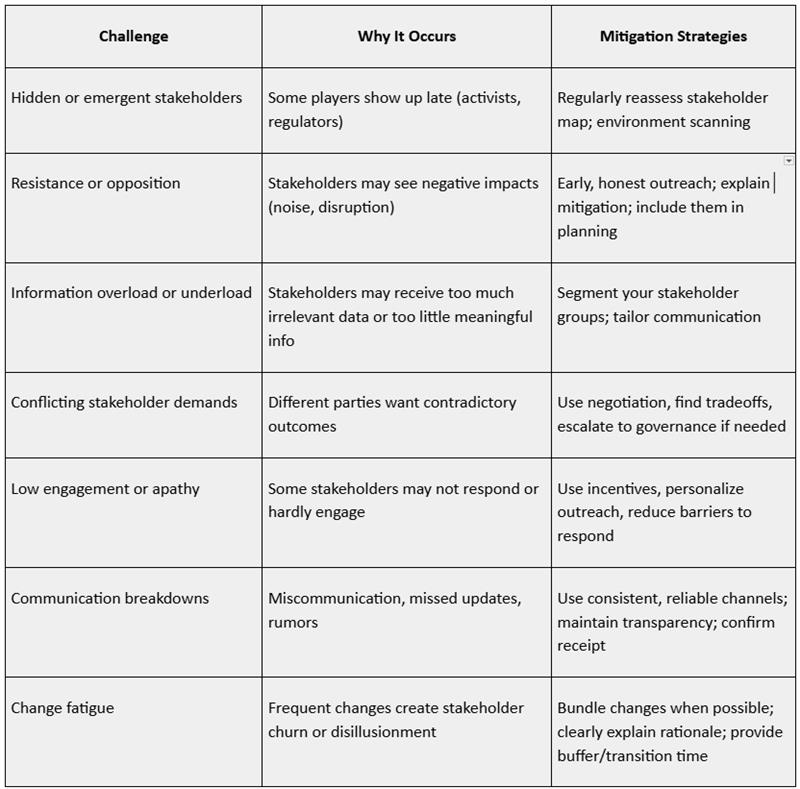
Common Challenges & How to Overcome Them

Real-World Examples & Illustrations

  • Construction & Infrastructure: As in the Public example, when construction causes noise, dust, and road closures, residents may be negatively impacted. Transparent scheduling, mitigation planning (like dust suppression, work hours, alternate routes), and proactive announcements can reduce complaints and local resistance.
  • Urban Redevelopment / Infrastructure Projects: Local businesses, commuters, environmental activists, municipal agencies—each must be engaged, informed, and sometimes compensated.
  • IT / Software Projects: Stakeholders include customers, sponsors, regulatory bodies, internal users, and third-party integrators. Managing expectations about feature scope, cutover plans, downtime, and data migration is critical.
  • Product Launch / Consumer Goods: External stakeholders may include media, influencers, end-users, and regulatory authorities. Early beta users’ feedback becomes critical.
  • NGO or Social Projects: Communities, donors, local government, and beneficiaries all have stakes in outcomes, transparency, and inclusiveness.

In each case, the principles (mapping, transparency, two-way communication, iteration) apply.

Tips & Best Practices

  • Start early – don’t wait until problems arise to engage stakeholders
  • Use stakeholder personas – treat groups with similar needs as a “persona” to tailor messaging
  • Use multiple channels – email, meetings, apps, dashboards, social media, town halls
  • Visual dashboards – for those who like quick overviews (Gantt, status RAG, heat maps)
  • Structured feedback loops – surveys, Q&A sessions, suggestion boxes
  • Governance forums – advisory boards, steering committees, where stakeholders can participate in decisions
  • Neutral facilitators – when tensions exist, use a mediator or third party to facilitate dialogue
  • Document every interaction – keep records of communications, concerns, decisions
  • Balance visibility vs confidentiality – some data is sensitive (bids, budget); gate who sees what
  • Empathy & respect – treat dissenting voices with dignity, acknowledge concerns, even if you cannot satisfy them fully

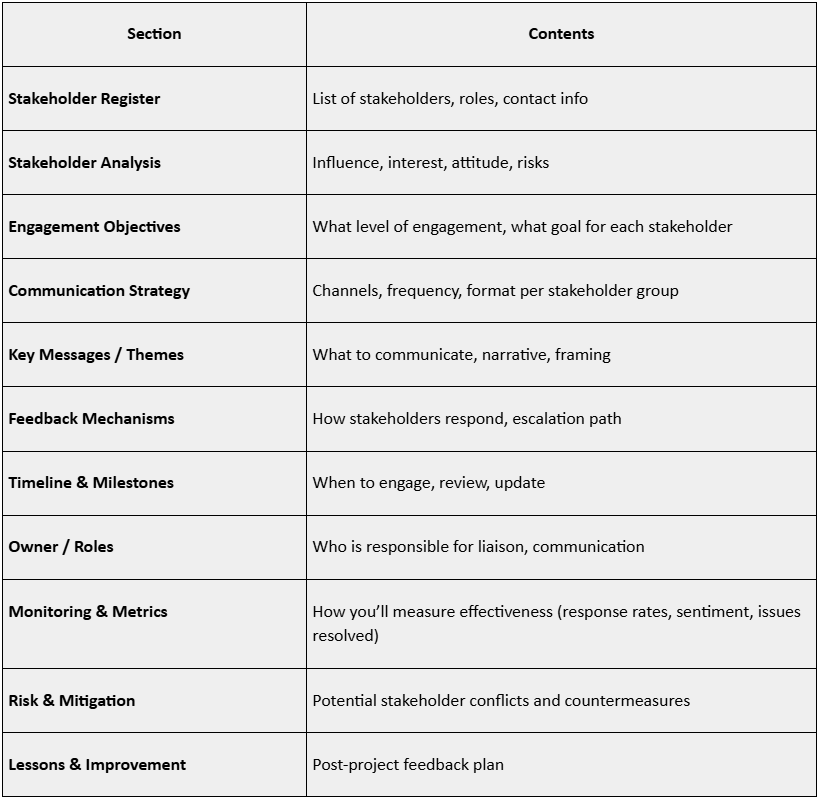
Sample Stakeholder Management Plan Outline

Here’s a template you can adapt:

Conclusion

Stakeholder management is not a peripheral activity — it’s central to project success. A project might have the best technology, schedule, or budget plan, but if key stakeholders feel ignored, misled, or antagonized, delays, pushback, or failure can ensue.

By systematically identifying, prioritizing, engaging, and adapting to stakeholders — with transparency, clarity, and responsiveness — you can keep everyone on the same page. That alignment helps reduce surprises, build trust, and enable smoother execution.

Would you like me to create a shorter “blueprint” or slide deck summary of this for your blog or presentation?

FAQs

1. What is stakeholder management in projects?

Stakeholder management is the process of identifying, analyzing, engaging, and communicating with individuals or groups who are affected by or can influence a project. It ensures expectations are aligned and conflicts are minimized.

2. Why is stakeholder management important?

Without proper stakeholder management, projects risk misaligned expectations, delays, conflicts, or even failure. Effective engagement builds trust, improves decision-making, and helps gain support from all parties.

3. Who are considered stakeholders in a project?

Stakeholders include anyone with a direct or indirect interest in the project: clients, project teams, vendors, investors, regulatory agencies, local communities, and even end users.

4. What is stakeholder mapping?

Stakeholder mapping is the process of visually identifying stakeholders, their level of influence, and their interest in the project. This helps prioritize engagement efforts and ensures no key stakeholder is overlooked.

5. How do you prioritize stakeholders?

Stakeholders are typically prioritized based on their power (influence) and interest (level of impact). High-power, high-interest stakeholders require the most attention, while others may simply need to be kept informed.

6. What are common challenges in stakeholder management?

Some challenges include hidden stakeholders emerging later, conflicting demands, resistance to change, communication breakdowns, and low engagement from certain groups.

7. How to manage conflicts between stakeholders?

Conflicts can be reduced by open communication, transparency, and negotiation. If disagreements persist, use governance structures (like steering committees) or neutral facilitators to resolve disputes.

8. How often should I update stakeholders?

The frequency depends on the stakeholder’s role and influence. Core team members may need daily or weekly updates, while external stakeholders may only require monthly progress reports or milestone reviews.

9. What tools can help in stakeholder management?

Tools include stakeholder registers, RACI charts, communication plans, project dashboards, feedback surveys, and specialized project management software that controls access and communication.

10. How can organizations improve stakeholder engagement over time?

By conducting post-project reviews, gathering feedback, documenting lessons learned, and refining communication strategies, organizations can build stronger stakeholder relationships for future projects.

Inventory Management Hacks for Large-Scale Construction Sites

Did you know that poor inventory control contributes to up to 35% of project cost overruns in the construction industry? Large-scale sites handle thousands of materials daily — steel, cement, pipes, safety gear, and machinery parts. One misstep can lead to delays, wasted materials, or even halted projects.

That’s where inventory management for construction sites comes in. With the right hacks and tools, you can prevent losses, optimize usage, and keep projects running smoothly. In this blog, we’ll explore proven strategies to manage construction inventory, avoid costly mistakes, and see how an integrated digital platform like OConstruction simplifies the process.

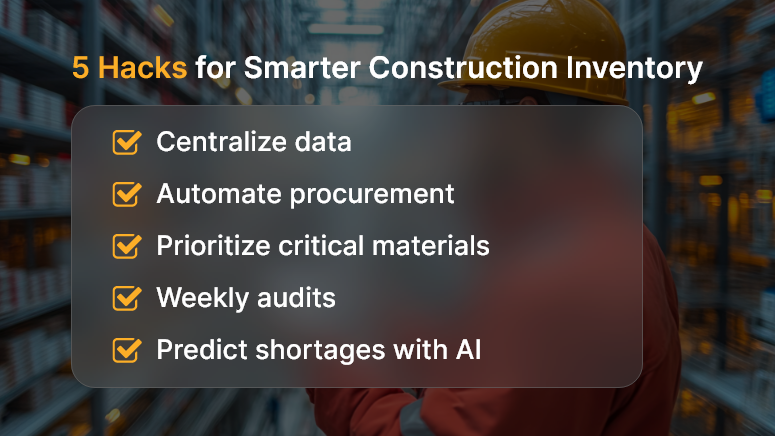
5 Hacks for Smarter Construction Inventory

Business Relevance & Why It Matters

Construction projects are high-stakes. Every delay or material shortage translates into financial loss and strained client relationships. Managing inventory at scale isn’t just about storing materials—it’s about ensuring the right resources are available at the right time, in the right quantity.

Why should companies care?

  • Cost savings: Proper material tracking reduces waste and theft.
  • Time efficiency: Automated updates avoid last-minute procurement chaos.
  • Compliance & safety: Some materials require regulated storage and usage documentation.

Who benefits the most?

  • Project managers juggling multiple sites.
  • Procurement teams negotiating bulk orders.
  • Site engineers rely on timely supply delivery.

Real-world pain vs. solution:

  • A high-rise project in Mumbai was delayed by 3 months due to the loss of shipments of steel bars.
  • A highway project in Texas wasted 10% of the cement because of double ordering.

Both problems could have been solved with real-time inventory management for construction sites.

Best Practices, Frameworks, and Actionable Strategies

Do’s and Don’ts of Inventory Management for Construction Sites

  • Adopt digital tracking systems – Manual logs are outdated and prone to errors. Digital systems ensure real-time updates.
  • Don’t rely solely on contractors – Always verify supply counts with internal checks to avoid misreporting.
  • Do set reorder thresholds – Automated alerts prevent stockouts or overstocking.
  • Don’t overlook material expiry – Chemicals, paint, and safety gear often have shelf lives; expired items compromise safety.

Quick Wins and Best Practices

  • Centralize Inventory Data: Instead of scattered spreadsheets, use a centralized platform. It provides a single source of truth across all sites.
  • Leverage QR Codes & RFID Tags: Tagging materials enables instant scanning and reduces manual counting errors.
  • Automate Procurement Triggers: Link usage patterns with vendor systems for seamless reordering.
  • Prioritize Critical Materials: Classify materials as high, medium, or low priority. Always buffer high-priority materials like steel, cement, and safety gear.
  • Conduct Weekly Audits: Digital audits spot inconsistencies early, preventing large-scale losses.

Step-by-Step Framework for Large Sites

  • Plan Before You Procure: Map project phases and align material requirements with timelines. This prevents both shortages and excess storage.
  • Digitize Material Tracking: Use platforms like OConstruction for real-time inventory monitoring across multiple sites.
  • Enable Multi-Site Visibility: Large contractors often manage multiple sites. With shared dashboards, managers can reallocate surplus materials instantly.
  • Integrate with Financial Systems: Connect inventory with budget tracking. This helps align procurement with cost forecasts.
  • Use Predictive Analytics: AI-driven insights forecast material demand and prevent last-minute supply gaps.

Customer Story

For example, BuildPro Constructions, a mid-sized infrastructure firm, used OConstruction’s real-time inventory tracking to streamline a highway expansion project. Previously, they faced frequent cement shortages, causing weekly delays. By digitizing their material flow and setting automated reorder triggers, they cut procurement delays by 40% and saved nearly ₹50 lakhs in wasted materials.

Here’s how:

  • QR-coded shipments reduced theft.
  • Real-time dashboards gave project managers live visibility.
  • Predictive analytics flagged shortages before they became critical.

Key Takeaways & Closing Summary

Key Insights:

  • Inventory management for construction sites is about accuracy, visibility, and efficiency.
  • Digital tools replace guesswork with real-time insights.
  • Preventing small errors today avoids massive delays tomorrow.

In summary:

Adopting smarter inventory practices isn’t optional — it’s a competitive edge. Large-scale projects demand precision, and the right platform ensures that every nail, brick, and beam is accounted for. By following the hacks outlined above, businesses can not only cut costs but also deliver projects faster and with higher quality.

FAQs

Q1. What is inventory management for construction sites?

Inventory management for construction sites refers to the process of tracking, controlling, and optimizing the use of construction materials, equipment, and tools across multiple projects. It ensures materials are available on time, reduces waste, and prevents costly project delays.

Q2. Why is inventory management important in large-scale construction projects?

Large-scale construction projects involve thousands of moving parts. Without proper construction inventory management, companies risk material shortages, overspending, and delays. Good practices reduce waste, optimize budgets, and improve project delivery timelines.

Q3. How does digital inventory tracking improve construction efficiency?

Digital inventory tracking provides real-time visibility into stock levels, locations, and usage. Features like QR codes, RFID tags, and automated reordering reduce manual errors, prevent theft, and save significant costs.

Q4. What are the common challenges in construction inventory management?

Typical challenges include:

  • Overstocking or understocking materials
  • Lack of real-time updates
  • Miscommunication between project managers and suppliers
  • Theft or material misuse
  • Manual errors in spreadsheets

Using a digital platform addresses most of these issues.

Q5. Can inventory management software integrate with financial systems?

Yes. Advanced platforms like OConstruction can connect inventory with procurement and accounting systems. This integration helps align material purchases with budgets, track expenses, and forecast project costs accurately.

Q6. How do predictive analytics help in construction inventory management?

Predictive analytics analyzes historical data and project timelines to forecast future material needs. This prevents last-minute shortages, avoids storage costs for unused items, and supports smarter procurement decisions.

Q7. Who benefits the most from effective construction inventory management?

  • Project managers – gain visibility across multiple sites
  • Procurement teams – streamline supplier management
  • Finance departments – track material expenses in real time
  • Site engineers – ensure materials are always available when needed

Q8. How can OConstruction help with inventory management for construction sites?

OConstruction’s digital platform enables real-time tracking, automated reordering, multi-site visibility, and predictive insights. This means fewer delays, reduced costs, and higher productivity for construction businesses of any size.

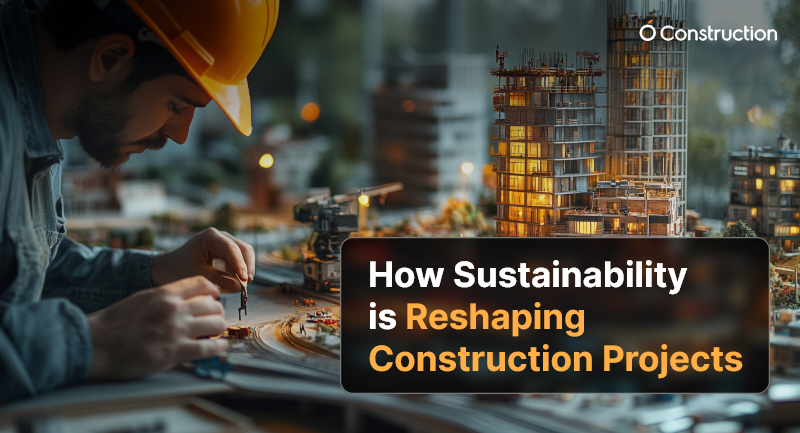
How Sustainability Is Reshaping Construction Projects

Sustainability isn’t just a buzzword — it’s a business imperative reshaping the construction industry. Did you know that the construction sector accounts for nearly 40% of global carbon emissions? Companies that fail to integrate eco-friendly practices face rising costs, regulatory scrutiny, and reputational risks.

For construction managers, project owners, and architects, understanding sustainable construction is no longer optional — it’s a competitive advantage. In this blog, we’ll explore how sustainable construction practices are transforming projects from design to delivery, uncover actionable strategies, and show how digital tools like OConstruction can simplify green initiatives. By the end, you’ll have clear, practical insights to reduce environmental impact while boosting efficiency and profitability.

Sustainable Construction

Business Relevance & Why It Matters

Sustainable construction goes beyond environmental responsibility — it drives measurable business value. For companies in the construction and real estate sectors, adopting eco-friendly practices can reduce operational costs, improve compliance, and enhance brand reputation.

Who benefits most?

  • Project managers: Streamline sustainable workflows with real-time visibility into materials and energy use.
  • Construction firms: Reduce waste and optimize supply chain efficiency.
  • Clients and investors: Gain confidence in projects that meet environmental, social, and governance (ESG) standards.

Real-world examples of challenges and solutions:

  • Excessive material waste: Traditional construction projects often discard 20–30% of materials. Sustainable alternatives reduce waste and save costs.
  • High energy consumption: Eco-friendly designs, including passive heating/cooling and energy-efficient materials, lower operating costs for buildings.
  • Regulatory hurdles: Digital tools can track compliance with green certifications such as LEED or BREEAM, preventing costly fines.

With a digital construction platform, these challenges transform into opportunities. By integrating project planning, resource management, and sustainability tracking in one dashboard, companies can make data-driven decisions that balance environmental goals with profitability.

Best Practices, Frameworks, and Actionable Strategies

1. Material Selection & Sourcing

  • Do: Opt for renewable, recyclable, and locally sourced materials to reduce carbon footprint and shipping emissions.
  • Don’t: Rely solely on traditional concrete or steel without evaluating alternatives such as bamboo, recycled steel, or low-carbon cement.
  • Quick Win: Use OConstruction’s material tracking module to monitor usage, procurement, and eco-certifications in real time.

2. Energy-Efficient Design

  • Do: Implement passive design principles, solar panels, and energy-efficient lighting.
  • Don’t: Ignore building orientation, insulation, and ventilation, which significantly impact energy performance.

Step-by-Step Framework:

  • Analyze site and climate data.
  • Select energy-efficient systems and materials.
  • Track projected vs. actual energy consumption using your digital platform.

3. Waste Management & Recycling

  • Do: Create a waste management plan and assign recycling responsibilities.
  • Don’t: Dispose of construction debris without considering reuse or repurposing.
  • Tip: OConstruction can generate reports showing waste reduction metrics and material savings for sustainability reporting.

4. Water & Resource Conservation

  • Do: Implement rainwater harvesting, greywater recycling, and low-flow fixtures.
  • Don’t: Neglect water audits, which can reveal significant savings opportunities.

5. Monitoring & Reporting Sustainability Goals

  • Track carbon emissions, material usage, and compliance metrics digitally.
  • Set KPI targets for each project and monitor progress in real time.
  • Use dashboards to communicate results to stakeholders, ensuring accountability.

6. Staff Training & Culture

  • Do: Educate your workforce on sustainable construction practices.
  • Don’t: Treat sustainability as a one-off checklist.

Customer Story

For example, GreenBuild Co., a mid-sized construction firm, used OConstruction’s sustainability tracking feature to reduce material waste by 25% and energy usage by 18% across multiple projects. By integrating project management with real-time dashboards:

  • Project managers gained visibility into material sourcing and on-site consumption.
  • Teams optimized workflows to minimize environmental impact without delaying deadlines.
  • Clients appreciated transparent sustainability reports, boosting trust and securing repeat contracts.

The outcome? Cost savings, regulatory compliance, and stronger brand positioning — all while actively contributing to greener construction practices.

Key Takeaways & Closing Summary

  • Sustainable construction isn’t just eco-friendly; it’s strategically profitable. Businesses that implement these practices reduce costs, comply with regulations, and strengthen their brand.
  • Digital platforms like OConstruction simplify sustainability by offering real-time tracking, reporting, and actionable insights.
  • Quick wins: Optimize materials, implement energy-efficient designs, manage waste effectively, and engage staff in a sustainability culture.
  • Remember: Sustainability is a journey, not a single point to check. Starting small with measurable steps can lead to long-term environmental and business impact.

By integrating sustainability into construction projects, companies can achieve cost savings, efficiency, and competitive advantage — while building a better future for communities and the environment.

FAQs

1. What is sustainable construction?

Sustainable construction involves designing, building, and operating structures in ways that minimize environmental impact, reduce waste, conserve resources, and improve energy efficiency. It balances economic, social, and ecological considerations for long-term value.

2. Why is sustainable construction important in today’s projects?

It helps companies reduce carbon footprints, lower operating costs, comply with regulations, and enhance brand reputation. With growing environmental concerns and stricter standards, sustainable construction has become a competitive necessity.

3. How can digital tools support sustainable construction?

Platforms like OConstruction track material usage, energy consumption, waste management, and compliance metrics in real time. This helps teams make data-driven decisions, optimize workflows, and ensure transparency in sustainability efforts.

4. What are the key benefits of adopting sustainable construction practices?

  • Reduced construction and operational costs
  • Enhanced compliance with green building standards (LEED, BREEAM)
  • Lower carbon emissions and resource usage
  • Stronger client trust and brand reputation

5. What are some common sustainable construction strategies?

  • Using eco-friendly and recycled materials
  • Energy-efficient design, lighting, and HVAC systems
  • Waste reduction and recycling on-site
  • Water conservation through rainwater harvesting and greywater reuse

6. Can small construction firms implement sustainable practices?

Yes. Sustainable construction is scalable. Digital platforms help even small firms monitor, track, and report sustainability metrics efficiently, without major upfront investment.

7. How does sustainable construction impact project timelines?

When planned properly, sustainability can improve efficiency by reducing waste and rework. Tools like OConstruction ensure better scheduling and resource management, keeping projects on track.

8. How do clients benefit from sustainable construction projects?

Clients get energy-efficient, environmentally responsible buildings with lower long-term costs. Transparent sustainability reporting also builds trust and supports ESG commitments.

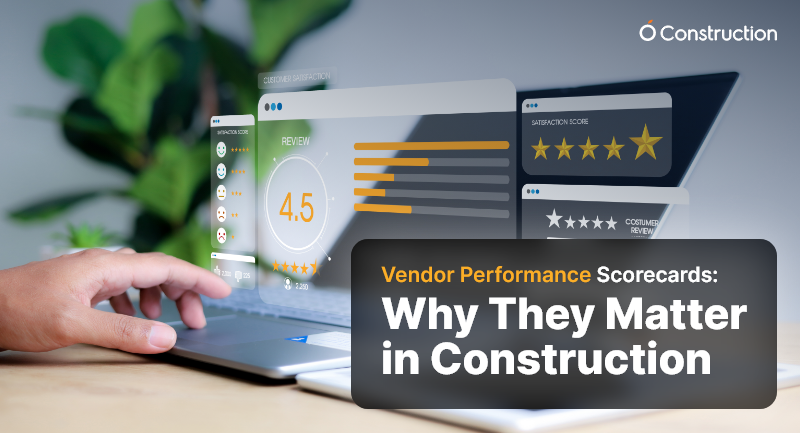
Vendor Performance Scorecards: Why They Matter in Construction

Did you know that nearly 70% of construction projects face cost overruns or delays due to vendor-related issues? That’s a staggering number — and one that reveals a hidden truth: no matter how strong your project plan is, your vendors can make or break your success.

This is where vendor performance scorecards step in. They aren’t just spreadsheets; they’re powerful tools to measure, monitor, and improve how your vendors deliver on promises. By tracking key metrics like cost, quality, and timeliness, construction firms can ensure accountability, reduce risks, and make smarter decisions.

In this blog, we’ll explore why vendor performance scorecards matter in construction, how they can transform vendor management, and practical strategies to implement them effectively with a digital platform like OConstruction.

Vendor Scorecards Project Success

Business Relevance & Why It Matters

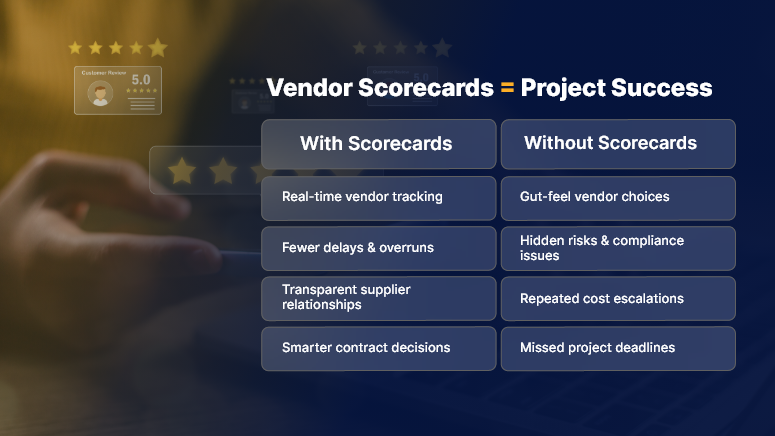
In construction, your vendors are your lifeline. From equipment suppliers to subcontractors, each plays a vital role in meeting deadlines and keeping projects within budget. But here’s the problem: many companies still rely on gut feeling or fragmented spreadsheets to evaluate vendors.

This approach creates three major risks:

  • Hidden inefficiencies — poor-performing vendors get repeat contracts because there’s no structured data.
  • Inconsistent quality — projects suffer when vendors don’t meet compliance or safety standards.
  • Wasted money — delayed deliveries and cost escalations eat into project profits.

By contrast, vendor performance scorecards bring clarity, structure, and accountability. They help you:

  • Identify your top-performing vendors.
  • Spot and fix recurring problems early.
  • Build stronger, data-driven vendor relationships.

Use Cases in Construction:

  • A contractor uses scorecards to compare multiple suppliers and choose the most reliable one.
  • A project manager leverages scorecards to negotiate better terms with vendors backed by data.
  • A finance controller uses vendor scorecards to track compliance and cost efficiency across projects.

The bottom line: vendor performance scorecards aren’t optional anymore — they’re strategic.

Best Practices, Frameworks, and Actionable Strategies

1. Define the Right Metrics

Your scorecard is only as good as the metrics you track. In construction, focus on:

  • Timeliness: Were deliveries made on schedule?
  • Quality: Did materials meet project standards?
  • Cost compliance: Were invoices aligned with contracts?
  • Safety compliance: Did vendors follow safety protocols?
  • Collaboration: Was communication responsive and transparent?

Each metric should have a clear scoring scale (e.g., 1–5 or percentage-based).

2. Standardize Across Projects

Don’t let each site or manager create their own version. Standardize your scorecards to ensure consistent vendor evaluation across the organization. This reduces bias and makes comparisons fair.

3. Automate Data Collection

Manual scorecards often fail because they rely on subjective opinions or delayed updates. With OConstruction, you can automate:

  • Data pulled from invoices (cost accuracy).
  • Project timelines (delivery performance).
  • Safety reports (compliance tracking).

Automation ensures real-time, objective evaluation.

4. Use Scorecards for Strategic Decisions

Don’t just file away the results. Use them actively to:

  • Award contracts to high performers.
  • Blacklist unreliable vendors.
  • Negotiate better terms with borderline performers.
  • Identify training needs for subcontractors.

5. Communicate Results with Vendors

A scorecard should not be a secret file. Share results with vendors to encourage transparency and improvement. Frame it as a partnership tool, not just a policing mechanism.

6. Track Trends Over Time

One scorecard doesn’t tell the whole story. Look at performance over 6–12 months to see if vendors are improving or declining. This helps you decide whether to continue long-term partnerships.

Customer Story Example

BuildMax Construction, a mid-sized contracting company, struggled with repeated delays from multiple suppliers. They adopted OConstruction’s vendor performance scorecards to track timeliness, quality, and cost metrics.

Within just six months, they identified their top three vendors, cut ties with underperformers, and renegotiated terms with others. The result? A 25% reduction in project delays and a 15% increase in cost savings.

By making vendor evaluation data-driven, BuildMax not only improved project delivery but also built stronger relationships with suppliers.

Key Takeaways & Closing Summary

Vendor performance scorecards are not just operational tools; they’re strategic assets in construction management.

Key Insights:

  • Vendor scorecards bring accountability, consistency, and transparency.
  • They reduce risks of cost overruns and delays.
  • Digital platforms like OConstruction make scorecards automated, real-time, and actionable.

In short, when you simplify vendor evaluation, you amplify project success.

Takeaway Thought:

Think of vendor performance scorecards as your project’s early warning system. They highlight strengths, flag risks, and give you the power to make smarter business decisions.

FAQs on Vendor Performance Scorecards in Construction

1. What are vendor performance scorecards in construction?

Vendor performance scorecards are structured evaluation tools that track vendor performance across metrics like cost, quality, timeliness, and compliance. In construction, they help project managers and contractors ensure accountability, reduce risks, and select the most reliable suppliers.

2. Why do vendor performance scorecards matter in construction projects?

They matter because vendor-related issues are one of the leading causes of project delays and cost overruns. Vendor performance scorecards provide data-driven insights that enable construction firms to choose the best vendors, negotiate better contracts, and eliminate inefficiencies.

3. How do you create a vendor performance scorecard?

To create one, define key performance indicators (KPIs) such as timeliness, quality, safety compliance, and cost control. Assign weightages to each metric, design a scoring system, and ensure all project managers use a standardized template. Platforms like OConstruction can automate this process for accuracy and real-time insights.

4. Can vendor performance scorecards improve vendor relationships?

Yes. When shared transparently, scorecards act as a collaborative tool. They show vendors where they’re excelling and where improvement is needed. This fosters accountability and builds long-term, trust-based relationships between contractors and suppliers.

5. What is the role of digital platforms in vendor performance scorecards?

Digital platforms like OConstruction automate scorecard data collection by integrating with invoices, project timelines, and safety reports. This ensures evaluations are objective, consistent, and updated in real time, eliminating manual errors and delays.

6. How often should construction companies evaluate vendors using scorecards?

Best practice is to review vendor performance scorecards after each project milestone or at least quarterly. Regular evaluation ensures issues are spotted early and long-term trends in vendor performance are visible.

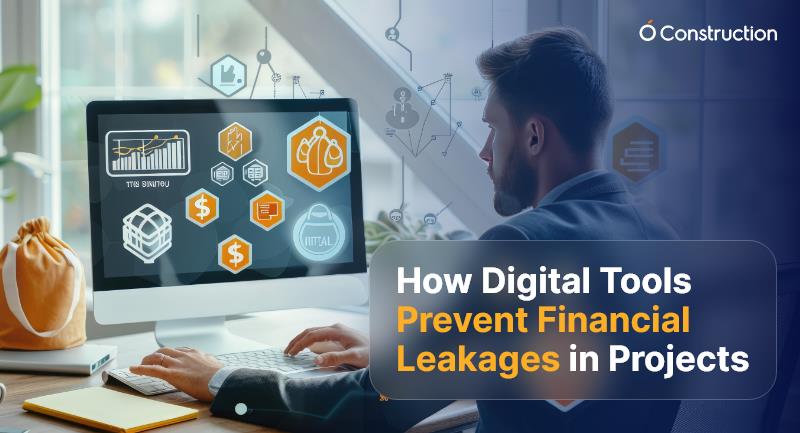
How Digital Tools Prevent Financial Leakages in Projects

Cost overruns are the Achilles’ heel of the construction industry. Studies reveal that 9 out of 10 large projects exceed their budgets, sometimes by as much as 50% or more. The reasons vary — from untracked invoices to material wastage, scope creep, or delayed approvals. But the root cause is often the same: poor visibility and lack of control over finances.

This is where digital project management tools come in. By providing real-time cost tracking, automated workflows, and predictive insights, they enable construction companies to identify leaks early and prevent them from escalating into substantial financial losses.

In this blog, we’ll delve into why financial leakages in projects are a pressing issue, how they impact profitability, and the practical ways digital tools like OConstruction help address these gaps. Whether you’re a project manager, contractor, or finance controller, this guide will show you how to safeguard your bottom line.

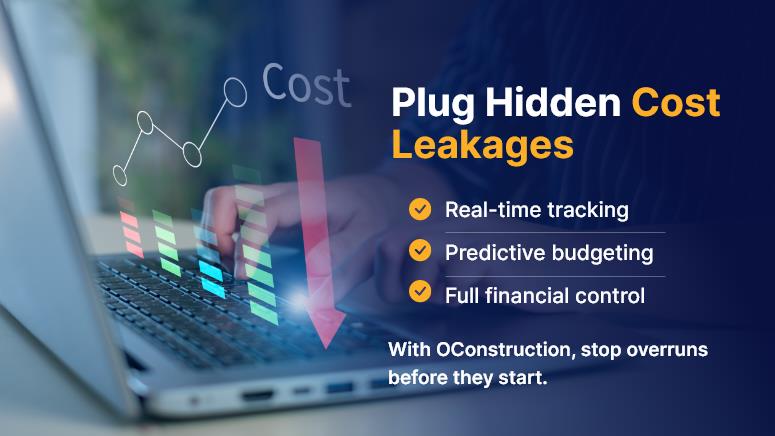
Plug Hidden Cost Leakages

Business Relevance & Why It Matters

Financial leakages in projects may seem like small issues at first glance. A misplaced invoice, a delayed approval, or a minor over-purchase of materials might not raise alarms immediately.

But when multiplied across a large construction project with multiple vendors, subcontractors, and timelines, these “small” issues can quickly escalate into significant financial drains.

Why This Matters for Businesses

Construction projects already operate on tight margins. Any unmonitored leak not only eats into profits but also damages client trust. Imagine promising to deliver a commercial complex within a ₹50 crore budget, only to explain midway that costs have ballooned by 20%. That’s not just a financial setback; it’s a reputational hit.

Who Benefits Most from Prevention

  • Contractors: Gain visibility into expenses and reduce disputes with clients.
  • Project Managers: Ensure smooth execution without firefighting cost overruns.
  • Finance Controllers: Strengthen compliance and reporting accuracy.
  • Owners/Investors: Protect ROI and gain confidence in project delivery.

Real-World Problems Across Industries

  • Infrastructure Projects: A highway contractor delays vendor payments due to manual reconciliation. Result? Late fees and strained supplier relationships.
  • Commercial Construction: A retail mall project overspends on materials due to duplicate procurement requests not caught in time.
  • Residential Projects: A housing developer faces hidden labor costs because subcontractor hours are tracked on paper instead of a central system.

The pain vs. solution contrast couldn’t be clearer: traditional methods expose businesses to leakages, while digital systems build a safety net.

Best Practices, Frameworks, and Actionable Strategies

Digital construction tools don’t just replace spreadsheets; they transform how costs are planned, tracked, and controlled. Below are the proven practices and frameworks that leading construction companies use to prevent financial leakages in projects.

1. Automate Cost Tracking for Accuracy

Manual expense tracking is prone to errors and delays. Even the most diligent project manager cannot match the precision of an automated system.

  • With digital tools: every transaction is captured instantly and linked to the right project, task, or vendor.
  • Outcome: Managers know exactly where the money is going, ensuring no expense goes untracked.

Example: Instead of waiting for monthly reconciliations, a project manager can see daily material costs logged automatically into the system.

2. Leverage Real-Time Dashboards for Transparency

Dashboards are more than pretty visuals. They provide instant clarity on budgets, expenses, and forecasts.

  • Identify areas where costs are rising faster than expected.
  • Monitor project performance against financial baselines.
  • Take corrective action before overruns occur.

Imagine catching an over-budget material purchase on the same day it’s requested — that’s the power of real-time visibility.

3. Integrate Finance and Project Operations

Siloed teams are a major cause of financial leakages. Finance works on one set of numbers, while the project team works on another. Misalignment creates discrepancies that only surface too late.

  • With integration: Finance, procurement, and site managers use the same system.
  • Result: No duplicate costs, no missed payments, and smoother audits.

OConstruction ensures everyone speaks the same financial language.

4. Adopt Predictive Budgeting for Proactive Control

Traditional budgeting reacts after the damage is done. Predictive budgeting flips the script by using historical and live data to forecast potential overruns.

  • Anticipate cost spikes in labor or materials.
  • Adjust budgets before commitments are made.
  • Prevent risks from escalating into losses.

For example, if steel prices are projected to rise, the system alerts managers to secure materials early, saving costs.

5. Do’s and Don’ts for Preventing Leakages

Do’s

  • Standardize workflows to minimize manual errors.
  • Set automated alerts for budget threshold breaches.
  • Regularly review subcontractor invoices and link them to contracts.
  • Track material usage to prevent wastage.

Don’ts

  • Don’t rely only on manual reconciliation — errors multiply fast.
  • Don’t delay expense reporting; late entries distort reality.
  • Don’t overlook “minor” costs — they accumulate quickly.
  • Don’t manage separate systems for finance and projects.

6. Quick Wins for Immediate Impact

  • Digitize procurement to reduce fraud and ensure transparency.
  • Automate payroll and subcontractor payments to avoid hidden costs.
  • Schedule monthly audits using system-generated reports.
  • Link costs to project milestones for better accountability.

These steps deliver fast ROI without complex implementations.

7. A Practical Framework for Financial Control

Here’s a simple but powerful framework to follow:

  • Baseline the Budget Digitally – Define expected costs across labor, materials, and overhead.
  • Connect Every Expense – Link every rupee spent to specific tasks, vendors, or milestones.
  • Track Actual vs. Planned Costs – Use live dashboards for daily monitoring.
  • Review Weekly – Conduct quick reviews with finance and site managers.
  • Report Automatically – Share transparent reports with stakeholders to build trust.

Following this framework ensures continuous financial discipline across the project lifecycle.

Customer Story/Use Case Example

For example, Skyline Builders, a mid-sized construction company, struggled with frequent budget overruns due to manual invoice approvals and late expense tracking. By adopting OConstruction’s digital project cost management platform, they achieved measurable improvements:

  • Reduced untracked expenses by 30% in the first year
  • Saved nearly 15% in overall project costs
  • Accelerated subcontractor payment cycles by 40%
  • Delivered projects on schedule with improved client confidence

This transformation highlights how plugging financial leakages with digital tools delivers both financial and operational wins.

Key Takeaways & Closing Summary

Financial leakages in projects are silent killers of profitability. But with the right strategies, they are preventable.

In summary:

  • Automated cost tracking ensures accuracy.
  • Real-time dashboards provide transparency.
  • Integration of finance and project teams eliminates silos.
  • Predictive budgeting enables proactive control.

By combining these best practices with a platform like OConstruction, companies not only stop leakages but also gain the ability to deliver projects faster, cheaper, and with higher quality.

Final Thought:

The choice is simple: stick with outdated methods and risk uncontrolled losses, or adopt digital tools to future-proof financial management. The companies that embrace digital transformation today will be tomorrow’s leaders in construction efficiency.

FAQs

1. What are financial leakages in projects?

There are hidden costs like duplicate payments, material wastage, or billing errors that increase project expenses.

2. How can digital tools stop financial leakages?

They track costs in real time, automate approvals, and flag unusual spending before it escalates.

3. Why are leakages common in construction projects?

Because of multiple vendors, manual tracking, and a lack of centralized cost control.

4. Who benefits most from preventing financial leakages?

Project managers, finance teams, and owners—all gain clarity, savings, and smoother execution.

5. Is OConstruction suitable for small firms too?

Yes, it’s scalable for both small contractors and large enterprises, offering cost control and transparency.

Category: Construction Academy

Subcategory: Budgeting and Planning

Subcategory: Construction Phase

Subcategory: Design Coordination

Subcategory: Estimation Techniques

Subcategory: Initiation and Feasibility

Subcategory: Introduction

Subcategory: Personal Management

Subcategory: Project Close-Out

Subcategory: Project Scheduling

Subcategory: Project Teams

Subcategory: Proposal Management

Subcategory: Total Quality Management

Subcategory: Tracking and Control

Subcategory: Work Breakdown

Category: Help Desk

Subcategory: Client

Subcategory: Construction 101

Subcategory: Contractor Management

Subcategory: Expense

Subcategory: Finance Budget

Subcategory: Inventory Management

Subcategory: My Approvals

Subcategory: Site Management

Subcategory: Vendor Management