The Rise of Digital Construction Workflows: What Contractors Must Know

Construction projects routinely suffer from cost overruns, delays, and productivity gaps—studies show over 70% of projects exceed their budgets.

The Rise of Digital Construction Workflows: What Contractors Must Know explores why outdated tools like Excel sheets, WhatsApp messages, and paper logs no longer support today’s pace of execution.

When daily progress reports are late, material issues go unnoticed, or schedules shift without real-time visibility, teams lose time, money, and client trust.

In this blog, you’ll learn how to transition to end-to-end digital workflows that improve accuracy, visibility, and accountability. Whether you’re a project manager, EPC leader, QS engineer, site supervisor, or construction business owner, you’ll gain frameworks, best practices, and real-world insights.

You’ll also see how OConstruction becomes your digital partner for planning, BOQ management, DPR automation, tracking, cost control, scheduling, and site execution.
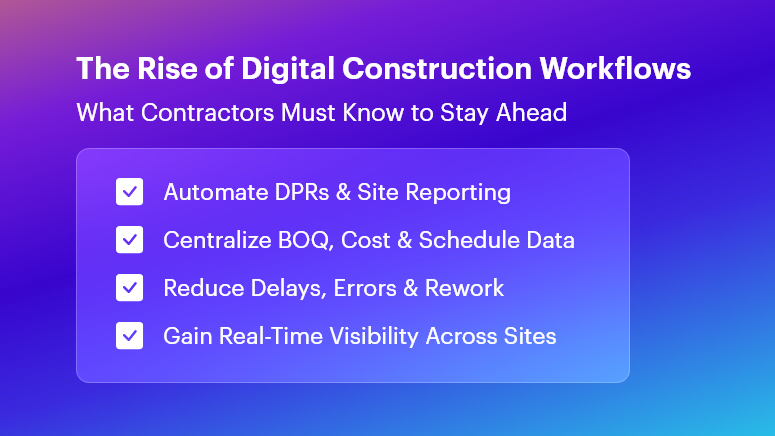
The Rise of Digital Construction Workflows

Why Digital Construction Workflows Matter

Construction inefficiencies carry major financial risks. Cost overruns, rework, and material waste can consume up to 30% of project value, and poor communication widens the gap.

Common Consequences

  • Delayed cash flow due to late DPR submissions
  • Material stockouts caused by manual logs and poor tracking
  • Rework and compromised quality from inaccurate BOQs

Industry Impact Examples

Sector Digital Gap Result
Residential Budget deviations due to delayed site reporting
Commercial Difficulty coordinating multiple subcontractors
Infrastructure Poor visibility across multi-site operations
EPC Misalignment from disconnected spreadsheets

Why Traditional Tools Fail

  • No real-time data sync → creates silos
  • No standardised workflows → human errors multiply
  • Weak audit trails → accountability disappears

Digital workflows solve these challenges through automation, transparency, and connected systems—making projects faster, more cost-efficient, and more predictable.

Best Practices, Frameworks & Actionable Steps

Transitioning to digital workflows requires structure — not just software adoption. Below is a proven rollout framework.

Define End-to-End Processes

  • Standardise workflows across all project phases
  • Use digital checklists to ensure consistent task execution
  • Automate reminders to reduce missed actions

Optimise BOQ & Estimate Management

  • Break BOQs into granular items linked to live quantities
  • Maintain version control for seamless updates
  • Use historical data to improve forecasting accuracy

Automate DPRs & Daily Logs

  • Capture photo-based site progress using mobile forms
  • Auto-generate reports in minutes
  • Sync updates directly to project schedules

Streamline Material & Inventory Management

  • Use FIFO with barcode/QR scanning
  • Automate reorder triggers to prevent shortages
  • Track every receipt, issue, and consumption event

Strengthen Cost Control & Budget Monitoring

  • Track costs daily — not monthly
  • Use Earned Value Management (EVM) to measure health
  • Act early using real-time alerts and dashboards

Coordinate Multi-Site Operations

  • Enforce uniform workflows across projects
  • Compare performance across locations with standard KPIs
  • Use centralised dashboards for live status visibility

Common Mistakes to Avoid

  • Overloading teams early — start with essentials
  • Ignoring change management — training is critical
  • Neglecting audits — compliance must be reinforced

Following these steps with OConstruction enables a seamless transition to truly digital, data-driven execution.

Mini Case Study: Sunrise Infrastructure

Sunrise Infrastructure—a highway contractor—struggled with two-day reporting delays.

After adopting OConstruction’s DPR Automation & Daily Logs:

  • 85% faster reporting turnaround
  • 30% fewer quantity reporting errors
  • 25% reduction in rework cost

With mobile entries, geotagged photos, and automated workflows, managers gained real-time visibility into material usage and progress — keeping the project on schedule and improving stakeholder confidence.

Key Takeaways

  • Digital workflows eliminate silos and reduce delays
  • Automated DPRs ensure accountability and real-time progress
  • Granular BOQ control prevents wastage and cost leakage
  • Cost dashboards with EVM metrics detect variances early
  • Multi-site standardisation strengthens reporting and scalability

The era of manual logs and disconnected spreadsheets is ending. The future of construction belongs to integrated, automated, and insight-driven execution.

FAQs

1. What is The Rise of Digital Construction Workflows: What Contractors Must Know?

The Rise of Digital Construction Workflows: What Contractors Must Know refers to adopting integrated, end-to-end software like OConstruction that streamlines planning, BOQ management, DPR automation, and site execution for contractors of all sizes.

2. How do digital construction workflows reduce cost overruns?

By automating daily logs, enforcing EVM metrics, and centralising BOQs, digital workflows provide real-time visibility into budget variances and material consumption. This prevents overspending and waste.

3. Can OConstruction integrate with existing ERP or accounting tools?

Yes. OConstruction offers APIs to sync its Cost Control & Budget Monitoring data with popular ERP and finance systems, ensuring seamless financial reporting and audit trails.

4. How quickly can a team implement OConstruction?

With our phased onboarding, teams can start digitising DPRs and BOQs within two weeks. Full end-to-end adoption typically completes in 6–8 weeks, depending on project complexity.

5. Does OConstruction support multi-site coordination?

Absolutely. Through Real-time Field-to-Office Sync and standardised dashboards, OConstruction lets you manage multiple sites from a single portal, ensuring consistent KPIs and resource allocation.

6. What security measures protect my project data?

OConstruction employs enterprise-grade encryption, role-based access controls, and regular backups to safeguard your BOQs, DPRs, and financial records, ensuring compliance with industry standards.

7. How does OConstruction improve DPR accuracy?

By enabling geotagged photos, digital forms, and automated workflows, OConstruction minimises manual entry errors and delivers high-fidelity DPRs within minutes of data capture.

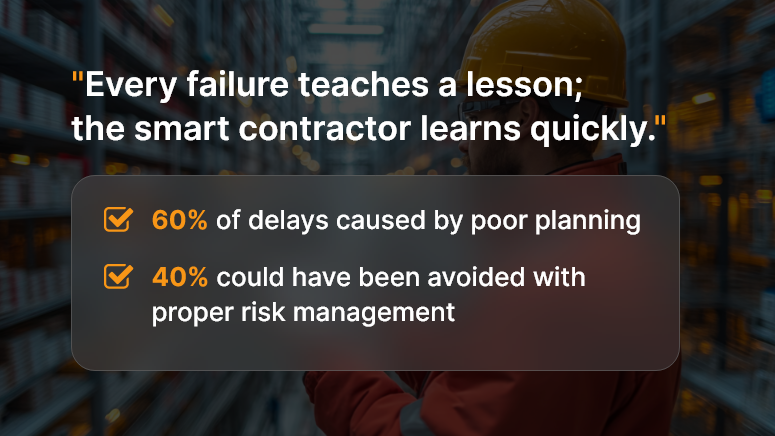
Lessons Learned from Failed Construction Projects and How to Avoid Them

Construction projects are ambitious, high-stakes undertakings that require precise coordination across people, processes, and resources. Yet, even the best-laid plans can falter — resulting in cost overruns, delays, disputes, or outright project failure. While failures are painful, they also provide invaluable lessons that can shape how future projects are planned and executed.

In this blog, we’ll explore the key lessons learned from failed construction projects and provide actionable strategies to avoid repeating these mistakes.

Every failure teaches a lesson

1. Poor Project Planning and Scope Definition

Lesson Learned:

One of the most common reasons for project failure is unclear scope or inadequate planning at the outset. When requirements are vague or stakeholders are not aligned, the project suffers from scope creep, rework, and escalating costs.

How to Avoid It:

  • Develop a clear project charter outlining objectives, deliverables, and success criteria.
  • Use a Work Breakdown Structure (WBS) to break down activities into manageable tasks.
  • Involve all key stakeholders during scope definition to ensure alignment.
  • Validate assumptions early with feasibility studies and risk assessments.

2. Ineffective Communication

Lesson Learned:

Breakdowns in communication — whether between owners, contractors, architects, or subcontractors — often lead to misunderstandings, errors, and delays. Many failed projects reveal that critical information was not shared on time, or decisions were not clearly documented.

How to Avoid It:

  • Implement a centralized communication platform or Common Data Environment (CDE).
  • Standardize documentation formats for RFIs, submittals, and approvals.
  • Establish a communication matrix that defines who gets what information and when.
  • Conduct regular progress meetings and distribute meeting minutes promptly.

3. Unrealistic Scheduling and Deadlines

Lesson Learned:

Projects often fail when schedules are too ambitious or do not account for contingencies. Unrealistic deadlines create a domino effect — overworked crews, compromised quality, and increased safety risks.

How to Avoid It:

  • Use tools like Critical Path Method (CPM) to create realistic schedules.
  • Factor in potential risks like weather delays, supply chain disruptions, or labor shortages.
  • Build time buffers for complex or high-risk activities.
  • Continuously monitor progress against milestones and update the schedule dynamically.

4. Insufficient Risk Management

Lesson Learned:

Unexpected challenges — ranging from design errors and regulatory changes to financial crises—can derail projects that lack a robust risk management plan. Many failed projects ignored warning signs until it was too late.

How to Avoid It:

  • Identify risks early during the planning phase and categorize them (financial, technical, environmental, contractual).
  • Develop risk response strategies: avoid, mitigate, transfer, or accept.
  • Assign a risk owner for each critical risk.
  • Maintain a live risk register and review it regularly during project meetings.

5. Financial Mismanagement

Lesson Learned:

Budget overruns are one of the biggest red flags in failed projects. Common causes include poor cost estimation, lack of transparency, and uncontrolled scope changes.

How to Avoid It:

  • Use detailed cost estimation techniques (bottom-up or activity-based costing).
  • Implement real-time cost tracking systems integrated with the project schedule.
  • Allocate a contingency budget of 5–10% to absorb unexpected expenses.
  • Regularly review financial reports and adjust forecasts as needed.

6. Lack of Quality Control

Lesson Learned:

In failed projects, quality issues often surface due to rushed timelines, inadequate inspections, or poor workmanship. These errors not only increase costs but also compromise safety and reputation.

How to Avoid It:

  • Establish a Quality Management Plan (QMP) before execution begins.
  • Conduct frequent inspections, audits, and testing at each project phase.
  • Train workers on quality standards and procedures.
  • Use digital tools for punch lists and defect tracking to close gaps faster.

7. Ignoring Human Resources and Workforce Management

Lesson Learned:

Labor shortages, unskilled workers, or poor workforce coordination can severely impact productivity. Several failed projects cite workforce mismanagement as a key factor in missed deadlines.

How to Avoid It:

  • Forecast labor requirements accurately using resource management tools.
  • Provide continuous training and certification for site workers.
  • Balance workloads to prevent fatigue and maintain morale.
  • Foster collaboration by clearly defining roles, responsibilities, and accountability.

8. Resistance to Technology Adoption

Lesson Learned:

Many construction projects still rely heavily on paper-based processes and outdated systems. This results in errors, delays, and a lack of real-time visibility. Projects that resist digital transformation risk falling behind.

How to Avoid It:

  • Adopt construction project management software for scheduling, budgeting, and communication.
  • Use Building Information Modeling (BIM) for clash detection and design coordination.
  • Implement mobile apps for on-site reporting, safety checklists, and daily logs.
  • Leverage drones, IoT sensors, and AI for progress monitoring and predictive insights.

9. Weak Stakeholder Engagement

Lesson Learned:

Ignoring the concerns of clients, communities, or regulators often results in disputes, protests, or costly project shutdowns. Failed projects highlight that stakeholder management is just as important as technical execution.

How to Avoid It:

  • Map all stakeholders and assess their level of influence and interest.
  • Engage stakeholders early and keep them updated with transparent communication.
  • Establish grievance redressal mechanisms for local communities.
  • Align project objectives with client and end-user expectations.

10. Failure to Capture and Apply Lessons Learned

Lesson Learned:

Ironically, one of the biggest lessons from failed projects is that teams often don’t document lessons learned. This leads to the same mistakes being repeated across multiple projects.

How to Avoid It:

  • Conduct post-project reviews and document lessons learned.
  • Share findings across teams and departments.
  • Maintain a knowledge repository accessible to all stakeholders.
  • Integrate lessons learned into future planning, training, and process improvements.

Conclusion

Construction projects fail not just because of external challenges but often due to avoidable internal missteps — poor planning, weak communication, and inadequate risk management. The good news? Every failure is an opportunity to improve. By learning from past mistakes and adopting proactive strategies, construction firms can reduce risks, protect margins, and deliver projects on time and within budget.

FAQs

1. Why do construction projects fail most often?

Construction projects typically fail due to poor planning, weak communication, unrealistic schedules, financial mismanagement, or a lack of proper risk controls.

2. How can scope creep be avoided in construction projects?

Scope creep can be minimized by clearly defining project scope at the outset, documenting all requirements, and implementing a strict change management process for any modifications.

3. What role does communication play in construction project success?

Effective communication ensures that all stakeholders stay aligned, decisions are documented, and critical information flows without delay. Poor communication often results in rework, disputes, and costly mistakes.

4. How do unrealistic schedules contribute to project failure?

Unrealistic deadlines pressure teams to cut corners, compromise safety, and overlook quality. They also increase stress on workers, leading to mistakes and burnout.

5. What are the best practices for construction risk management?

Identify potential risks early, categorize them (financial, technical, environmental), maintain a risk register, and assign clear responsibilities for monitoring and mitigation.

6. How can contractors avoid budget overruns?

Accurate cost estimation, real-time expense tracking, contingency reserves, and regular financial reviews are essential to prevent budget overruns.

7. Why is quality control so critical in construction projects?

Quality lapses not only lead to costly rework but also compromise safety, compliance, and reputation. Regular inspections and a strong Quality Management Plan (QMP) ensure long-term durability.

8. How can technology prevent construction project failures?

Digital project management tools, BIM (Building Information Modeling), mobile apps, and drones provide real-time insights, reduce errors, and improve collaboration between teams.

9. What’s the importance of stakeholder management in construction?

Active stakeholder engagement ensures transparency, reduces disputes, and aligns project goals with client and community expectations — ultimately preventing resistance and delays.

10. How can companies ensure they learn from past project failures?

By conducting post-project reviews, documenting lessons learned, sharing them across teams, and embedding improvements into future processes, companies build a culture of continuous learning.

The Ultimate Checklist Before Starting Any Construction Project

Starting a construction project is thrilling — but without a clear construction project checklist, it can quickly turn chaotic. Before the foundation is poured, every plan, permit, and precaution must be in place. A well-designed checklist ensures that your project stays on budget, meets deadlines, and complies with all relevant regulations.

Let’s explore the ultimate pre-construction checklist you should complete before starting any construction project.

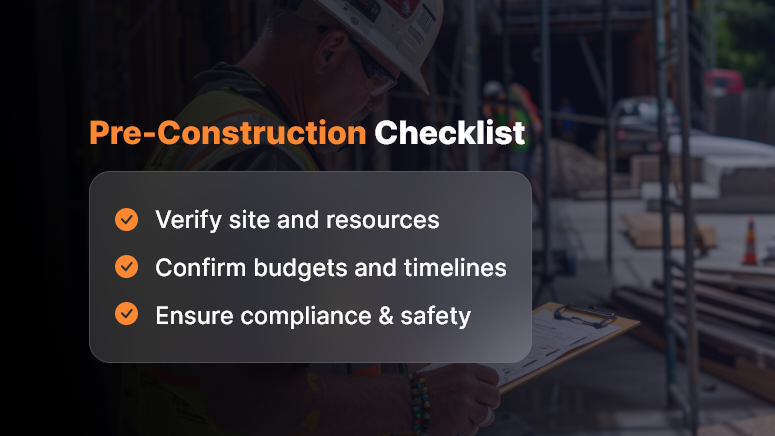
Pre-Construction Checklist

1. Pre-Planning and Feasibility

Good preparation builds great projects.

  • Define project objectives: Clarify if the goal is residential, commercial, or industrial.
  • Conduct feasibility studies: to assess the technical, environmental, and financial aspects.
  • Set budget and funding: Confirm total costs, cash flow, and backup financing.
  • Identify stakeholders: Include investors, contractors, engineers, and government bodies.
  • Survey the site: Perform soil tests, topographic mapping, and geotechnical investigations.

Strong feasibility planning ensures the entire construction project checklist starts on solid ground.

2. Legal and Regulatory Compliance

Ignoring compliance can halt progress instantly.

  • Verify land ownership: Ensure titles and deeds are authentic and dispute-free.
  • Obtain building permits: Get all local, zoning, and environmental clearances.
  • Follow municipal codes: Meet fire safety, labor, and pollution standards.
  • Secure insurance: Include liability, builder’s risk, and workers compensation.

This section of your pre-construction checklist guarantees legality and accountability.

3. Design and Engineering

Design is the bridge between planning and execution.

  • Finalize architectural design: Align with the client’s vision and local regulations.
  • Validate structural safety: Review wind load, seismic resistance, and material standards.
  • Coordinate MEP systems: Integrate mechanical, electrical, and plumbing seamlessly.
  • Embrace sustainability: Add green materials and energy-efficient layouts.
  • Conduct value engineering: Balance quality with cost-effectiveness.

With this, your construction planning checklist becomes both smart and sustainable.

4. Contracts and Procurement

Before construction starts, lock in the essentials.

  • Choose qualified contractors: Review licenses, portfolios, and references.
  • Define the scope of work: Avoid vague deliverables and cost disputes.
  • Run fair bidding processes: Maintain transparency in selection.
  • Plan procurement: Identify long-lead items and verify supplier reliability.
  • Fix payment schedules: Link payments to milestones and inspections.

Transparent contracts keep your construction checklist legally and financially secure.

5. Project Management and Scheduling

Timing is everything in construction.

  • Create a Work Breakdown Structure (WBS): Divide work into manageable sections.
  • Build a Gantt chart: Track progress visually across timelines.
  • Apply the Critical Path Method (CPM): Focus on activities affecting delivery time.
  • Allocate resources smartly: Assign the workforce and machinery efficiently.
  • Plan risk management: Prepare for weather delays or material shortages.

A well-planned schedule transforms your construction project checklist into a live project control tool.

6. Health, Safety, and Environment (HSE)

Safety ensures productivity.

  • Develop a site safety plan: Include PPE usage, emergency drills, and audits.
  • Identify hazards: Assess risks from excavation, heights, or chemicals.
  • Manage waste effectively: Segregate and recycle construction debris.
  • Protect the environment: Control noise, dust, and runoff.
  • Train all workers: Provide first-aid, fire safety, and machinery handling sessions.

A complete construction safety checklist reduces incidents and improves team morale.

7. Technology and Documentation

Digitization drives modern construction success.

  • Use digital project tools: Manage approvals, drawings, and reports online.
  • Implement paperless workflows: Store all files securely in the cloud.
  • Adopt BIM (Building Information Modeling): Detect design clashes early.
  • Set communication protocols: Ensure transparent reporting and follow-ups.
  • Centralize document control: Store contracts, permits, and inspection records efficiently.

This step ensures your construction documentation checklist stays organized and audit-ready.

8. Financial Controls

Financial discipline keeps projects healthy.

  • Prepare detailed cost plans: Include labor, materials, and overheads.
  • Forecast cash flow: Align payment cycles with project stages.
  • Ensure tax compliance: Review GST, VAT, and statutory rules.
  • Maintain contingency reserves: Allocate at least 5–10% for emergencies.
  • Conduct monthly audits: Track financial performance consistently.

Strong financial management fortifies your construction project checklist from the ground up.

9. Stakeholder Communication

Collaboration drives clarity.

  • Host a kickoff meeting: Align everyone on scope, schedule, and deliverables.
  • Define accountability: Assign clear roles to each stakeholder.
  • Maintain reporting cadence: Provide weekly and monthly progress updates.
  • Set dispute resolution systems: Define mediation or arbitration processes.
  • Encourage transparency: Keep communication open and factual.

Effective communication ensures your construction project planning checklist remains collaborative and efficient.

10. Final Pre-Construction Checklist

Before breaking ground, review everything once more:

  • All approvals and permits are in place
  • Budget and contingencies are verified
  • Contracts are signed and sealed
  • Site is cleared and secure
  • HSE plans are ready and trained
  • Stakeholders approved all designs

You’re now ready to begin your project with confidence and compliance.

Conclusion

Every great structure starts with an even greater plan. A thorough construction project checklist ensures your project remains compliant, efficient, and safe.

By following this guide, you’ll minimize risk, maximize productivity, and deliver successful outcomes — from the first blueprint to final handover.

Frequently Asked Questions (FAQs)

1. What is a Construction Project Checklist?

A construction project checklist is a structured document that outlines all essential steps, approvals, and verifications needed before starting construction. It ensures compliance, safety, and readiness.

2. Why is a Pre-Construction Checklist Important?

It prevents costly mistakes by ensuring you’ve addressed every aspect — from land approvals to contractor selection and safety compliance — before the project begins.

3. What Should Be Included in a Construction Checklist?

Key items include site verification, budgeting, permits, design approvals, contracts, safety measures, and financial controls.

4. How Do You Prepare a Construction Project Checklist?

Start by listing all stages — planning, legal, design, safety, and procurement — and assign responsible teams for each. Review it regularly before execution.

5. How Does a Checklist Help in Project Management?

It streamlines communication, tracks progress, and ensures accountability across teams, reducing delays and rework.

6. Who Uses a Construction Project Checklist?

Project managers, contractors, engineers, architects, and site supervisors rely on it to align work and maintain compliance.

7. How Can Technology Simplify Construction Planning?

Digital project management tools centralize tasks, automate documentation, and track progress in real time, ensuring transparency and accuracy.

8. How Do I Ensure Legal Compliance Before Construction?

Verify land titles, acquire all permits, and comply with fire, environmental, and labor laws as part of your pre-construction checklist.

9. What Are Common Risks in Pre-Construction Planning?

Inadequate feasibility studies, missing permits, and poor budgeting are major risks that can delay projects or increase costs.

10. Can Small Construction Firms Use This Checklist?

Absolutely. Whether small or large, every firm benefits from a detailed construction project checklist that ensures control, compliance, and confidence.

How Sustainability Is Reshaping Construction Projects

Sustainability isn’t just a buzzword — it’s a business imperative reshaping the construction industry. Did you know that the construction sector accounts for nearly 40% of global carbon emissions? Companies that fail to integrate eco-friendly practices face rising costs, regulatory scrutiny, and reputational risks.

For construction managers, project owners, and architects, understanding sustainable construction is no longer optional — it’s a competitive advantage. In this blog, we’ll explore how sustainable construction practices are transforming projects from design to delivery, uncover actionable strategies, and show how digital tools like OConstruction can simplify green initiatives. By the end, you’ll have clear, practical insights to reduce environmental impact while boosting efficiency and profitability.

Sustainable Construction

Business Relevance & Why It Matters

Sustainable construction goes beyond environmental responsibility — it drives measurable business value. For companies in the construction and real estate sectors, adopting eco-friendly practices can reduce operational costs, improve compliance, and enhance brand reputation.

Who benefits most?

  • Project managers: Streamline sustainable workflows with real-time visibility into materials and energy use.
  • Construction firms: Reduce waste and optimize supply chain efficiency.
  • Clients and investors: Gain confidence in projects that meet environmental, social, and governance (ESG) standards.

Real-world examples of challenges and solutions:

  • Excessive material waste: Traditional construction projects often discard 20–30% of materials. Sustainable alternatives reduce waste and save costs.
  • High energy consumption: Eco-friendly designs, including passive heating/cooling and energy-efficient materials, lower operating costs for buildings.
  • Regulatory hurdles: Digital tools can track compliance with green certifications such as LEED or BREEAM, preventing costly fines.

With a digital construction platform, these challenges transform into opportunities. By integrating project planning, resource management, and sustainability tracking in one dashboard, companies can make data-driven decisions that balance environmental goals with profitability.

Best Practices, Frameworks, and Actionable Strategies

1. Material Selection & Sourcing

  • Do: Opt for renewable, recyclable, and locally sourced materials to reduce carbon footprint and shipping emissions.
  • Don’t: Rely solely on traditional concrete or steel without evaluating alternatives such as bamboo, recycled steel, or low-carbon cement.
  • Quick Win: Use OConstruction’s material tracking module to monitor usage, procurement, and eco-certifications in real time.

2. Energy-Efficient Design

  • Do: Implement passive design principles, solar panels, and energy-efficient lighting.
  • Don’t: Ignore building orientation, insulation, and ventilation, which significantly impact energy performance.

Step-by-Step Framework:

  • Analyze site and climate data.
  • Select energy-efficient systems and materials.
  • Track projected vs. actual energy consumption using your digital platform.

3. Waste Management & Recycling

  • Do: Create a waste management plan and assign recycling responsibilities.
  • Don’t: Dispose of construction debris without considering reuse or repurposing.
  • Tip: OConstruction can generate reports showing waste reduction metrics and material savings for sustainability reporting.

4. Water & Resource Conservation

  • Do: Implement rainwater harvesting, greywater recycling, and low-flow fixtures.
  • Don’t: Neglect water audits, which can reveal significant savings opportunities.

5. Monitoring & Reporting Sustainability Goals

  • Track carbon emissions, material usage, and compliance metrics digitally.
  • Set KPI targets for each project and monitor progress in real time.
  • Use dashboards to communicate results to stakeholders, ensuring accountability.

6. Staff Training & Culture

  • Do: Educate your workforce on sustainable construction practices.
  • Don’t: Treat sustainability as a one-off checklist.

Customer Story

For example, GreenBuild Co., a mid-sized construction firm, used OConstruction’s sustainability tracking feature to reduce material waste by 25% and energy usage by 18% across multiple projects. By integrating project management with real-time dashboards:

  • Project managers gained visibility into material sourcing and on-site consumption.
  • Teams optimized workflows to minimize environmental impact without delaying deadlines.
  • Clients appreciated transparent sustainability reports, boosting trust and securing repeat contracts.

The outcome? Cost savings, regulatory compliance, and stronger brand positioning — all while actively contributing to greener construction practices.

Key Takeaways & Closing Summary

  • Sustainable construction isn’t just eco-friendly; it’s strategically profitable. Businesses that implement these practices reduce costs, comply with regulations, and strengthen their brand.
  • Digital platforms like OConstruction simplify sustainability by offering real-time tracking, reporting, and actionable insights.
  • Quick wins: Optimize materials, implement energy-efficient designs, manage waste effectively, and engage staff in a sustainability culture.
  • Remember: Sustainability is a journey, not a single point to check. Starting small with measurable steps can lead to long-term environmental and business impact.

By integrating sustainability into construction projects, companies can achieve cost savings, efficiency, and competitive advantage — while building a better future for communities and the environment.

FAQs

1. What is sustainable construction?

Sustainable construction involves designing, building, and operating structures in ways that minimize environmental impact, reduce waste, conserve resources, and improve energy efficiency. It balances economic, social, and ecological considerations for long-term value.

2. Why is sustainable construction important in today’s projects?

It helps companies reduce carbon footprints, lower operating costs, comply with regulations, and enhance brand reputation. With growing environmental concerns and stricter standards, sustainable construction has become a competitive necessity.

3. How can digital tools support sustainable construction?

Platforms like OConstruction track material usage, energy consumption, waste management, and compliance metrics in real time. This helps teams make data-driven decisions, optimize workflows, and ensure transparency in sustainability efforts.

4. What are the key benefits of adopting sustainable construction practices?

  • Reduced construction and operational costs
  • Enhanced compliance with green building standards (LEED, BREEAM)
  • Lower carbon emissions and resource usage
  • Stronger client trust and brand reputation

5. What are some common sustainable construction strategies?

  • Using eco-friendly and recycled materials
  • Energy-efficient design, lighting, and HVAC systems
  • Waste reduction and recycling on-site
  • Water conservation through rainwater harvesting and greywater reuse

6. Can small construction firms implement sustainable practices?

Yes. Sustainable construction is scalable. Digital platforms help even small firms monitor, track, and report sustainability metrics efficiently, without major upfront investment.

7. How does sustainable construction impact project timelines?

When planned properly, sustainability can improve efficiency by reducing waste and rework. Tools like OConstruction ensure better scheduling and resource management, keeping projects on track.

8. How do clients benefit from sustainable construction projects?

Clients get energy-efficient, environmentally responsible buildings with lower long-term costs. Transparent sustainability reporting also builds trust and supports ESG commitments.

The Importance of Construction Project Closeout Checklists

Completing a construction project isn’t just about finishing the build — it’s about closing it out properly. Did you know that nearly 30% of construction projects face disputes or delays due to poor closeout processes?

Whether it’s missing documentation, incomplete inspections, or overlooked punch-list items, neglecting the project closeout phase can lead to costly delays and frustrated clients.

That’s where project closeout checklists come in. They act as your final roadmap, ensuring every critical task is completed before handing over the project.

In this blog, we’ll explore why project closeout checklists matter, the key steps involved, and how integrating OConstruction’s platform can simplify and streamline your closeout process.

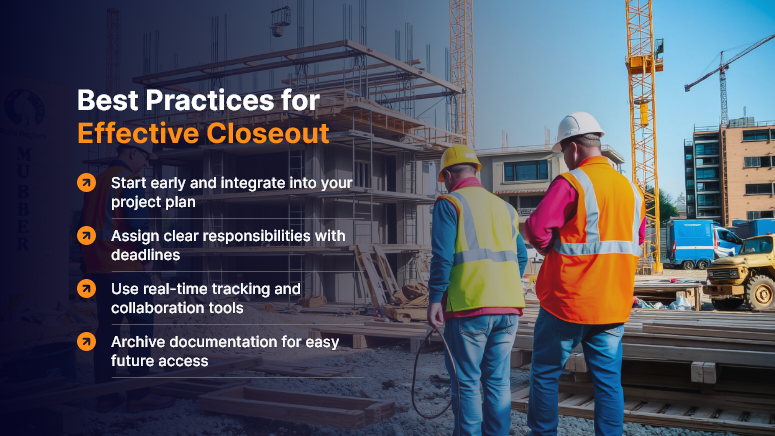
Best Practices for Effective Closeout

Business Relevance & Why Project Closeout Checklists Matter

The construction closeout phase often determines client satisfaction and project profitability. A detailed project closeout checklist guarantees all requirements are met — from final inspections and documentation to warranties and client training.

Why should construction companies care?

  • Reduce Disputes: Clear documentation limits legal risks and misunderstandings.
  • Improve Cash Flow: Efficient closeout accelerates final payments.
  • Boost Client Trust: Delivering a fully complete and organized project builds your reputation.

Who benefits the most?

  • Project Managers ensure nothing slips through the cracks.
  • Contractors get paid faster and reduce rework.
  • Clients and Developers receive smooth handovers with clear expectations.

Common challenges without checklists:

  • Missed inspections cause costly rework.
  • Lost warranties or manuals delay maintenance.
  • Incomplete punch lists reduce client confidence.

By contrast, a well-designed checklist powered by OConstruction’s integrated tools keeps all teams aligned and accountable.

Best Practices for Project Closeout Checklists

Do’s and Don’ts

  • Do start your checklist early — incorporate closeout tasks during planning and execution.
  • Don’t treat the checklist as a formality; use it actively to track progress and assign responsibility.
  • Do include all stakeholders — subcontractors, suppliers, and clients — in the closeout process.
  • Don’t overlook documentation — warranties, permits, and manuals are essential.

Key Closeout Checklist Items

  • Final Inspections: Confirm all inspections meet code and contract requirements.
  • Punch List Completion: Track and resolve every outstanding issue before handover.
  • Documentation Gathering: Collect all warranties, manuals, as-builts, and permits.
  • Financial Closure: Verify invoices, retainage release, and final payments.
  • Client Training & Handover: Provide operational training and clear communication.

Step-by-Step Framework

  • Create a Customizable Checklist: Tailor it for each project’s scope and requirements using OConstruction’s digital templates.
  • Assign Tasks and Deadlines: Delegate checklist items to responsible teams with automated reminders.
  • Track Progress in Real-Time: Utilize OConstruction dashboards to monitor completion status and instantly flag delays.
  • Collaborate Seamlessly: Enable real-time updates and communication among all stakeholders directly within the platform.
  • Archive for Future Reference: Maintain a digital closeout archive for warranties and lessons learned, accessible anytime.

By embedding your project closeout checklists into OConstruction, you reduce errors, save time, and improve overall project quality.

Customer Success Story

For example, Skyline Builders, a residential construction firm, struggled with delayed handovers and frequent punch list rework. After adopting OConstruction’s checklist and collaboration features, they:

  • Reduced punch list items by 40% through early tracking.
  • Shortened closeout timelines by 25%.
  • Increased client satisfaction scores by delivering well-documented handovers.

This streamlined closeout process not only saved money but also helped Skyline win more repeat business.

Key Takeaways & Closing Summary

In construction, the final step is just as critical as the first. Using project closeout checklists ensures no detail is missed, enabling smooth transitions from build to operation.

  • Start early and customize your checklist for each project.
  • Keep all stakeholders involved and accountable.
  • Leverage digital tools like OConstruction for real-time tracking and collaboration.

A strong closeout process means faster payments, fewer disputes, and happier clients — making it an essential part of construction project success.

Frequently Asked Questions

1. What should a construction project closeout checklist include?

A good checklist covers final inspections, punch list completion, warranty and documentation collection, financial closure, and client training. It ensures all deliverables are verified before handover.

2. When should I start preparing for project closeout?

Closeout planning should start early — ideally during project planning. This way, you can assign responsibilities, avoid last-minute rush, and integrate closeout tasks seamlessly into the workflow.

3. How does a checklist improve client satisfaction?

A checklist ensures nothing is overlooked, from safety inspections to documentation. This builds trust with clients, speeds up handover, and reduces the chance of disputes or rework.

4. What are the risks of not using a project closeout checklist?

Without one, teams often face delays, missed inspections, incomplete documentation, lost warranties, and disputes over unfinished work. This can hurt cash flow and damage client relationships.

5. How can digital tools like OConstruction improve closeout checklists?

Platforms like OConstruction allow you to create customizable checklists, assign responsibilities, track tasks in real time, collaborate across teams, and archive documents — making the entire closeout process faster, error-free, and transparent.

5 Common Construction Scheduling Mistakes and How to Avoid Them

Ever been on a job site where the crew shows up ready to work, but the materials aren’t there yet? Everyone just stands around, burning time — and money.

Or maybe you’ve had that sinking feeling when a client calls asking, “Why is the project behind schedule?” and you don’t have a solid answer.

If you’ve been in construction long enough, you’ve probably lived through both. The truth is, even the best teams fall victim to scheduling mistakes. And when they do, the ripple effect is brutal — missed milestones, higher costs, frustrated crews, and unhappy clients.

According to McKinsey, big construction projects take 20% longer than planned. And yes, scheduling problems are a huge reason why.

But here’s the thing: it doesn’t have to be this way. Most scheduling mistakes are avoidable. And with the right tools (hello, OConstruction), you can keep your projects moving like clockwork.

Let’s walk through the five most common scheduling mistakes — the ones I’ve seen over and over — and more importantly, how to avoid them.

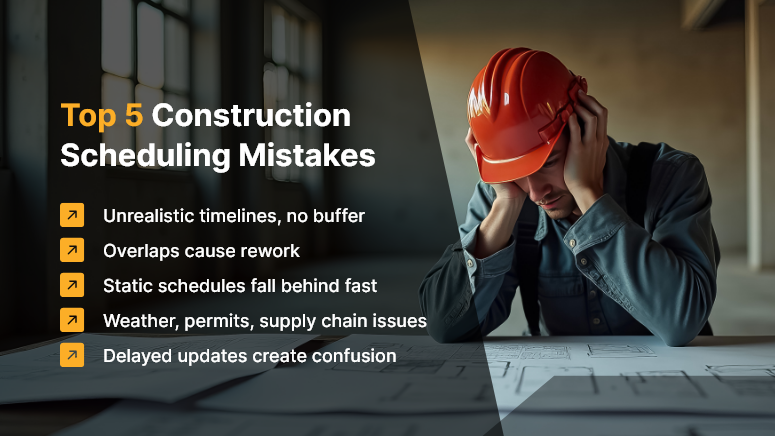
Top 5 Construction Scheduling Mistakes

Why Scheduling Mistakes Hurt More Than You Think

Your schedule isn’t just a timeline. It’s the backbone of your entire project.

Think about it: every crew, every supplier, every permit — they all depend on it. When the schedule slips, everything else starts to wobble.

  • Crews show up before materials.
  • Deadlines overlap, causing rework.
  • Clients get vague updates and lose trust.

And suddenly, you’re not just managing a project. You’re putting out fires.

Now flip the script. When your scheduling is solid, you’re in control:

  • Costs stay under control.
  • Resources are used efficiently.
  • Clients actually trust your process.

That’s the power of getting it right.

Mistake #1: Underestimating Task Durations

We’ve all been there. A task looks simple on paper, so you assign a quick turnaround. Then reality kicks in — site conditions, unexpected complexity, permit delays — and suddenly that “three-day task” stretches into two weeks.

The fix: Stop guessing. Use real data. OConstruction lets you pull from historical projects so your estimates aren’t just optimistic guesses. And don’t forget to add a little buffer for the unexpected. Because in construction, the unexpected is the rule, not the exception.

Mistake #2: Ignoring Task Dependencies

Picture this: the drywall crew is ready, but the electrical work isn’t finished. Now you’ve got wasted labor and a frustrated crew.

The fix: Map it out visually. With OConstruction’s Gantt charts, you can see dependencies at a glance. The system even flags conflicts before they blow up your timeline.

Mistake #3: Treating the Schedule as Static

Too many teams build a beautiful schedule at the start — then never touch it again. Weeks later, reality and the schedule don’t match, and no one knows what’s really happening.

The fix: Treat your schedule like a living, breathing thing. Update it often. With OConstruction, progress updates are live. Missed milestones, shifting timelines, new changes — everyone sees it in real time.

Mistake #4: Forgetting About Risks

Weather delays. Supply shortages. Permits are stuck in approval. These things aren’t “what ifs.” They’re when, not if.

The fix: Plan for them. Build contingency time into your schedule. With OConstruction, you can tag and track risks so you’re not blindsided when they hit. Instead of scrambling, you’re ready.

Mistake #5: Poor Communication

This one stings the most. Imagine your client only finds out about a delay after they show up on site. Or crews get conflicting instructions about when to start. Miscommunication doesn’t just cause delays — it damages trust.

The fix: Overcommunicate. Automate updates. OConstruction makes it simple with built-in notifications and status reports. Everyone — clients, crews, suppliers — stays in the loop.

A Real-World Example

Take SummitWorks Construction. They were constantly rescheduling because suppliers delivered late. Crews would arrive ready to work, but the materials weren’t there. Morale dropped. Clients were frustrated. Costs went up.

Then they switched to OConstruction.

  • Supplier delivery schedules got synced directly into their project plans.
  • Automated alerts went out the moment something changed.
  • Crews stayed informed and ready.

The result? 28% fewer overruns in just six months. Costs dropped, clients were happier, and repeat business shot up.
That’s the difference between firefighting and smooth sailing.

Key Takeaways

Avoiding scheduling mistakes isn’t about working harder — it’s about being smarter. Here’s what successful construction teams do differently:

1. Be Realistic – Use Data, Not Guesswork

Overly ambitious timelines might look good in the bid, but they rarely survive on the ground. Smart project managers use historical data and lessons learned from past jobs to set achievable timelines. OConstruction makes this easier by storing project records you can reference when planning. That way, your schedules aren’t based on optimism — they’re based on reality.

2. Stay Proactive – Keep the Schedule Alive

A construction schedule isn’t a one-and-done document. It’s a living plan that shifts as the project progresses. Too many teams forget to update it, which confuses, missed milestones, and chaos on site. With OConstruction’s real-time updates, your schedule adjusts dynamically so everyone knows exactly where the project stands — today, not last month.

3. Plan for Risks Before They Happen

Rain, late permits, supply chain hiccups — they’re not “if,” they’re “when.” Ignoring them is like walking onto a site without safety gear. By building in risk buffers and contingency plans, you create breathing room for your project. OConstruction lets you tag potential risks, track their impact, and respond quickly when something goes wrong. It’s about expecting the unexpected.

4. Keep Everyone Connected – No Surprises

Nothing frustrates clients and crews more than being left in the dark. A missed update can erode trust faster than a missed milestone. By automating updates and sharing schedule changes instantly, you make sure stakeholders always know what’s happening. With OConstruction, clients feel informed, crews know when to show up, and suppliers stay aligned — no more last-minute surprises.

The Bottom Line

When you get scheduling right, projects run smoother, crews stay productive, costs stay under control, and clients actually enjoy working with you. It’s not just about finishing on time — it’s about building a reputation for reliability. And that’s exactly what OConstruction helps you achieve.

Category: Construction Academy

Subcategory: Budgeting and Planning

Subcategory: Construction Phase

Subcategory: Design Coordination

Subcategory: Estimation Techniques

Subcategory: Initiation and Feasibility

Subcategory: Introduction

Subcategory: Personal Management

Subcategory: Project Close-Out

Subcategory: Project Scheduling

Subcategory: Project Teams

Subcategory: Proposal Management

Subcategory: Total Quality Management

Subcategory: Tracking and Control

Subcategory: Work Breakdown

Category: Help Desk

Subcategory: Client

Subcategory: Construction 101

Subcategory: Contractor Management

Subcategory: Expense

Subcategory: Finance Budget

Subcategory: Inventory Management

Subcategory: My Approvals

Subcategory: Site Management

Subcategory: Vendor Management