Automation & Predictive Analytics in Construction Scheduling

Every year, global construction projects lose over $1.6 trillion due to delays, cost overruns, and inefficient workflows. In fast-paced job sites, relying on whiteboards, WhatsApp groups, and siloed Excel sheets no longer cuts it.

The Future of Construction Scheduling: Automation & Predictive Analytics tackles these persistent challenges head-on, delivering real-time insights and proactive alerts that save time and money.

In this blog, you’ll learn how modern project managers, site engineers, and contractors can harness automation, predictive analytics, and OConstruction’s end-to-end platform to streamline planning, DPR automation, BOQ management, cost control, and site execution.
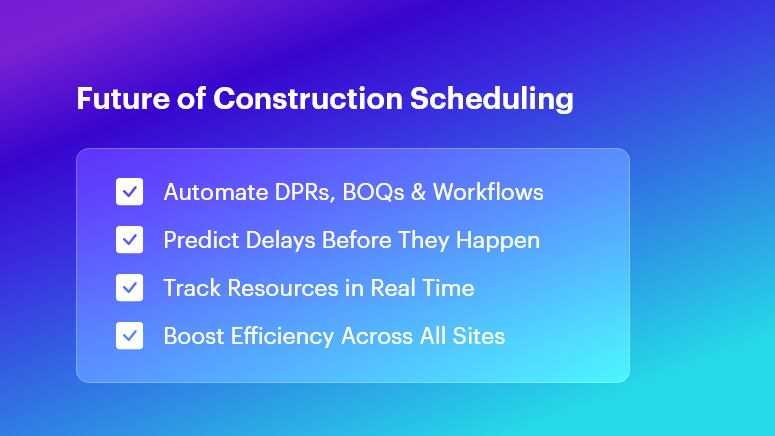
Future of Construction Scheduling

Why This Matters in Construction

Construction teams face mounting pressure to deliver projects on time and within budget. However, traditional, manual workflows create several avoidable challenges:

  • Cost Overruns & Material Wastage

Inaccurate BOQs and delayed DPRs cause procurement errors. As a result, materials are over-ordered or underutilized — increasing costs by up to 15%.

  • Rework & Quality Issues

Miscommunication between the field and office leads to corrective work. Rework alone can add 10–20% to project timelines and inflate labor budgets.

  • Scattered Data & Delayed Decisions

Disjointed tools — logs, spreadsheets, and messaging apps — create blind spots. This leads teams to react rather than proactively prevent issues.

From real estate and commercial buildings to highways and EPC projects, these inefficiencies are universal.

A highway project, for instance, may see months of delays simply because field teams wait days for schedule updates — crippling resource coordination and cost tracking.

Modern digital workflows are no longer optional. With automation and predictive analytics, teams gain speed, accuracy, accountability — and real-time clarity.

OConstruction unifies scattered tools into one platform, replacing WhatsApp threads and manual logs with real-time field-to-office synchronization.

Best Practices, Frameworks & Actionable Steps

Implementing construction scheduling through automation and predictive analytics requires a structured approach. Below are proven workflows using OConstruction:

1. Detailed Project Planning & Scheduling

  • Build Gantt charts with resource dependencies and automated alerts.
  • OConstruction’s Project Planning & Schedule Tracking ensures accurate timelines.
  • Stakeholders receive notifications instantly when milestones slip.

2. Robust BOQ & Estimate Management

  • Standardize templates and apply version control.
  • Using BOQ & Estimate Management, quantity take-offs remain accurate, and budgets stay aligned with project realities.

3. DPR Automation & Daily Logs

  • Capture photos, safety reports, and progress data using your mobile device.
  • With DPR Automation, reporting time reduces by up to 70%.

4. Material & Inventory Tracking

5. Labor & Resource Management

  • Monitor attendance and productivity using geofencing.
  • With Resource, Labor & Material Tracking, labor utilization stays optimized.

6. Cost Control & Budget Monitoring

7. Task & Workflow Management

  • Centralize approvals, dependencies, and priority-based task planning.
  • Nothing slips through the cracks with Task & Workflow Management.

8. Multi-Site Coordination

  • Standardize templates and governance across all locations.
  • OConstruction’s multi-project dashboard provides visibility for leaders.

9. Data-Driven Predictive Analytics

  • Forecast risks like delays, resource conflicts, and overruns.
  • OConstruction analyzes historical performance to identify early warning signals.

Common Mistakes to Avoid

  • Relying on manual data entry → Use mobile data capture
  • Skipping stakeholder training → Run quick, scenario-based onboarding

Construction Success Story

SkyHigh Infra adopted OConstruction’s DPR Automation & Daily Logs to eliminate reporting delays and data duplication.

Within just 8 weeks, they achieved:

  • 40% faster DPR completion
  • 25% reduction in rework
  • 15% less material waste

Progress photos and checklists captured in the mobile app synced instantly to the central dashboard. Automated alerts flagged deviations early, preventing small issues from turning into major setbacks.

Key Takeaways

  • Digitize & Automate: Replace manual logs and WhatsApp approvals with a unified platform.
  • Use Predictive Analytics: Forecast risks before they become delays or overruns.
  • Automate Core Workflows: DPRs, BOQs, and material tracking should be real-time and mobile-enabled.
  • Gain Real-Time Visibility: Connect field teams and office teams instantly.
  • Scale Confidently: Deploy consistent processes across multiple job sites.

FAQs

1. What is The Future of Construction Scheduling: Automation & Predictive Analytics?

It refers to the use of intelligent tools and data models to plan, track, and forecast project performance — reducing delays and cost overruns.

2. How does OConstruction enable automation in scheduling?

OConstruction automates resource leveling, task assignments, DPRs, and alerts — synced in real time.

3. Can predictive analytics reduce delays?

Yes — it identifies bottlenecks early and recommends corrective actions before they impact schedules.

4. Is DPR automation secure?

Absolutely — data is encrypted, role-based, and audit-logged.

5. How fast can teams adopt OConstruction?

Most teams fully transition within 2–4 weeks with quick onboarding.

6. What ROI can be expected?

Users report 15–25% material savings, 25% rework reduction, and 20–40% faster reporting cycles.

7. Can OConstruction integrate with external ERP or accounting systems?

Yes. APIs and middleware enable seamless integration.

Multi-Site Coordination: Optimize project execution across multiple sites

Managing a single construction or infrastructure project is challenging. Managing multiple active sites simultaneously — often in different locations, with varied teams and vendors — demands a far higher level of coordination and control.

This is where multi-site coordination comes in: an integrated approach that synchronizes communication, resources, schedules, and performance tracking across all sites to ensure consistency, accountability, and timely delivery.

In industries such as construction, energy, infrastructure, and manufacturing, effective multi-site coordination directly impacts project success, cost efficiency, and client satisfaction.

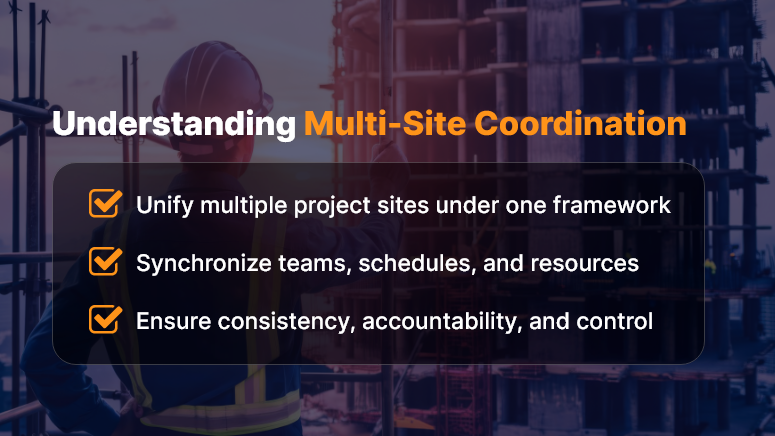
Understanding Multi-Site Coordination

What Is Multi-Site Coordination?

Multi-site coordination is the systematic management of projects executed at multiple geographic locations under a unified operational framework.

It ensures that every site — whether it’s a construction zone, solar installation, or infrastructure upgrade — works toward shared objectives, aligned schedules, and standardized quality metrics.

Key objectives include:

  • Real-time visibility into each site’s progress and performance.
  • Seamless collaboration between central offices and field teams.
  • Standardized workflows and documentation.
  • Efficient allocation of shared resources, materials, and equipment.

In essence, multi-site coordination consolidates dispersed operations into a single, synchronized ecosystem.

Challenges in Managing Multiple Project Sites

Without a structured coordination framework, teams face a host of challenges:

  • Communication silos: Field teams and head offices often operate with fragmented updates.
  • Inconsistent reporting: Different formats and standards confuse progress tracking.
  • Duplicate work or missed dependencies: When schedules and responsibilities aren’t synchronized.
  • Resource conflicts: Equipment or manpower overbooked across sites.
  • Delayed decision-making: Managers lack real-time data for quick intervention.

These pain points can cause schedule slippage, cost overruns, and reduced productivity — especially in large-scale infrastructure or construction programs.

Key Strategies to Optimize Multi-Site Coordination

1. Centralized Project Management Platform

Use a cloud-based project management system that consolidates updates, schedules, and documents from all sites in one place. For example, tools like OConstruction or Orangescrum allow you to:

  • Assign and monitor tasks across multiple sites.
  • Track progress visually through dashboards and Gantt charts.
  • Log issues, RFIs, and approvals in real time.

This centralization eliminates the guesswork and ensures every stakeholder sees the same data.

2. Standardize Communication Protocols

Define clear communication channels:

  • Daily site logs for on-ground updates.
  • Weekly review calls between site managers and HQ.
  • Centralized chat or ticketing system for queries and escalations.

Using structured communication templates ensures everyone follows a consistent reporting rhythm, reducing misunderstandings.

3. Real-Time Data and IoT Integration

Leverage IoT sensors, drones, and mobile apps to feed live data into your coordination system:

  • Monitor equipment usage and site safety remotely.
  • Capture progress images or videos for validation.
  • Track resource utilization through GPS-enabled machinery.

Real-time data not only improves transparency but also helps anticipate delays or equipment downtime early.

4. Optimize Resource Allocation

A unified resource pool across sites helps balance workload and reduce idle time. With centralized scheduling tools, you can:

  • Check resource availability instantly.
  • Reassign underutilized assets.
  • Track material dispatches and deliveries in real time.

This ensures materials, machinery, and manpower are always available where they’re needed most.

5. Implement Unified Quality and Safety Standards

Multi-site projects often fail due to inconsistent safety or quality compliance. Develop a shared inspection checklist, accessible digitally, to ensure:

  • Uniform quality benchmarks across sites.
  • Compliance with safety standards and local regulations.
  • Real-time corrective action tracking for identified issues.

Digitized QA/QC workflows help teams avoid rework and ensure predictable outcomes.

6. Use Dashboards and Analytics

Data visualization plays a key role in multi-site management. Dashboards can help decision-makers:

  • Compare performance metrics across all sites.
  • Identify high-risk areas through variance reports.
  • Forecast delays or budget overruns early.

Analytics transforms scattered data into actionable insights — improving planning, forecasting, and performance reviews.

7. Encourage Cross-Site Collaboration

Build a culture of shared learning:

  • Conduct virtual coordination meetings.
  • Share best practices, risk logs, and vendor feedback.
  • Recognize top-performing site teams to motivate others.

When teams communicate across locations, innovation and problem-solving accelerate.

The Role of Technology in Multi-Site Coordination

Modern project management relies heavily on digital transformation:

  • Cloud collaboration tools ensure all stakeholders have access to the same information.
  • Mobile apps enable site engineers to update data instantly.
  • AI and predictive analytics forecast delays, cost risks, and resource shortages.
  • BIM (Building Information Modeling) and Digital Twins connect design, execution, and monitoring phases across all sites.

These technologies help project leaders shift from reactive management to proactive control.

Business Impact of Optimized Multi-Site Coordination

Implementing structured coordination delivers measurable benefits:

  • 20–30% improvement in project visibility and reporting accuracy.
  • Reduced delays through early identification of critical issues.
  • Better resource utilization and cost savings.
  • Higher client satisfaction through consistent quality delivery.
  • Improved team accountability and cross-site collaboration.

Organizations that adopt digital multi-site coordination report faster decision-making, leaner operations, and scalable project control.

Best Practices for Long-Term Success

  • Document every process and update regularly.
  • Assign a Multi-Site Coordinator or Program Manager role to oversee synchronization.
  • Conduct monthly performance reviews across all sites.
  • Integrate ERP or CRM systems for financial and vendor tracking.
  • Continuously train site teams on digital tools and communication protocols.

Consistency and discipline are the cornerstones of multi-site success.

Conclusion

In a world of distributed operations, multi-site coordination is no longer optional — it’s essential for competitive, high-performing project delivery.

By integrating technology, standardizing processes, and fostering cross-site collaboration, organizations can ensure smoother execution, timely completion, and predictable outcomes.

If your enterprise manages projects across cities or regions, adopting a digital coordination platform like OConstruction can give you real-time visibility, control, and confidence — across every site.

Logistics Optimization: Plan Deliveries to Ensure Timely Procurement

In every construction or infrastructure project, timing is everything. A single material delay can halt work, inflate costs, and disrupt downstream schedules. That’s where logistics optimization comes in — a data-driven process that ensures materials arrive exactly when needed, neither too early (clogging storage space) nor too late (stalling progress).

For modern construction teams, logistics optimization isn’t just about moving goods — it’s about coordinating procurement, transport, warehousing, and delivery schedules in perfect sync with the project plan.

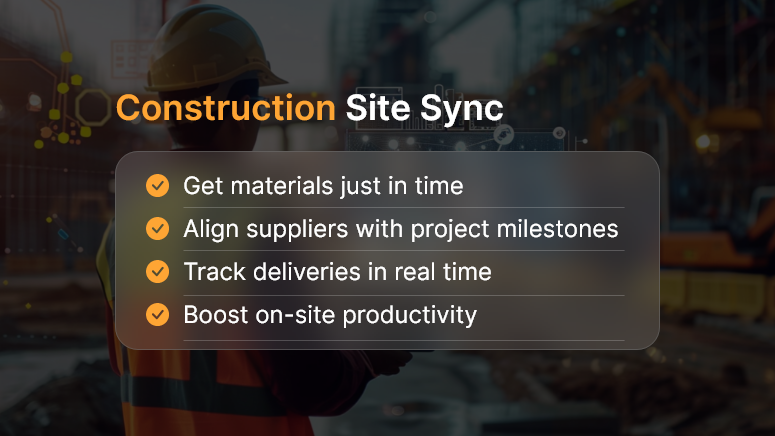
Construction Site Sync

What Is Logistics Optimization?

Logistics optimization is the strategic process of planning, executing, and refining material delivery schedules to align perfectly with project milestones. It uses real-time data from procurement, suppliers, and project sites to predict demand, plan transport routes, and coordinate warehouse releases efficiently.

Key Components

  • Demand Forecasting: Predicting what materials are needed and when.
  • Route Planning: Determining the fastest, most cost-effective routes for delivery.
  • Warehouse Scheduling: Managing dispatch and storage to prevent overstocking.
  • Supplier Coordination: Synchronizing supplier timelines with project deadlines.

Why Construction Projects Need Logistics Optimization

Unlike manufacturing or retail, construction logistics face unique challenges — variable site conditions, weather risks, and fluctuating resource availability. Optimized logistics allow you to:

  • Avoid Material Shortages: Ensure every material is available before work begins.
  • Reduce Idle Time: Keep equipment and labor productive without delays.
  • Save Storage Costs: Deliver materials just in time to avoid warehousing overhead.
  • Enhance Accountability: Track material movement across suppliers and contractors.
  • Improve Sustainability: Optimize delivery frequency and reduce fuel consumption.

The Role of Technology in Logistics Optimization

Today, digital platforms like OConstruction or Orangescrum play a crucial role in synchronizing field operations with supply chain workflows.

1. Real-Time Tracking

GPS-enabled tracking provides instant visibility of trucks, materials, and delivery status.

2. Automated Alerts

Teams receive notifications if deliveries are delayed, rerouted, or rescheduled.

3. Integrated Scheduling

The project Gantt chart directly links with supplier schedules, ensuring every delivery aligns with on-site activity.

4. Predictive Insights

AI-based forecasting tools predict material demand, helping planners avoid both shortages and surplus.

5. Collaboration Dashboards

Stakeholders — contractors, vendors, and logistics partners — collaborate in one workspace, reducing miscommunication.

How to Implement Logistics Optimization

Step 1: Map Your Supply Chain

Document all suppliers, warehouses, and delivery points. Identify bottlenecks or dependencies that frequently cause delays.

Step 2: Digitize Material Planning

Use project management software to create a material requirement plan (MRP) linked to project tasks and milestones.

Step 3: Set Up Smart Scheduling

Adopt just-in-time delivery models, ensuring materials arrive only when the site is ready to use them.

Step 4: Integrate Data Systems

Connect procurement, inventory, and transportation systems under one digital platform.

Step 5: Monitor and Improve

Use analytics dashboards to track performance metrics like delivery lead times, transport utilization, and delay frequency.

Benefits of Optimized Logistics

Benefit Impact
Reduced Delays Seamless coordination between suppliers and project timelines.
Lower Costs Less idle labor, lower fuel and storage expenses.
Improved Quality Materials handled and stored properly before use.
Enhanced Safety Minimized on-site clutter and equipment congestion.
Greater Transparency Real-time visibility into supply chain activities.

Common Challenges in Logistics Optimization

Despite its advantages, several issues can still arise:

  • Unpredictable Delays: Weather, strikes, or vehicle breakdowns.
  • Supplier Non-Compliance: Vendors failing to follow just-in-time schedules.
  • Lack of Integration: Disconnected systems across procurement, transport, and projects.
  • Manual Tracking: Human error in data entry or delivery documentation.

The solution lies in automation and integration — ensuring all stakeholders work on a single, real-time data platform.

Best Practices for Construction Logistics Optimization

  • Adopt Just-In-Time (JIT) Procurement: Align deliveries with activity schedules.
  • Use Predictive Analytics: Anticipate material needs and delivery delays.
  • Establish Clear SLAs with Suppliers: Define delivery times, penalties, and escalation paths.
  • Centralize Communication: Keep everyone informed using digital collaboration tools.
  • Review and Adjust Weekly: Logistics is dynamic; continuous improvement keeps it efficient.

How OConstruction Simplifies Logistics Planning

Platforms like OConstruction and Orangescrum are designed to remove the guesswork from material logistics.

  • Integrated Material Scheduling: Link every delivery with project milestones.
  • Vendor Coordination: Invite suppliers to track and confirm deliveries directly.
  • Analytics & Dashboards: Get insights into delivery performance and cost efficiency.
  • Real-Time Alerts: Receive instant notifications for delays or dispatch issues.

With these tools, you can achieve end-to-end logistics visibility, ensuring your projects run on schedule and under budget.

Conclusion

Logistics optimization isn’t just a backend process — it’s a strategic advantage. By aligning material flow with project timelines, companies can eliminate waste, reduce delays, and increase profitability.

In a fast-moving world of tight margins and complex projects, mastering logistics optimization is the key to operational excellence.

FAQs on Logistics Optimization

1. What does logistics optimization mean in construction?

It means planning and managing material deliveries so they arrive exactly when needed, avoiding delays and excess storage.

2. How does logistics optimization improve project efficiency?

It ensures that labor, equipment, and materials are available in sync, reducing idle time and costs.

3. What tools help with logistics optimization?

Tools like OConstruction and Orangescrum provide scheduling, tracking, and analytics dashboards.

4. How does real-time tracking support logistics?

It gives visibility of delivery status, location, and estimated arrival times.

5. What is Just-In-Time (JIT) delivery?

It’s a logistics strategy that ensures materials arrive right before they are needed for use.

6. Can logistics optimization reduce costs?

Yes — by minimizing storage, fuel, and downtime costs.

7. How does AI improve logistics planning?

AI predicts material demand and identifies potential delivery risks before they occur.

8. What are common causes of delivery delays?

Supplier issues, route inefficiencies, poor weather, and manual tracking errors.

9. How often should logistics data be reviewed?

Ideally, weekly, to adapt to changing site conditions and project timelines.

10. What’s the biggest advantage of digital logistics systems?

End-to-end visibility and collaboration between all project stakeholders.

Just-in-Time (JIT) Material Procurement: Optimize Procurement

In the construction world, time and material flow define success. A delay in the delivery of steel, cement, or electrical supplies can halt an entire site. On the other hand, overstocking materials ties up capital and increases waste.

This is where Just-in-Time (JIT) Material Procurement steps in — a smart, lean approach to ensure materials arrive exactly when needed, not weeks before or days too late.

JIT helps builders and contractors achieve the perfect balance between availability and efficiency, reducing inventory costs and avoiding costly downtime.

What Is Just-in-Time (JIT) Material Procurement?

Just-in-Time (JIT) is a lean supply chain strategy that minimizes inventory levels by synchronizing procurement and delivery with actual project schedules.

Instead of stockpiling materials, project managers procure items in smaller quantities, scheduled to arrive “just in time” for use.

In construction, this approach demands real-time coordination among procurement teams, suppliers, transporters, and site engineers — often enabled through digital construction management systems.

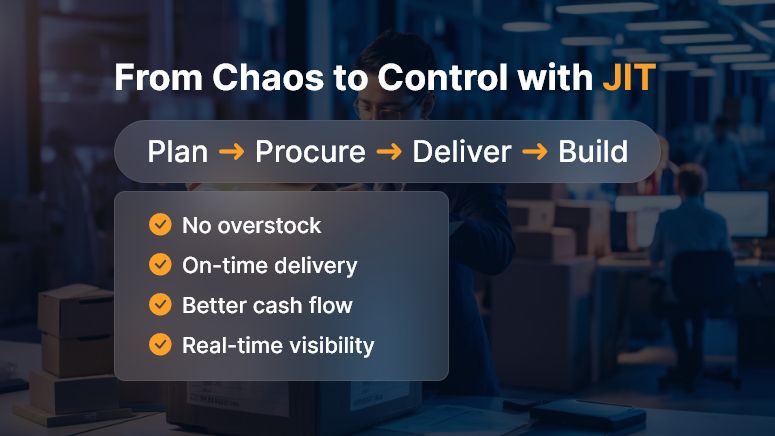
From Chaos to Control with JIT

Why JIT Matters for Modern Construction Projects

Construction projects today are complex, fast-paced, and multi-site. JIT material procurement provides several operational and financial advantages:

1. Reduced Inventory and Storage Costs

Traditional procurement models require bulk buying, leading to expensive warehousing, spoilage, and pilferage. With JIT, materials arrive only when required — saving up to 25-30% of storage and handling costs.

2. Improved Cash Flow

By avoiding premature bulk purchases, contractors keep working capital free for core operations. This helps maintain liquidity and financial agility throughout the project lifecycle.

3. Fewer Material Wastages

Overstocking leads to damage, obsolescence, and poor accountability. JIT reduces waste by ensuring materials match usage, improving sustainability and cost efficiency.

4. Enhanced Project Scheduling and Coordination

Because JIT aligns procurement with task schedules, it encourages teams to plan better and synchronize timelines across departments — procurement, site operations, and vendors.

5. Minimized On-Site Clutter and Safety Risks

Less material clutter means safer, cleaner, and more productive construction sites — directly improving workplace safety and site mobility.

How Digital Tools Enable JIT Procurement

Implementing JIT procurement manually can be challenging. However, digital tools make it achievable and scalable. Here’s how:

1. Real-Time Inventory and Demand Tracking

Cloud-based construction platforms provide live dashboards showing consumption rates, reorder levels, and stock positions across sites. Procurement teams can forecast needs precisely and schedule deliveries automatically.

2. Integrated Vendor Portals

Modern tools allow vendors to see upcoming requirements and update their delivery schedules proactively. This eliminates manual follow-ups and communication gaps.

3. Smart Alerts and Notifications

Automated alerts notify teams before material depletion or delay, ensuring proactive decisions rather than reactive firefighting.

4. Data-Driven Procurement Decisions

Analytics modules assess past consumption patterns, supplier reliability, and lead times — enabling smarter purchase planning and negotiation.

5. Seamless Site-to-Procurement Coordination

Field engineers can raise requisitions directly from mobile apps, while central procurement teams can approve, order, and track deliveries in real time.

Steps to Implement JIT Material Procurement in Construction

If you’re planning to move toward a JIT model, here’s a proven roadmap:

  • Map Your Material Flow

Identify which materials can be sourced on a JIT basis without disrupting workflow. Bulk materials (cement, steel) may still require buffer stock.

  • Collaborate with Reliable Suppliers

Choose vendors who can guarantee consistent quality and delivery timelines.

  • Digitize Procurement and Inventory

Use construction management software to track demand, deliveries, and usage in real time.

  • Create Predictive Schedules

Integrate project Gantt charts with procurement modules to automatically trigger purchase requests based on task progress.

  • Set Performance KPIs

Monitor supplier reliability, lead times, delivery accuracy, and cost savings to evaluate the success of JIT adoption.

  • Train Your Teams

Help procurement and site teams understand the lean principles behind JIT to ensure smooth adoption.

Challenges of JIT Procurement (and How to Overcome Them)

While JIT delivers high efficiency, it requires precision and digital readiness. Common challenges include:

Challenge Impact Solution
Supplier delays Workflow disruption Build a network of backup vendors
Transportation issues Missed deadlines Use route tracking & logistics alerts
Poor forecasting Material shortages Leverage AI-based demand prediction
Lack of visibility Communication gaps Use centralized project dashboards

The ROI of JIT Procurement

Companies implementing JIT procurement report:

  • 20–35% reduction in inventory carrying costs
  • 15–25% faster project completion through smoother coordination
  • 10–20% higher cash flow efficiency
  • Fewer material wastages and better sustainability metrics

Over time, these improvements translate to higher profit margins, better client satisfaction, and stronger supplier partnerships.

Conclusion: Building the Future, One On-Time Delivery at a Time

Just-in-Time Material Procurement isn’t just about reducing inventory — it’s about building a culture of precision, collaboration, and efficiency.

For construction firms adopting digital transformation, JIT is a cornerstone of lean operations. With integrated procurement dashboards, predictive analytics, and vendor collaboration, you can turn timing into your competitive advantage.

FAQs

1. What is Just-in-Time procurement in construction?

It’s a method of sourcing materials to arrive exactly when needed, reducing storage and holding costs.

2. How does JIT reduce project delays?

By synchronizing procurement with task schedules, materials are always available when required — no waiting time.

3. What type of software supports JIT procurement?

Integrated construction management platforms with modules for inventory tracking, supplier coordination, and analytics.

4. Is JIT suitable for all materials?

Not always. Critical or imported materials may need buffer stock, while consumables and short-lead materials fit JIT best.

5. What are the key benefits of JIT procurement?

Reduced costs, better cash flow, less waste, improved coordination, and safer worksites.

6. How can JIT improve sustainability?

By minimizing excess stock and wastage, it supports eco-friendly and resource-efficient construction.

7. Does JIT work for multi-site projects?

Yes, if supported by centralized procurement dashboards and strong vendor communication.

8. What KPIs track JIT success?

Inventory turnover rate, supplier lead time, delivery accuracy, and stock-out frequency.

9. Can JIT procurement work without automation?

It’s possible, but inefficient — automation ensures accuracy, transparency, and speed.

10. How does JIT impact supplier relationships?

It builds long-term, trust-based relationships through consistent collaboration and visibility.

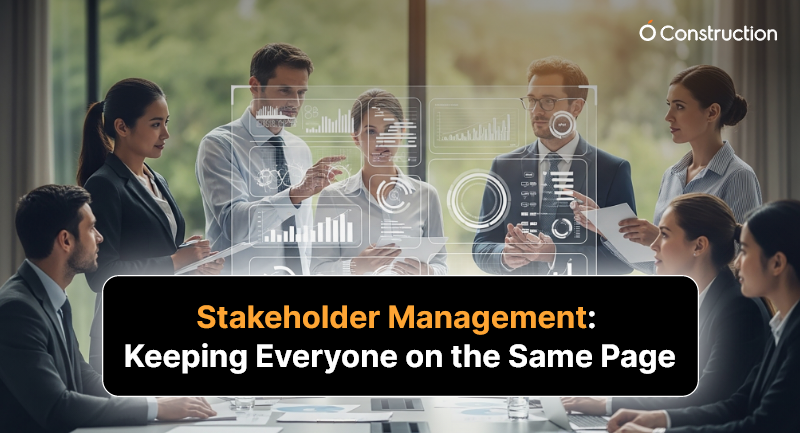
Stakeholder Management: Keeping Everyone on the Same Page

The success or failure of a project often hinges less on technical execution than on how well stakeholders are managed. Stakeholders—whether clients, team members, vendors, local communities, regulatory agencies, or end users—carry expectations, influence, and sometimes conflicting goals.

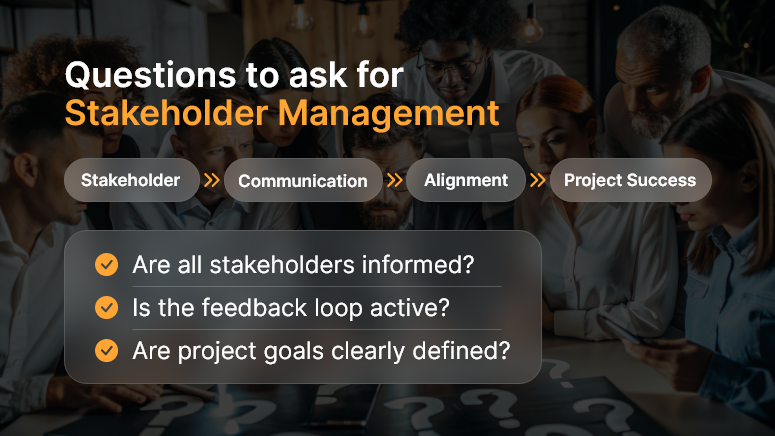
Stakeholder management is the art and practice of identifying, engaging, communicating with, and aligning all parties so that the project proceeds smoothly, conflict is minimized, and value is delivered.

In this blog, we explore key principles, steps, challenges, and strategies for stakeholder management—so you can keep everyone on the same page throughout the project lifecycle.

Why Stakeholder Management Matters

Let’s start with why stakeholder management is not just “nice to have” but critical:

  • Alignment of expectations: Misaligned expectations lead to scope creep, disputes, or dissatisfaction.
  • Risk mitigation: Unheard stakeholders may raise objections, delays, or resistance midstream.
  • Better decision-making: Stakeholders often hold valuable insights, constraints, or feedback that improve outcomes.
  • Trust and buy-in: When people feel included and informed, they are more supportive and cooperative.
  • Conflict reduction: Proactive communication and transparent decision paths help reduce surprises and confrontations.
  • Smoother change management: When changes are necessary, good stakeholder relationships ease acceptance.

In construction projects, for example, Public notes that “indirect stakeholders” (residents, shop owners, political groups) often get overlooked in favor of direct ones (clients, contractors), but their influence can make or break the project’s public perception and regulatory compliance.

That principle holds in nearly all domains: it’s not enough to focus only on parties who deliver or receive the project’s outputs; you must also manage those impacted.

The Stakeholder Management Lifecycle

A robust stakeholder management approach can be organized in phases:

  • Identification & Mapping
  • Analysis & Prioritization
  • Engagement Strategy & Planning
  • Communication & Interaction
  • Monitoring, Feedback & Adjustment
  • Post-Project Review & Improvement

Let’s unpack each phase.

1. Identification & Mapping

What to do:

  • List all potential stakeholders (internal and external).
  • Include direct participants (e.g., clients, team, vendors) and indirect ones (e.g., regulators, communities, media, neighboring businesses, interest groups).
  • Build a stakeholder map or visual (flowchart, matrix, network diagram) showing relationships, influence, roles, and interactions.
  • Regularly revisit and update this map — stakeholders may emerge, shift in influence, or drop off.
  • Public emphasizes that stakeholder mapping must be repeated regularly, because new stakeholders may appear, priorities change, and risk profiles shift.

Tips:

  • Use frameworks like the impact/influence matrix (e.g., high-influence / high-interest quadrant)
  • Use tools such as stakeholder maps, stakeholder registers, and entity-relationship diagrams

2. Analysis & Prioritization

What to analyze:

  • Influence or power (how much a stakeholder can affect the project)
  • Interest or stake (how affected they are by the project)
  • Attitude (supportive, neutral, resistant)
  • Risks or issues they may pose (delays, objections, negative press)
  • Dependence relationships (who is dependent on whom)
  • Needs, concerns, and expectations

How to prioritize:

  • Focus more resources on high-power, high-interest stakeholders
  • Identify “watch” group (high power, low interest) and “keep informed” group (low power, high interest)
  • Balance across stakeholder groups so no key stakeholder feels neglected

3. Engagement Strategy & Planning

Once you know who matters most and what their concerns are, decide how, when, and how much to engage them.

Key components:

  • Communication channels and frequency (meetings, newsletters, workshops, town halls, social media, one-on-one)
  • Tone, content, and format depend on stakeholder type and literacy
  • Two-way engagement, not just broadcasting: include mechanisms for input, feedback, grievance redressal
    Escalation and issue resolution paths
  • Roles & responsibilities: who in your team is responsible for stakeholder relationships
  • Governance & access control: who sees what information, when, and who can respond

In the Public example, their tool allows defining what each stakeholder sees and who can interact with whom, ensuring access control and relevance.

4. Communication & Interaction

This is the execution phase: implementing your engagement plan.

Best practices:

  • Be transparent: Even the bad news. Publish schedules, explain “why,” and explain what you’ll do to mitigate negative impacts. Public gives the example of informing residents in advance about noise, pollution, scheduling, and mitigation efforts.
  • Communicate clearly and concisely: Use language the stakeholder understands. Avoid jargon when talking to non-technical audiences.
  • Regular cadence: Consistency builds trust — weekly or monthly updates, standups for the core team, newsletters for the broader group.
  • Tailor messages: Different stakeholders have different needs. A subcontractor may want technical details; a community group needs a high-level schedule, impact, and mitigation steps.
  • Active listening: Provide mechanisms for suggestions, complaints, and feedback. Don’t ignore or dismiss them.
  • Respond respectfully: Even negative or unreasonable complaints merit proper replies. Sometimes an apology or clarification goes a long way.
  • Facilitate stakeholder interactions: Encourage dialogue, co-creation, and joint problem solving.

5. Monitoring, Feedback & Adjustment

Stakeholder management is not “set and forget.” You must continuously monitor, evaluate, and refine your approach.

  • Track engagement metrics: response rates, sentiment, escalation frequency
  • Monitor risks or dissatisfactions emerging from stakeholders
  • Update your stakeholder maps and priority lists as conditions change
  • Adjust communication frequency, content, or format based on feedback
  • Document lessons learned and evolve engagement strategies

6. Post-Project Review & Improvement

Once the project is done, close the loop:

  • Conduct stakeholder debriefs: What worked? What didn’t?
  • Collect stakeholder satisfaction surveys or feedback
  • Document best practices and improvement areas
  • Feed them into your organization’s process library so future projects benefit

As the Public says, “When every construction project comes to an end, you transfer these experiences to future endeavours.”

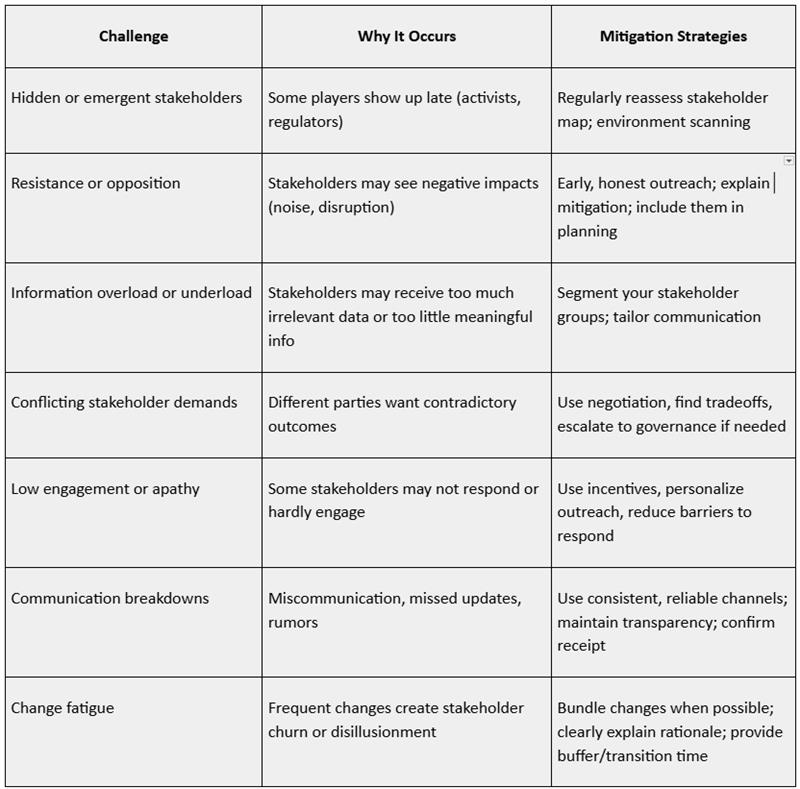
Common Challenges & How to Overcome Them

Real-World Examples & Illustrations

  • Construction & Infrastructure: As in the Public example, when construction causes noise, dust, and road closures, residents may be negatively impacted. Transparent scheduling, mitigation planning (like dust suppression, work hours, alternate routes), and proactive announcements can reduce complaints and local resistance.
  • Urban Redevelopment / Infrastructure Projects: Local businesses, commuters, environmental activists, municipal agencies—each must be engaged, informed, and sometimes compensated.
  • IT / Software Projects: Stakeholders include customers, sponsors, regulatory bodies, internal users, and third-party integrators. Managing expectations about feature scope, cutover plans, downtime, and data migration is critical.
  • Product Launch / Consumer Goods: External stakeholders may include media, influencers, end-users, and regulatory authorities. Early beta users’ feedback becomes critical.
  • NGO or Social Projects: Communities, donors, local government, and beneficiaries all have stakes in outcomes, transparency, and inclusiveness.

In each case, the principles (mapping, transparency, two-way communication, iteration) apply.

Tips & Best Practices

  • Start early – don’t wait until problems arise to engage stakeholders
  • Use stakeholder personas – treat groups with similar needs as a “persona” to tailor messaging
  • Use multiple channels – email, meetings, apps, dashboards, social media, town halls
  • Visual dashboards – for those who like quick overviews (Gantt, status RAG, heat maps)
  • Structured feedback loops – surveys, Q&A sessions, suggestion boxes
  • Governance forums – advisory boards, steering committees, where stakeholders can participate in decisions
  • Neutral facilitators – when tensions exist, use a mediator or third party to facilitate dialogue
  • Document every interaction – keep records of communications, concerns, decisions
  • Balance visibility vs confidentiality – some data is sensitive (bids, budget); gate who sees what
  • Empathy & respect – treat dissenting voices with dignity, acknowledge concerns, even if you cannot satisfy them fully

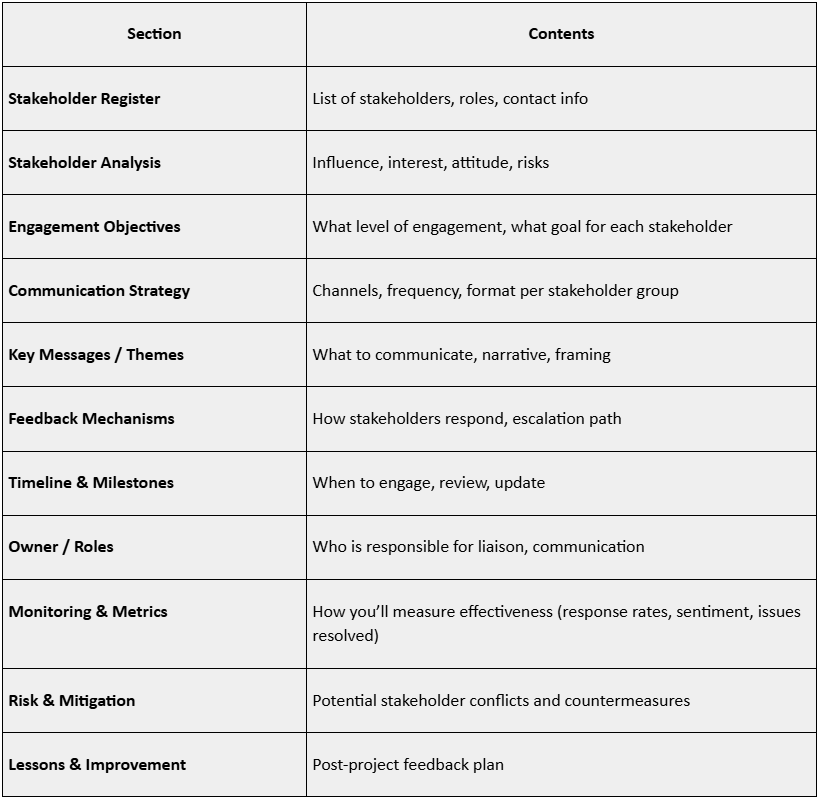
Sample Stakeholder Management Plan Outline

Here’s a template you can adapt:

Conclusion

Stakeholder management is not a peripheral activity — it’s central to project success. A project might have the best technology, schedule, or budget plan, but if key stakeholders feel ignored, misled, or antagonized, delays, pushback, or failure can ensue.

By systematically identifying, prioritizing, engaging, and adapting to stakeholders — with transparency, clarity, and responsiveness — you can keep everyone on the same page. That alignment helps reduce surprises, build trust, and enable smoother execution.

Would you like me to create a shorter “blueprint” or slide deck summary of this for your blog or presentation?

FAQs

1. What is stakeholder management in projects?

Stakeholder management is the process of identifying, analyzing, engaging, and communicating with individuals or groups who are affected by or can influence a project. It ensures expectations are aligned and conflicts are minimized.

2. Why is stakeholder management important?

Without proper stakeholder management, projects risk misaligned expectations, delays, conflicts, or even failure. Effective engagement builds trust, improves decision-making, and helps gain support from all parties.

3. Who are considered stakeholders in a project?

Stakeholders include anyone with a direct or indirect interest in the project: clients, project teams, vendors, investors, regulatory agencies, local communities, and even end users.

4. What is stakeholder mapping?

Stakeholder mapping is the process of visually identifying stakeholders, their level of influence, and their interest in the project. This helps prioritize engagement efforts and ensures no key stakeholder is overlooked.

5. How do you prioritize stakeholders?

Stakeholders are typically prioritized based on their power (influence) and interest (level of impact). High-power, high-interest stakeholders require the most attention, while others may simply need to be kept informed.

6. What are common challenges in stakeholder management?

Some challenges include hidden stakeholders emerging later, conflicting demands, resistance to change, communication breakdowns, and low engagement from certain groups.

7. How to manage conflicts between stakeholders?

Conflicts can be reduced by open communication, transparency, and negotiation. If disagreements persist, use governance structures (like steering committees) or neutral facilitators to resolve disputes.

8. How often should I update stakeholders?

The frequency depends on the stakeholder’s role and influence. Core team members may need daily or weekly updates, while external stakeholders may only require monthly progress reports or milestone reviews.

9. What tools can help in stakeholder management?

Tools include stakeholder registers, RACI charts, communication plans, project dashboards, feedback surveys, and specialized project management software that controls access and communication.

10. How can organizations improve stakeholder engagement over time?

By conducting post-project reviews, gathering feedback, documenting lessons learned, and refining communication strategies, organizations can build stronger stakeholder relationships for future projects.

Inventory Management Hacks for Large-Scale Construction Sites

Did you know that poor inventory control contributes to up to 35% of project cost overruns in the construction industry? Large-scale sites handle thousands of materials daily — steel, cement, pipes, safety gear, and machinery parts. One misstep can lead to delays, wasted materials, or even halted projects.

That’s where inventory management for construction sites comes in. With the right hacks and tools, you can prevent losses, optimize usage, and keep projects running smoothly. In this blog, we’ll explore proven strategies to manage construction inventory, avoid costly mistakes, and see how an integrated digital platform like OConstruction simplifies the process.

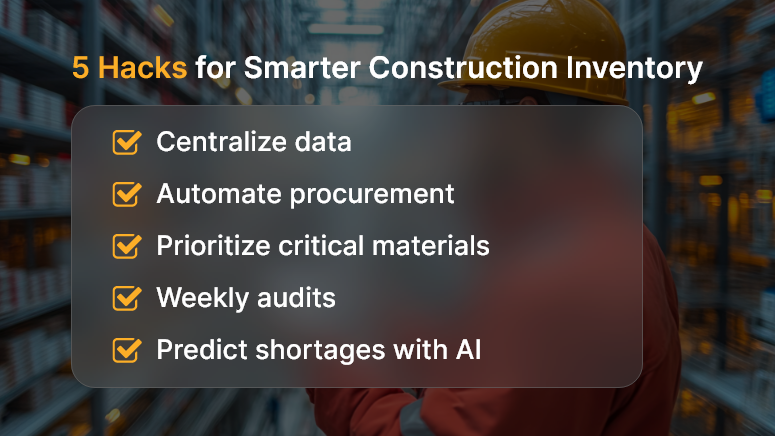
5 Hacks for Smarter Construction Inventory

Business Relevance & Why It Matters

Construction projects are high-stakes. Every delay or material shortage translates into financial loss and strained client relationships. Managing inventory at scale isn’t just about storing materials—it’s about ensuring the right resources are available at the right time, in the right quantity.

Why should companies care?

  • Cost savings: Proper material tracking reduces waste and theft.
  • Time efficiency: Automated updates avoid last-minute procurement chaos.
  • Compliance & safety: Some materials require regulated storage and usage documentation.

Who benefits the most?

  • Project managers juggling multiple sites.
  • Procurement teams negotiating bulk orders.
  • Site engineers rely on timely supply delivery.

Real-world pain vs. solution:

  • A high-rise project in Mumbai was delayed by 3 months due to the loss of shipments of steel bars.
  • A highway project in Texas wasted 10% of the cement because of double ordering.

Both problems could have been solved with real-time inventory management for construction sites.

Best Practices, Frameworks, and Actionable Strategies

Do’s and Don’ts of Inventory Management for Construction Sites

  • Adopt digital tracking systems – Manual logs are outdated and prone to errors. Digital systems ensure real-time updates.
  • Don’t rely solely on contractors – Always verify supply counts with internal checks to avoid misreporting.
  • Do set reorder thresholds – Automated alerts prevent stockouts or overstocking.
  • Don’t overlook material expiry – Chemicals, paint, and safety gear often have shelf lives; expired items compromise safety.

Quick Wins and Best Practices

  • Centralize Inventory Data: Instead of scattered spreadsheets, use a centralized platform. It provides a single source of truth across all sites.
  • Leverage QR Codes & RFID Tags: Tagging materials enables instant scanning and reduces manual counting errors.
  • Automate Procurement Triggers: Link usage patterns with vendor systems for seamless reordering.
  • Prioritize Critical Materials: Classify materials as high, medium, or low priority. Always buffer high-priority materials like steel, cement, and safety gear.
  • Conduct Weekly Audits: Digital audits spot inconsistencies early, preventing large-scale losses.

Step-by-Step Framework for Large Sites

  • Plan Before You Procure: Map project phases and align material requirements with timelines. This prevents both shortages and excess storage.
  • Digitize Material Tracking: Use platforms like OConstruction for real-time inventory monitoring across multiple sites.
  • Enable Multi-Site Visibility: Large contractors often manage multiple sites. With shared dashboards, managers can reallocate surplus materials instantly.
  • Integrate with Financial Systems: Connect inventory with budget tracking. This helps align procurement with cost forecasts.
  • Use Predictive Analytics: AI-driven insights forecast material demand and prevent last-minute supply gaps.

Customer Story

For example, BuildPro Constructions, a mid-sized infrastructure firm, used OConstruction’s real-time inventory tracking to streamline a highway expansion project. Previously, they faced frequent cement shortages, causing weekly delays. By digitizing their material flow and setting automated reorder triggers, they cut procurement delays by 40% and saved nearly ₹50 lakhs in wasted materials.

Here’s how:

  • QR-coded shipments reduced theft.
  • Real-time dashboards gave project managers live visibility.
  • Predictive analytics flagged shortages before they became critical.

Key Takeaways & Closing Summary

Key Insights:

  • Inventory management for construction sites is about accuracy, visibility, and efficiency.
  • Digital tools replace guesswork with real-time insights.
  • Preventing small errors today avoids massive delays tomorrow.

In summary:

Adopting smarter inventory practices isn’t optional — it’s a competitive edge. Large-scale projects demand precision, and the right platform ensures that every nail, brick, and beam is accounted for. By following the hacks outlined above, businesses can not only cut costs but also deliver projects faster and with higher quality.

FAQs

Q1. What is inventory management for construction sites?

Inventory management for construction sites refers to the process of tracking, controlling, and optimizing the use of construction materials, equipment, and tools across multiple projects. It ensures materials are available on time, reduces waste, and prevents costly project delays.

Q2. Why is inventory management important in large-scale construction projects?

Large-scale construction projects involve thousands of moving parts. Without proper construction inventory management, companies risk material shortages, overspending, and delays. Good practices reduce waste, optimize budgets, and improve project delivery timelines.

Q3. How does digital inventory tracking improve construction efficiency?

Digital inventory tracking provides real-time visibility into stock levels, locations, and usage. Features like QR codes, RFID tags, and automated reordering reduce manual errors, prevent theft, and save significant costs.

Q4. What are the common challenges in construction inventory management?

Typical challenges include:

  • Overstocking or understocking materials
  • Lack of real-time updates
  • Miscommunication between project managers and suppliers
  • Theft or material misuse
  • Manual errors in spreadsheets

Using a digital platform addresses most of these issues.

Q5. Can inventory management software integrate with financial systems?

Yes. Advanced platforms like OConstruction can connect inventory with procurement and accounting systems. This integration helps align material purchases with budgets, track expenses, and forecast project costs accurately.

Q6. How do predictive analytics help in construction inventory management?

Predictive analytics analyzes historical data and project timelines to forecast future material needs. This prevents last-minute shortages, avoids storage costs for unused items, and supports smarter procurement decisions.

Q7. Who benefits the most from effective construction inventory management?

  • Project managers – gain visibility across multiple sites
  • Procurement teams – streamline supplier management
  • Finance departments – track material expenses in real time
  • Site engineers – ensure materials are always available when needed

Q8. How can OConstruction help with inventory management for construction sites?

OConstruction’s digital platform enables real-time tracking, automated reordering, multi-site visibility, and predictive insights. This means fewer delays, reduced costs, and higher productivity for construction businesses of any size.

Category: Construction Academy

Subcategory: Budgeting and Planning

Subcategory: Construction Phase

Subcategory: Design Coordination

Subcategory: Estimation Techniques

Subcategory: Initiation and Feasibility

Subcategory: Introduction

Subcategory: Personal Management

Subcategory: Project Close-Out

Subcategory: Project Scheduling

Subcategory: Project Teams

Subcategory: Proposal Management

Subcategory: Total Quality Management

Subcategory: Tracking and Control

Subcategory: Work Breakdown

Category: Help Desk

Subcategory: Client

Subcategory: Construction 101

Subcategory: Contractor Management

Subcategory: Expense

Subcategory: Finance Budget

Subcategory: Inventory Management

Subcategory: My Approvals

Subcategory: Site Management

Subcategory: Vendor Management