Progress Measurement in Design Projects

Unlike physical construction, design progress is intangible — measured in deliverables, not cubic meters or tons.

Accurate tracking ensures the timely issue of drawings and prevents construction delays.

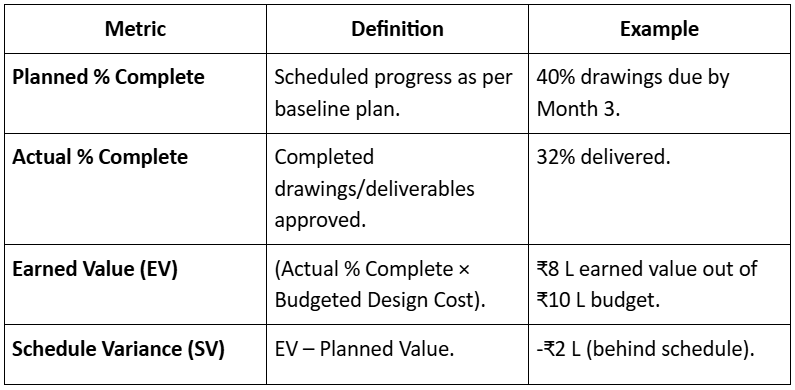
1. Design Progress Metrics
2. Tracking Mechanisms

  • Maintain a Design Deliverable Register (DDR) listing all drawings, statuses, and approval dates.
  • Conduct weekly design coordination meetings.
  • Use traffic-light dashboards (Green = on track, Amber = delay risk, Red = critical).
  • Integrate design progress into the Master Schedule (MSP/Primavera).

3. Managing Revisions and Change Control

  • Log all Revisions (R1, R2, etc.) with reason codes.
  • Assess cost and schedule impact before issuing revised drawings.
  • Maintain a Change Control Register linking changes to approvals.
“You can’t manage what you can’t measure — even in design.”

Module Summary

  • Design development transforms concepts into executable plans.
  • The Project Execution Plan (PEP) governs coordination, cost, and control.
  • Mini-drawings simplify reviews and fast-track execution.
  • Proper design budgeting ensures resource efficiency and accountability.

Measuring design progress through EV and DDR prevents downstream delays.
Budgeting for Design Activities

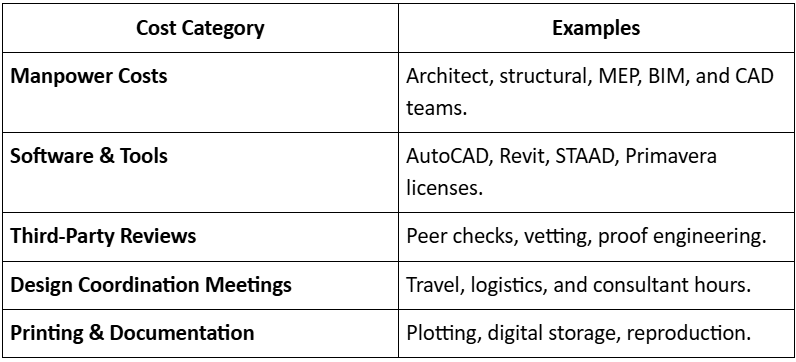
Design development requires resources — architects, engineers, software, and coordination meetings — all of which have associated costs.

Hence, budgeting for design is as crucial as budgeting for construction.

1. Design Budget Components

Budgeting for Design Activities

2. Budgeting Process

  1. Identify all design deliverables and required resources.
  2. Estimate hours and rates for each discipline.
  3. Include review and re-submission cycles.
  4. Add contingency (typically 5–10%) for scope changes.
  5. Track actual design hours vs. planned (Earned Value Technique).

3. Key Performance Indicators (KPIs)

  • Design cost % vs. total project cost (usually 5–8%).
  • Number of re-submissions per package.
  • Design productivity (drawings per engineer per month).
  • Design change impact on total project cost.
“Control your design hours, or they will control your budget.”

Engineering Scope Definition & Mini-Drawings

Clear scope definition ensures that the engineering team knows exactly what to deliver and avoids gaps between design intent and construction reality.

1. Engineering Scope Definition

  • Define discipline-wise boundaries (civil, structural, MEP, architecture).
  • Identify codes, standards, and performance criteria.
  • Document interfaces between disciplines (e.g., structure-MEP coordination).
  • Prepare a Design Responsibility Matrix (DRM) to show who owns each deliverable.

2. Mini-Drawings (or Mini-Design Packages)

Used in large projects to control design progress in manageable sections.

Purpose:

  • Divide the total design into smaller, reviewable parts.
  • Enable faster approval cycles.
  • Allow early start of procurement and construction.

Typical Contents:

  • Key plan and section drawings.
  • BOQ summary for that section.
  • Material specification sheet.
  • Design assumptions and calculation notes.
  • Approval sign-off sheet.
“Breaking large designs into mini-packages accelerates decisions and reduces rework.”

Developing the Project Execution Plan (PEP)

The Project Execution Plan (PEP) is the master document that defines how the project will be executed, monitored, and controlled.

It connects the design intent to the construction strategy — ensuring alignment among all stakeholders.

Purpose of a PEP

  • Acts as a roadmap for execution.
  • Defines roles, responsibilities, and interfaces.
  • Links project objectives to deliverables and milestones.
  • Provides a baseline for performance monitoring.

Typical Structure of a PEP

  • Project Overview & Objectives
  • Scope of Work and Deliverables
  • Project Organization & Responsibilities
  • Design Management Approach
  • Procurement & Subcontracting Strategy
  • Schedule and Key Milestones
  • Cost and Budget Management Plan
  • Quality Assurance and Control Plan
  • Safety and Risk Management Plan
  • Communication and Reporting Matrix

Design Manager’s Role

  • Coordinate design inputs from multiple disciplines.
  • Control design changes through a documented process.
  • Verify that design deliverables meet contractual and regulatory requirements.
“A well-written PEP turns project chaos into clarity.”

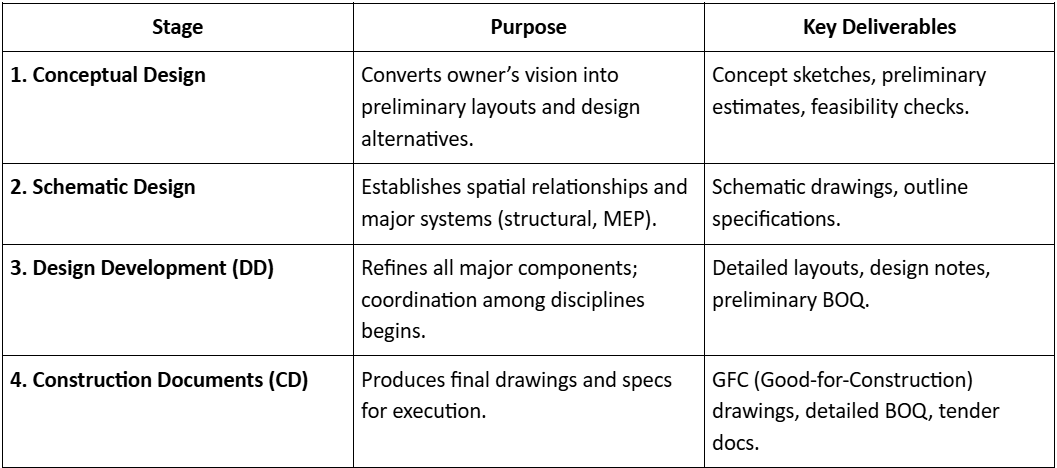
From Concept to Design Proposals

The design phase translates the project concept into practical, buildable solutions.

It involves multiple iterations — from initial concept sketches to detailed construction drawings — balancing aesthetics, function, cost, and compliance.

Stages of Design Development

From Concept to Design Proposals

Core Principles

  • Early collaboration between the owner, the architect, and the contractor prevents redesign and rework.
  • Maintain traceability between design decisions and cost impacts.
  • Ensure designs comply with codes, standards, and sustainability guidelines (IS codes, NBC 2016, GRIHA, LEED).
“Design is not just what it looks like — it’s how it works, how it’s built, and how it pays off.”

Communication and Follow-Up Mechanisms

Even the best plans fail without consistent communication and follow-up.

Construction projects involve multiple teams, locations, and subcontractors — hence, a structured system is essential.

1. Communication Plan

Defines how information will be shared and tracked.

Communication and Follow-Up Mechanisms

2. Reporting Tools

  • Dashboards and Progress Charts – Visual overview of schedule, cost, and productivity.
  • Meeting Minutes (MoM) – Document decisions and assign action items.
  • Change Logs – Track and control variations.
  • Follow-Up Registers – Ensure accountability for pending issues.

3. Communication Best Practices

  • Keep communication structured but flexible.
  • Use visual aids (charts, dashboards, BIM models).
  • Encourage two-way updates — feedback loops are crucial.
  • Record and archive all official communications digitally.

4. Follow-Up Mechanisms

  • Weekly Coordination Meetings with clear action items.
  • Daily Stand-Ups for short-term priorities (especially for site teams).
  • Escalation Protocols for unresolved issues.
  • Performance Reviews tied to milestones and KPIs.
“Follow-up is not micromanagement — it’s project discipline.”

Module Summary

  • The WBS forms the foundation of planning and control.
  • Work packages translate scope into measurable deliverables.
  • A clear organizational structure enhances accountability and communication.
  • Kickoff meetings align all stakeholders at the project’s start.

Effective communication and follow-up keep the project on course.

Category: Construction Academy

Subcategory: Budgeting and Planning

Subcategory: Construction Phase

Subcategory: Design Coordination

Subcategory: Estimation Techniques

Subcategory: Initiation and Feasibility

Subcategory: Introduction

Subcategory: Personal Management

Subcategory: Project Close-Out

Subcategory: Project Scheduling

Subcategory: Project Teams

Subcategory: Proposal Management

Subcategory: Total Quality Management

Subcategory: Tracking and Control

Subcategory: Work Breakdown

Category: Help Desk

Subcategory: Client

Subcategory: Construction 101

Subcategory: Contractor Management

Subcategory: Expense

Subcategory: Finance Budget

Subcategory: Inventory Management

Subcategory: My Approvals

Subcategory: Site Management

Subcategory: Vendor Management