Kickoff Meetings and Project Work Plans

A kickoff meeting is the formal start of the project execution phase — ensuring everyone is aligned on goals, roles, and expectations.

Purpose

  • To review the project scope, objectives, and deliverables.
  • To clarify roles and responsibilities among stakeholders.
  • To communicate project schedule, risks, and quality standards.
  • To set the tone for collaboration, accountability, and performance.

Agenda of a Kick-Off Meeting

  • Introduction of key team members.
  • Review of project scope and milestones.
  • Discussion of constraints and success factors.
  • Overview of reporting and communication structure.
  • Review of safety, quality, and risk management procedures.
  • Agreement on follow-up schedule and meeting frequency.

Output: Project Work Plan (PWP) — the guiding document for execution.

Components of a Project Work Plan

  • Project Overview and Objectives
  • Scope of Work and Deliverables
  • WBS and Schedule Baseline
  • Budget Summary
  • Roles & Responsibilities
  • Quality & Safety Standards
  • Risk Management Plan
  • Reporting and Communication Matrix
A kickoff meeting converts planning documents into team commitment.

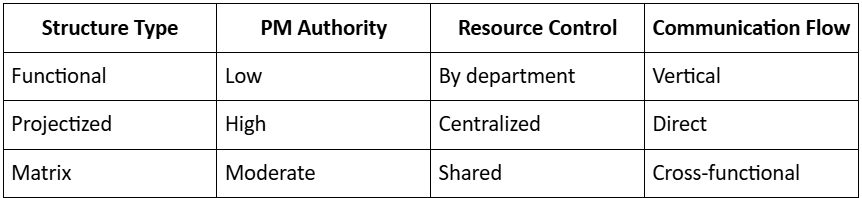
Project Organizational Structures

A project’s success depends on how teams are organized and lines of authority are defined.

The organizational structure determines how communication flows and decisions are made.

1. Functional Organization

  • Teams grouped by specialization (engineering, procurement, construction).
  • The project manager has limited authority; coordination is slow.

Best for: Routine or departmental projects.

2. Projectized Organization

  • All resources directly report to the Project Manager.
  • Decisions are fast; accountability is clear.

Best for: Large, complex, time-bound projects.

3. Matrix Organization

  • A hybrid model where resources report to both functional and project managers.
  • Encourages collaboration but requires clear communication.

Best for: Organizations handling multiple projects simultaneously.

Project Organizational Structures

4. Construction Project Team Hierarchy

Typical roles:

  • Project Manager – overall responsibility
  • Construction Manager / Site Engineer – daily operations
  • Planning & Billing Engineer – schedule and cost tracking
  • Procurement Officer – materials and logistics
  • Quality and Safety Officer – compliance and inspection
  • Contractor / Foreman / Crew – field execution
The right structure transforms communication into collaboration.

Work Package Development

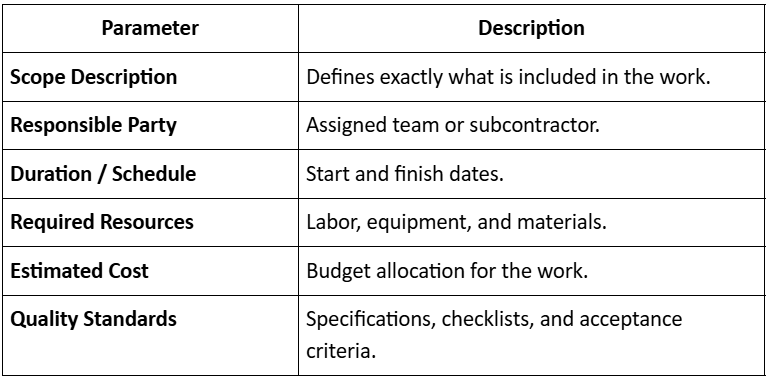
A work package is the lowest manageable unit in the WBS, where cost, duration, and responsibility can be assigned. Each work package represents a mini-project within the larger project.

Contents of a Work Package

Work Package Development

Steps in Work Package Development

  • Identify deliverables from WBS Level 3 or 4.
  • Define the work content and performance expectations.
  • Estimate duration, resources, and cost.
  • Assign ownership (team or vendor responsible).
  • Integrate into a schedule for monitoring progress.
  • Document dependencies and quality requirements.

Example:

Work Package: “Column Reinforcement – Ground Floor”

  • Duration: 5 days
  • Crew: 6 rebar fitters + 1 foreman
  • Materials: 8 MT TMT bars
  • Cost: ₹1,20,000
  • Acceptance: As per IS 1786 & structural drawings

“A good work package is measurable, assignable, and trackable.”

Creating the Work Breakdown Structure (WBS)

The Work Breakdown Structure (WBS) is the foundation of all project planning. It defines the “what” of the project — breaking down large, complex work into smaller, more manageable parts.

Definition

A hierarchical decomposition of the total scope of work to be carried out by the project team to accomplish the project objectives and deliverables.” — PMBOK®

Purpose of WBS

  • Clarifies scope and deliverables.
  • Establishes the basis for scheduling, cost estimating, and resource planning.
  • Enables better monitoring, accountability, and reporting.
  • Prevents scope creep and duplication of work.

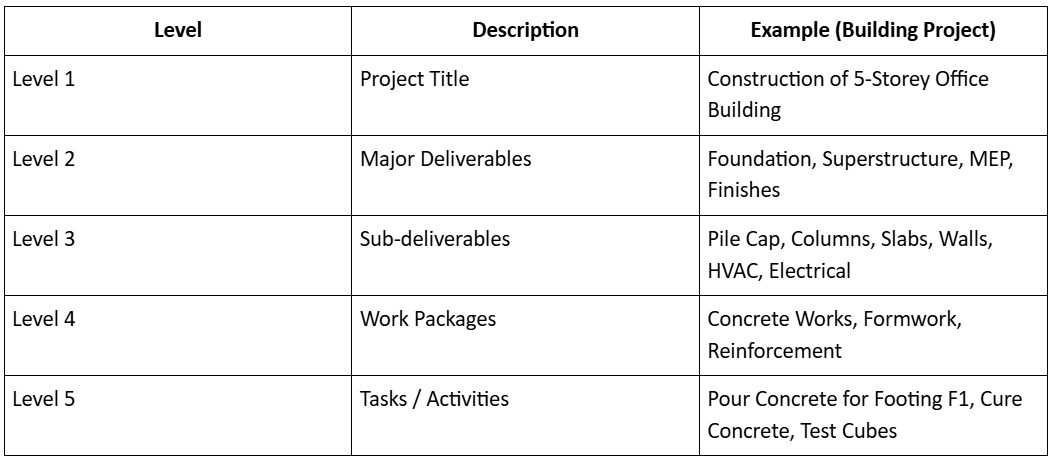
Structure of a WBS

A WBS is hierarchical, typically using 3–5 levels:

Work Breakdown Structure (WBS)

Types of WBS

  • Deliverable-Based WBS – Focused on what needs to be delivered.
  • Phase-Based WBS – Organized by project stages (Design → Procurement → Construction → Handover).
  • Hybrid WBS – Combination of deliverables and phases (most common in construction).
If you can’t measure it or schedule it, it’s not properly defined in your WBS.

Estimating Accuracy and Variance Control

Budgeting is not static. Once execution begins, actual costs start to deviate from the planned values — hence, variance tracking becomes essential.

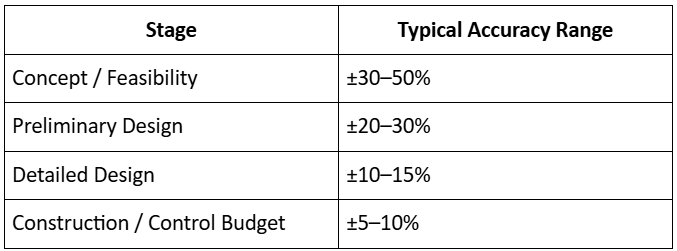
1. Accuracy Levels by Project Stage

 Accuracy

2. Causes of Variance

  • Scope changes or rework
  • Market rate fluctuations
  • Poor productivity or labor inefficiency
  • Weather delays or unforeseen conditions
  • Design errors or material shortages

3. Variance Control Techniques

  • Regular Cost Reporting: Monthly budget vs. actual review.
  • Trend Analysis: Tracking cumulative deviation patterns.
  • Forecast at Completion (FAC): Predicting total project cost using real data.
EAC = BAC​ / CPI

(EAC = Estimate at Completion, BAC = Budget at Completion)

  • Change Management: All cost deviations must be approved and documented.
  • Cash Flow Monitoring: Ensure expenditure aligns with planned disbursements.

4. Continuous Improvement

Post-project review helps improve future estimate accuracy through historical data benchmarking and lessons learned.

Variance control is not about blame — it’s about early detection and corrective action.

Module Summary

  • A budget is the financial expression of project scope and schedule.
  • Linking cost, time, and work packages provides measurable control.
  • Economic feasibility ensures financial sustainability through NPV and IRR.
  • Owners focus on lifecycle value, while contractors focus on execution efficiency.

Continuous variance tracking and reporting maintain budget discipline.

Owner’s and Contractor’s Cost Perspectives

Both owners and contractors view budgets differently — yet both perspectives are essential for balanced financial planning.

1. Owner’s Perspective

  • Focused on total project cost and return on investment.
  • Concerned with long-term operation, maintenance, and life-cycle costs.
  • Uses budgets for funding approval, cost tracking, and performance evaluation.

Key Owner Budget Components:

  • Land acquisition
  • Design and consultancy
  • Construction contracts
  • Equipment and furnishing
  • Permits, insurance, legal fees
  • Contingency and escalation reserves

2. Contractor’s Perspective

  • Focused on project execution cost and profit margin.
  • Uses budgets to monitor productivity, control expenses, and meet bid commitments.

Key Contractor Budget Components:

  • Direct cost (labor, materials, equipment)
  • Indirect cost (supervision, temporary works)
  • Overhead allocation
  • Risk allowance and profit
  • Cash-flow management

3. Bridging the Perspectives

  • Owners seek value for money; contractors seek profitability.
  • Transparent communication and realistic estimates align both sides.
  • Incentive-based contracts (e.g., cost + incentive fee) can balance performance and profit.
A successful budget satisfies both the owner’s ROI and the contractor’s margin.

Category: Construction Academy

Subcategory: Budgeting and Planning

Subcategory: Construction Phase

Subcategory: Design Coordination

Subcategory: Estimation Techniques

Subcategory: Initiation and Feasibility

Subcategory: Introduction

Subcategory: Personal Management

Subcategory: Project Close-Out

Subcategory: Project Scheduling

Subcategory: Project Teams

Subcategory: Proposal Management

Subcategory: Total Quality Management

Subcategory: Tracking and Control

Subcategory: Work Breakdown

Category: Help Desk

Subcategory: Client

Subcategory: Construction 101

Subcategory: Contractor Management

Subcategory: Expense

Subcategory: Finance Budget

Subcategory: Inventory Management

Subcategory: My Approvals

Subcategory: Site Management

Subcategory: Vendor Management