Quantifying Risk & Contingency Planning

Even the best-prepared estimates include uncertainties. Hence, contingency planning ensures financial resilience.

1. Understanding Risk in Estimates

Common risk sources:

  • Incomplete scope definition
  • Market fluctuations in materials and labor
  • Design errors or late design changes
  • Site or geotechnical surprises
  • Regulatory or environmental delays

2. Types of Contingencies
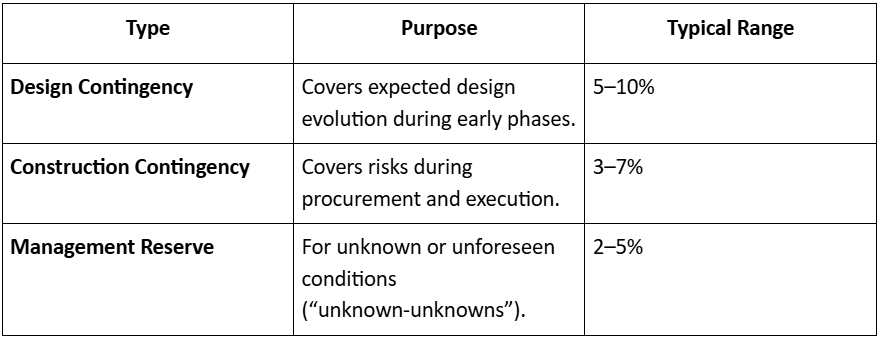
Contingency Planning

3. Risk Quantification Methods

  • Percentage Method: Add a fixed % of the base cost (simple but less scientific).
  • Expected Value Method: Expected Risk Cost = Probability × Impact
  • Monte Carlo Simulation: Runs multiple probabilistic simulations to define best and worst-case outcomes.

4. Sensitivity Analysis

Test how changes in key assumptions (e.g., material rate, productivity) affect total cost.

This identifies high-impact variables that require close monitoring.

Golden Rule:

Contingency ≠ Cushion

It’s a planned reserve for specific, measurable risks.
Developing the Project Budget

A project budget is the financial blueprint that defines how much the project will cost, where funds will be spent, and how performance will be measured.

It converts the cost estimate into a time-phased and accountable financial plan.

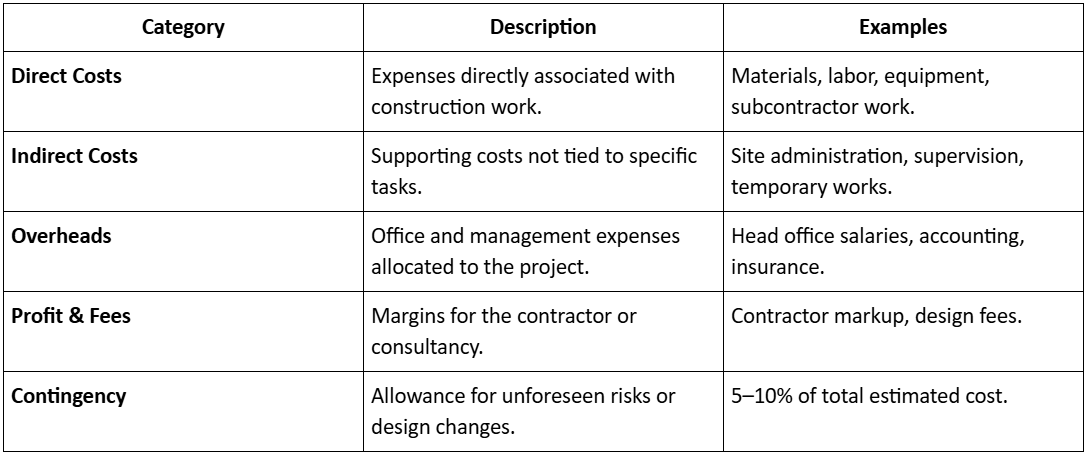
Key Components of a Construction Budget

Developing the Project Budget

Steps in Budget Development

  • Define Scope Clearly – base the budget on the approved WBS.
  • Convert Estimates into Budget Categories – organized by cost codes or divisions.
  • Integrate Cash Flow Forecasts – determine expenditure by month or quarter.
  • Include Contingencies and Escalations – account for inflation, labor/material changes.
  • Get Approvals and Baseline – lock the budget before procurement and execution.

Deliverables

  • Project Budget Report
  • Cash Flow Chart
  • Budget Approval Sheet
A good budget is not about precision; it’s about preparedness.

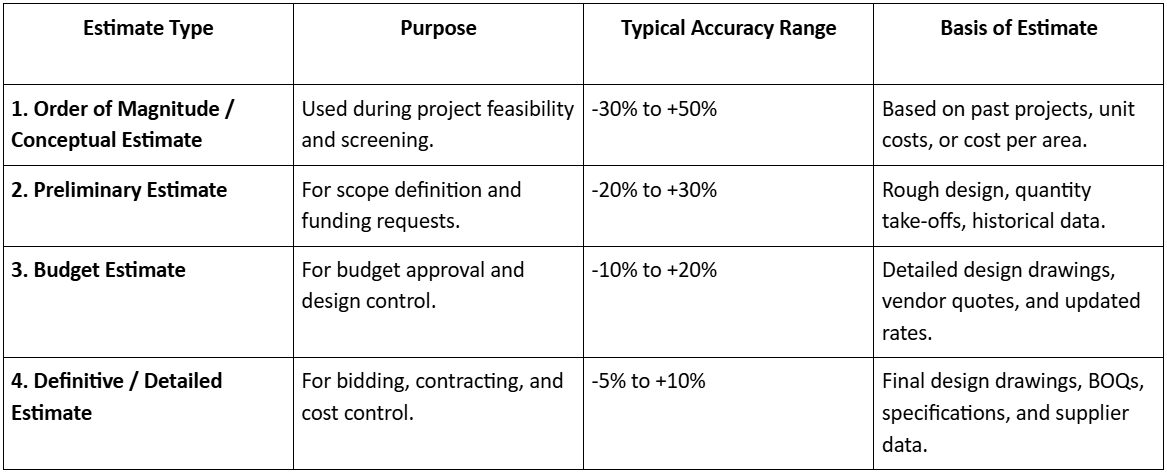
Types of Construction Estimates (Conceptual to Definitive)

Cost estimating evolves through various levels of detail as the project matures — from broad conceptual figures to precise contract bids.

Types of Construction Estimates

Examples

  • Conceptual Estimate: ₹1,200 per sq. ft. for a school building.
  • Preliminary Estimate: ₹2.5 Cr. based on schematic design and material assumptions.
  • Definitive Estimate: ₹2.35 Cr. after complete BOQ and vendor quotations.

As the project design matures, the accuracy increases and the uncertainty decreases.

Economic Feasibility & Time Value of Money

Construction projects involve long-term investments, where the timing of cash inflows and outflows affects profitability.

This is why understanding the Time Value of Money (TVM) is essential.

1. Basic Concept

A rupee today is worth more than a rupee tomorrow because of its potential earning capacity.

Hence, costs and revenues must be analyzed in present-value terms.

2. Core Financial Tools

Method – Formula – Used For

Present Value (PV)

PV = F / (1 + i)ⁿ

Used For: Calculating today’s value of future cash.

Future Value (FV)

FV = P (1 + i)ⁿ

Used For: Estimating the future worth of current funds.

Net Present Value (NPV)

NPV = Σ (Rt - Ct) / (1 + i)ᵗ

Used For: Evaluating the profitability of an investment.

Internal Rate of Return (IRR)

Discount rate where NPV = 0

Used For: Comparing investment alternatives.

Benefit–Cost Ratio (B/C)

Present Value of Benefits / Present Value of Costs

Used For: Decision-making for project approval.

Example

A ₹10 Cr. investment yields ₹2.5 Cr. per year for 5 years.

At a discount rate of 10%,

NPV = 2.5 × ((1 – (1.1)⁻⁵) / 0.1) – 10 = ₹1.9 Cr.

Since NPV > 0, the project is financially viable.

4. Economic Feasibility Factors

  • Interest rates and inflation
  • Project life cycle and maintenance cost
  • Market demand and revenue potential
  • Loan repayment schedule

Key Takeaway:

Project budgeting is incomplete without analyzing financial returns over time.

Linking Scope, Schedule, and Cost

Scope, schedule, and cost are the three pillars of project control — tightly linked through the Work Breakdown Structure (WBS).

1. The Scope–Cost–Schedule Relationship

  • Scope defines what work must be done.
  • The schedule defines when it will be done.
  • Cost defines how much it will take.

If one element changes, the others must be adjusted.

For example:

  • Expanding scope (adding a new floor) → increases both cost and schedule.
  • Accelerating schedule (faster delivery) → increases cost due to overtime or additional crews.

2. Work Breakdown Structure (WBS) Integration

The WBS links activities to budget line items.

Each work package includes:

  • Defined scope of work
  • Assigned resources (labor, material, equipment)
  • Estimated cost and duration

3. Time-Phased Budgets

A time-phased budget (or cost-loaded schedule) distributes total cost along the project timeline.

This helps managers:

  • Monitor actual vs. planned spending
  • Identify early cost overruns
  • Forecast monthly cash requirements

4. Earned Value Integration

Earned Value Management (EVM) links:

  • Planned Value (PV) – Budgeted cost of scheduled work.
  • Earned Value (EV) – Budgeted cost of completed work.
  • Actual Cost (AC) – Real cost incurred.

By tracking these, the project manager can measure:

  • Cost Performance Index (CPI) = EV / AC
  • Schedule Performance Index (SPI) = EV / PV
Cost control is not about spending less — it’s about knowing when and why you’re spending.

Team Alignment and Estimate Validation

Cost estimation is not just about numbers — it’s a collaborative process requiring alignment across engineering, procurement, and management teams.

1. Importance of Team Alignment

  • Ensures all stakeholders agree on the basis and assumptions of the estimate.
  • Reduces disputes later when budgets are locked.
  • Links technical scope with financial feasibility.
  • Builds confidence for management approvals or funding.

2. Estimate Validation Process

  • Internal Review: Cross-verification by project controls or estimation team.
  • Management Review: Validation by senior management or client-side PM.
  • Peer Benchmarking: Compare with similar past projects or industry databases.
  • Reconciliation: Resolve variances between design, procurement, and finance.
  • Sign-Off: Formal approval and baseline creation.

3. Common Validation Tools

  • Estimate Basis Document (EBD): Explains data sources, exclusions, and assumptions.
  • Estimate Review Checklist: Used to confirm accuracy and completeness.
  • Cost Benchmark Library: Maintains historical project cost data for reference.
A validated estimate is not the lowest — it’s the most defensible.

Module Summary

  • Early estimates shape project feasibility and decision-making.
  • Estimation evolves from conceptual to definitive stages as design matures.
  • The estimating process uses systematic data collection, WBS, and capacity models.
  • Risk and contingency must be quantified — not guessed.
  • Alignment and validation ensure credibility, transparency, and accountability.

Category: Construction Academy

Subcategory: Budgeting and Planning

Subcategory: Construction Phase

Subcategory: Design Coordination

Subcategory: Estimation Techniques

Subcategory: Initiation and Feasibility

Subcategory: Introduction

Subcategory: Personal Management

Subcategory: Project Close-Out

Subcategory: Project Scheduling

Subcategory: Project Teams

Subcategory: Proposal Management

Subcategory: Total Quality Management

Subcategory: Tracking and Control

Subcategory: Work Breakdown

Category: Help Desk

Subcategory: Client

Subcategory: Construction 101

Subcategory: Contractor Management

Subcategory: Expense

Subcategory: Finance Budget

Subcategory: Inventory Management

Subcategory: My Approvals

Subcategory: Site Management

Subcategory: Vendor Management