Estimating Work Process & Cost-Capacity Curves

1. The Estimating Work Process

A structured process ensures that estimates are consistent, documented, and traceable.

Steps in Cost Estimation:

  • Define Scope and Work Breakdown Structure (WBS)
    → Identify all activities, deliverables, and quantities.
  • Collect Data
    → Historical project costs, productivity rates, supplier quotations.
  • Develop Unit Costs
    → Material + Labor + Equipment + Overheads + Profit.
  • Apply Pricing Models
    → Use cost-capacity factors, ratios, or database-driven tools.
  • Review and Validate
    → Conduct internal peer reviews and management sign-offs.
  • Document and Archive
    → Record assumptions, exclusions, and risk notes for traceability.

2. Cost–Capacity Curves

Used primarily in early stages when detailed data is limited. The relationship between capacity (size) and cost is not linear but follows a power law.

Formula:

C₂ = C₁ × (Q₂/Q₁)ⁿ

Where:

  • C₁ = Cost of existing facility
  • Q₁ = Capacity of existing facility
  • C₂ = Estimated cost for new facility
  • Q₂ = New capacity
  • n = Cost-capacity exponent (typically 0.5–0.9)

Example:

If a 100 MW power plant costs ₹600 Cr, what’s the estimated cost for a 150 MW plant with n=0.6?

C₂ = 600 × (1.5)⁰·⁶ ≈ ₹760 Cr. (approx.)

Interpretation:

As capacity increases, cost rises — but not proportionally, due to economies of scale.
Importance of Early Cost Estimation

Early cost estimation is one of the most critical management functions in the initiation and planning stages of a construction project. It sets the foundation for the budget, financing strategy, design decisions, and project feasibility.

Why Early Estimates Matter

  • Provides the first financial picture of a project before design is finalized.
  • Enables go/no-go decisions by owners and investors.
  • Helps compare alternative design concepts and materials.
  • Guides budget allocation for design, procurement, and construction.
  • Detects financial risks early and allows proactive planning.

Consequences of Poor Early Estimation

  • Unrealistic budgets leading to funding shortfalls.
  • Frequent design changes and scope revisions.
  • Owner dissatisfaction and contractor disputes.
  • Cost overruns and project delays.

Key Idea:

The accuracy of an early estimate determines the credibility of the entire project plan.

Partnering and Early Collaboration Models

Modern construction emphasizes collaboration over confrontation. Early partnerships between owners, designers, and contractors help prevent disputes and delays.

1. What is Partnering?

Partnering is a structured relationship-building process among project stakeholders to promote teamwork, trust, and shared objectives.

2. Benefits of Partnering

  • Reduces adversarial relationships.
  • Promotes problem-solving instead of blame-shifting.
  • Enables early identification of risks and cost savings.
  • Enhances communication and transparency.
  • Improves overall project quality and morale.

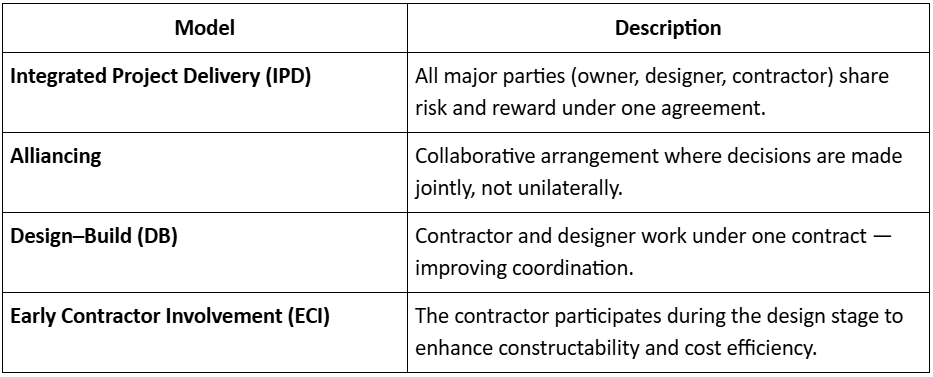
3. Partnering Models

Partnering and Early Collaboration Models

4. Principles for Effective Partnering

  • Establish joint goals and KPIs.
  • Sign a “Partnering Charter.”
  • Conduct regular joint workshops and performance reviews.
  • Foster a “no-blame” culture focused on solutions.
The best projects are not won through bids — they’re won through collaboration.

Module Summary

  • The project lifecycle sets the foundation for structured delivery.
  • Feasibility studies ensure projects are viable before investment.
  • A clearly defined scope and objectives prevent rework and confusion.
  • Value engineering aligns cost with performance.
  • Choosing the right contract model defines risk and efficiency.

Early collaboration among stakeholders builds trust and project success.

Contractual Arrangements (Public vs. Private Projects)

The type of contractual setup significantly impacts project delivery, risk allocation, and control.

1. Public Projects

  • Funded by government agencies, municipalities, or PSUs.
  • Governed by strict procurement laws (e.g., GFR, CVC, GeM).
  • Focused on transparency, accountability, and social benefit.
  • Bids are typically L1-based (lowest bidder).
  • Involves longer approval cycles and audit controls.

Common Forms:

  • Design–Bid–Build (DBB)
  • EPC (Engineering, Procurement & Construction)
  • PPP (Public–Private Partnership) models

2. Private Projects

  • Funded by individuals, corporations, or institutions.
  • Offer more flexibility in design and procurement.
  • Decision-making is faster; quality and speed are key drivers.
  • Contractors are often selected based on quality, capability, and relationships.

Common Forms:

  • Design–Build (Turnkey)
  • Construction Management (CM) at Risk
  • Cost-Plus or Guaranteed Maximum Price (GMP) models

Key Difference:

Public projects focus on compliance and fairness,

while private projects focus on efficiency and profitability.

Stakeholder Needs and Value Engineering

Construction projects succeed when they fulfill stakeholder expectations efficiently and economically.

1. Stakeholder Identification

Stakeholders include:

  • Owner / Client
  • Architects & Engineers
  • Contractors & Subcontractors
  • End-Users (operators, community, government)
  • Regulatory bodies and funding agencies

Each has different priorities — cost, quality, schedule, compliance, or safety.

A project manager’s task is to balance these needs through communication and negotiation.

2. Stakeholder Analysis

  • Identify influence and interest levels.
  • Develop engagement strategies: inform, consult, collaborate, or manage closely.
  • Maintain transparency to build trust throughout the project lifecycle.

3. Value Engineering (VE)

A systematic process to improve value = function/cost.

VE aims to achieve the same or better function at a lower cost without compromising quality.

Examples of VE Applications:

  • Using precast concrete instead of cast-in-situ to reduce labor and time.
  • Substituting locally available materials with equivalent performance.
  • Re-engineering mechanical systems for lower energy consumption.

Steps in Value Engineering:

  1. Information Phase – Collect data and define functions.
  2. Analysis Phase – Identify high-cost/low-value areas.
  3. Creativity Phase – Brainstorm alternative solutions.
  4. Evaluation Phase – Compare life-cycle cost and benefits.
  5. Implementation Phase – Integrate approved alternatives into design.
Value Engineering is not cost-cutting; it’s intelligent optimization.

Defining Project Scope and Objectives

Once feasibility is confirmed, the next step is to define exactly what will be built and what success looks like.

1. Project Scope Definition

  • Specifies what work is included and what is excluded.
  • Defines deliverables, standards, materials, systems, and performance requirements.
  • Creates a Scope Statement linked to the Work Breakdown Structure (WBS).

Example:

Construct a 20,000 sq. ft. three-story academic block including classrooms, labs, and administrative areas, with a 9-month completion schedule and ₹10 Cr. budget.

2. Project Objectives

Objectives should follow the SMART principle:

Specific, Measurable, Achievable, Realistic, and Time-bound.

Examples of Project Objectives:

  • Complete Phase I by Q4 within the approved ₹8 Cr. budget.
  • Achieve a 5-star GRIHA energy rating.
  • Maintain less than 2% deviation in cost and schedule.

3. Scope Change Control

To prevent “scope creep,” establish a formal process for modifying project scope, including documentation, approval, and a cost-time impact analysis.

Tip:

A project fails not from poor execution, but from an undefined scope.

Category: Construction Academy

Subcategory: Budgeting and Planning

Subcategory: Construction Phase

Subcategory: Design Coordination

Subcategory: Estimation Techniques

Subcategory: Initiation and Feasibility

Subcategory: Introduction

Subcategory: Personal Management

Subcategory: Project Close-Out

Subcategory: Project Scheduling

Subcategory: Project Teams

Subcategory: Proposal Management

Subcategory: Total Quality Management

Subcategory: Tracking and Control

Subcategory: Work Breakdown

Category: Help Desk

Subcategory: Client

Subcategory: Construction 101

Subcategory: Contractor Management

Subcategory: Expense

Subcategory: Finance Budget

Subcategory: Inventory Management

Subcategory: My Approvals

Subcategory: Site Management

Subcategory: Vendor Management