Feasibility and Conceptual Studies

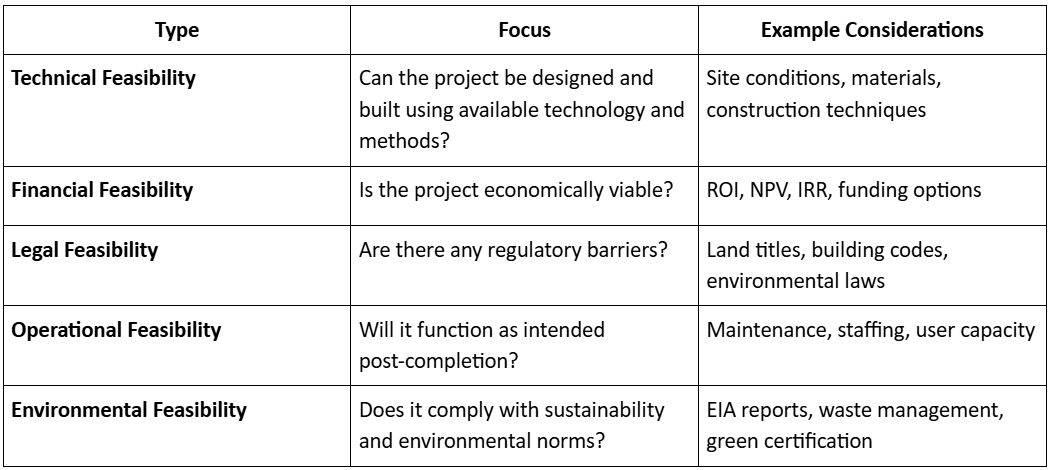
Before breaking ground, every project idea must pass through feasibility evaluation — assessing whether it should be built at all, and under what conditions.

Types of Feasibility Studies

Feasibility and Conceptual Studies

Conceptual Design Stage

  • Converts project ideas into concept sketches, rough layouts, and preliminary cost estimates.
  • Involves early stakeholder workshops and basic risk assessments.
  • Determines whether the project should proceed to detailed design.

Deliverable: Feasibility Report / Business Case Document summarizing project rationale, benefits, costs, risks, and recommendations.

Project Lifecycle & Phases

A construction project evolves through a structured lifecycle, typically divided into five core phases. Understanding these phases helps managers apply the right methods at the right time.

1. Initiation/Feasibility Phase

  • Identifying the project need or opportunity
  • Conducting feasibility, risk, and financial studies
  • Approving the project charter and initial scope

2. Planning/Design Phase

  • Defining scope, deliverables, and milestones
  • Preparing budgets, schedules, and resource plans
  • Developing conceptual, preliminary, and detailed designs

3. Execution / Construction Phase

  • Procuring resources, materials, and contractors
  • Performing construction and site management
  • Monitoring safety, quality, and progress

4. Monitoring and Control Phase

  • Measuring performance using cost and schedule metrics
  • Managing change orders and scope adjustments
  • Ensuring compliance and stakeholder satisfaction

5. Closure/Handover Phase

  • Conducting inspections, commissioning, and documentation
  • Handing over as-built drawings and warranties
  • Post-project review and lessons learned

Key Insight:

Over 70% of a project’s success is determined during the initiation and planning phases, not during construction.

Team Leadership and Consensus Building

A great construction project leader combines technical expertise with emotional intelligence.

Leadership is less about authority and more about influence, respect, and clarity.

Principles of Effective Team Leadership

  • Lead by example — demonstrate professionalism and punctuality.
  • Listen actively and empathize with team concerns.
  • Delegate tasks with trust, not control.
  • Encourage problem-solving instead of fault-finding.
  • Provide clarity in goals and consistency in direction.

Consensus Building Techniques

  • Involve key team members in decision-making.
  • Encourage brainstorming before finalizing critical choices.
  • Summarize agreed points and document them to avoid confusion.
  • Foster ownership — when people help decide, they help deliver.

Golden Rule:

People support what they help create.

Module Summary

  • Construction projects require teamwork across multiple organizations.
  • Each team has unique roles, challenges, and expectations.
  • Clear communication, trust, and shared accountability form the foundation of effective collaboration.
  • Leadership is about influence and clarity, not control.
  • Consensus and motivation drive alignment toward shared project outcomes.

Motivation, Communication & Conflict Management

Motivating the Team

Motivation in project teams is often challenged by tight deadlines, field pressure, and shifting goals. The project manager’s role is to create purpose and ownership.

Techniques for Motivation:

  • Recognize good performance publicly.
  • Celebrate small wins — e.g., achieving milestone completions.
  • Provide growth opportunities and on-site learning.
  • Address concerns promptly; avoid “blame culture.”
  • Align individual incentives with project success.

Effective Communication

Communication breakdowns cause most project failures. A good communication system ensures the right information reaches the right person at the right time.

Essentials:

  • Hold structured weekly coordination meetings.
  • Maintain clear and updated project documentation.
  • Use visual tools (dashboards, Gantt charts, reports).
  • Encourage feedback and two-way dialogue.

Conflict Management

Conflicts in construction teams arise from differences in priorities, interpretations, or responsibilities.

They must be managed, not avoided.

Approaches:

  • Identify Early: Detect conflicts through frequent communication.
  • Clarify Issues: Focus on facts, not personalities.
  • Collaborate: Find win–win solutions that align with project goals.
  • Escalate Professionally: If unresolved, use contractual or management escalation paths.
Conflict is not the problem — poor communication is.

Design Teams vs. Construction Teams

While both teams share the same end goal, their working styles, timelines, and motivations differ greatly. Understanding these differences helps avoid misalignment and friction.

Design Team Characteristics

  • Operates during the conceptual and planning phases.
  • Focused on accuracy, compliance, and innovation.
  • Delivers drawings, specifications, and cost estimates.
  • Works primarily in office or design studio settings.
  • Communication is formal and document-driven.

Construction Team Characteristics

  • Operates during the execution phase.
  • Focused on productivity, safety, and timely delivery.
  • Delivers physical work — structures, systems, and finishes.
  • Works in the field; decisions are time-sensitive.
  • Communication is dynamic and situational.

Bridging the Gap

  • Conduct Design–Build coordination meetings regularly.
  • Encourage early involvement of construction managers in design (constructability reviews).
  • Use shared digital models (BIM) to minimize design–site conflicts.
  • Promote “Design Intent + Field Reality” workshops.

Lesson: The smoother the transition between design and construction teams, the fewer the disputes, rework, and delays.

Building and Managing Multidisciplinary Teams

Construction is inherently multidisciplinary — combining architecture, engineering, finance, safety, and management. The project manager’s challenge is to integrate all these skill sets into one cohesive unit.

Steps to Build an Effective Team

  • Define the Mission Clearly: Start every project with a shared understanding of scope, priorities, and success criteria.
  • Select Members by Expertise and Attitude: Technical knowledge is essential, but willingness to collaborate is equally vital.
  • Assign Roles and Responsibilities: Clarify “Who does what?” using a Responsibility Matrix (RACI).
  • Set Communication Protocols: Decide how updates, meetings, and reporting will flow — daily logs, progress meetings, etc.
  • Establish Trust Early: Encourage transparency; acknowledge contributions and mistakes openly.

Tools for Managing Multidisciplinary Teams

  • Organizational Charts – clarify authority and reporting relationships.
  • Work Breakdown Structures (WBS) – connect roles to work packages.
  • Kickoff Meetings – align all stakeholders before execution.
  • Project Collaboration Tools – e.g., Orangescrum, MS Teams, or BIM 360 for task and document coordination.
A successful project manager doesn’t manage people — they manage interactions between people.

Category: Construction Academy

Subcategory: Budgeting and Planning

Subcategory: Construction Phase

Subcategory: Design Coordination

Subcategory: Estimation Techniques

Subcategory: Initiation and Feasibility

Subcategory: Introduction

Subcategory: Personal Management

Subcategory: Project Close-Out

Subcategory: Project Scheduling

Subcategory: Project Teams

Subcategory: Proposal Management

Subcategory: Total Quality Management

Subcategory: Tracking and Control

Subcategory: Work Breakdown

Category: Help Desk

Subcategory: Client

Subcategory: Construction 101

Subcategory: Contractor Management

Subcategory: Expense

Subcategory: Finance Budget

Subcategory: Inventory Management

Subcategory: My Approvals

Subcategory: Site Management

Subcategory: Vendor Management