Understanding Team Roles in Construction Projects

Construction projects are built by teams, not individuals. Each team member brings unique expertise, but success depends on how effectively these individuals coordinate toward a common goal.

In a typical project, multiple teams exist simultaneously — each with specific responsibilities yet deeply interconnected.

Key Teams and Their Core Roles
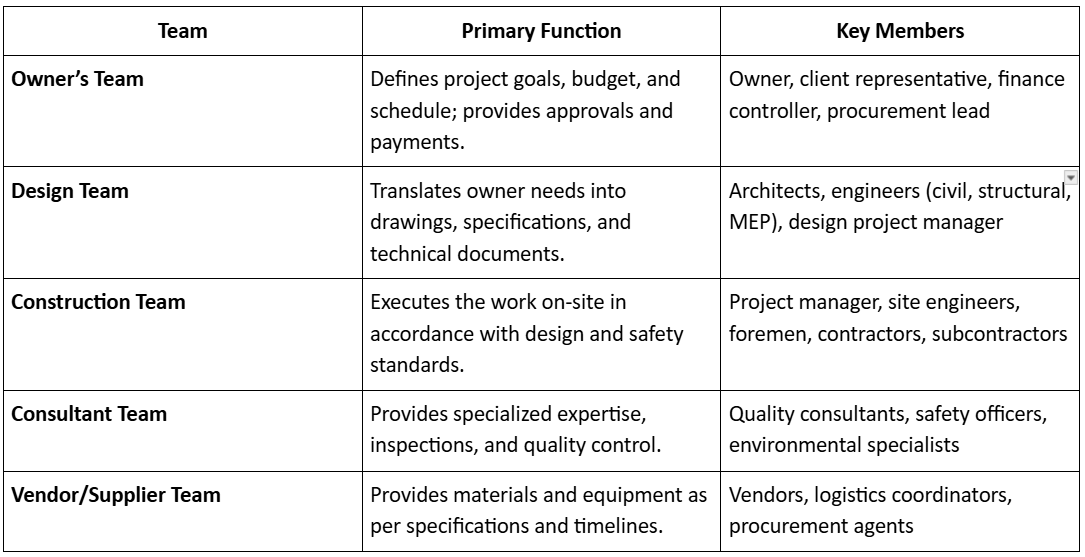
Understanding Team Roles in Construction Projects

Key Idea:

A project’s efficiency depends on how well these teams communicate, coordinate, and collaborate — rather than operate in silos.

Key Takeaways

  • A construction project is a temporary, goal-oriented endeavor involving multidisciplinary collaboration.
  • Scope, Cost, Time, and Quality form the foundation of project control.
  • Project management is a balance of technical execution and human leadership.
  • Communication, teamwork, and documentation are as crucial as design and construction.
  • Early application of management principles significantly influences project success.

Quality as an Integral Project Element

In construction, quality is not an afterthought—it’s embedded into every decision, from concept to commissioning.

True quality means fitness for purpose, compliance with specifications, and owner satisfaction.

A high-quality project is one that:

  • Performs as intended
  • Is delivered within agreed parameters
  • Complies with safety and environmental norms
  • Minimizes rework and defects
“If it doesn’t work, it’s worthless—no matter how fast or cheap it was built.”
— Garold D. Oberlender

Professional and Regulatory Frameworks

Modern project management practices are guided by recognized global standards and associations, such as:

  • PMI (Project Management Institute) – Publisher of the PMBOK Guide and certifying body for PMP® credentials.
  • CMAA (Construction Management Association of America) – Defines standards and certification for construction management.
  • ASCE (American Society of Civil Engineers) – Promotes construction management principles for civil engineers.
  • CII (Construction Industry Institute) – Develops research-based best practices in engineering and construction.

Familiarity with these frameworks helps construction professionals benchmark their practices to international standards.

The Role of the Construction Project Manager

The Project Manager (PM) is the central figure who integrates all project activities and ensures successful delivery.

A PM must balance technical competence with leadership and communication skills.

Key responsibilities include:

  • Establishing project goals and success criteria
  • Preparing and managing budgets and schedules
  • Coordinating design, procurement, and construction activities
  • Managing contracts, risks, and claims
  • Reporting progress and maintaining stakeholder relationships
  • Ensuring quality, safety, and compliance

A great project manager is both a strategist and a coach — guiding teams through challenges while maintaining alignment with project objectives.

Core Functions of Construction Project Management

Project management can be summarized into five key functions, applicable at every stage:

  • Planning – Defining project objectives, strategies, milestones, and work breakdown structures (WBS).
  • Organizing – Allocating resources, establishing project hierarchies, and assigning responsibilities.
  • Staffing – Selecting and training skilled professionals to perform specialized roles.
  • Directing – Leading teams, motivating personnel, and facilitating decision-making.
  • Controlling – Monitoring scope, cost, and time; identifying variances; and applying corrective measures.

These five functions form the managerial backbone of construction project execution — ensuring that every activity is aligned with the overall project vision.

Category: Construction Academy

Subcategory: Budgeting and Planning

Subcategory: Construction Phase

Subcategory: Design Coordination

Subcategory: Estimation Techniques

Subcategory: Initiation and Feasibility

Subcategory: Introduction

Subcategory: Personal Management

Subcategory: Project Close-Out

Subcategory: Project Scheduling

Subcategory: Project Teams

Subcategory: Proposal Management

Subcategory: Total Quality Management

Subcategory: Tracking and Control

Subcategory: Work Breakdown

Category: Help Desk

Subcategory: Client

Subcategory: Construction 101

Subcategory: Contractor Management

Subcategory: Expense

Subcategory: Finance Budget

Subcategory: Inventory Management

Subcategory: My Approvals

Subcategory: Site Management

Subcategory: Vendor Management