Conducting Meetings and Writing Reports

Meetings and reports are the backbone of project coordination, but they must be purposeful and result-driven.

1. Conducting Effective Meetings
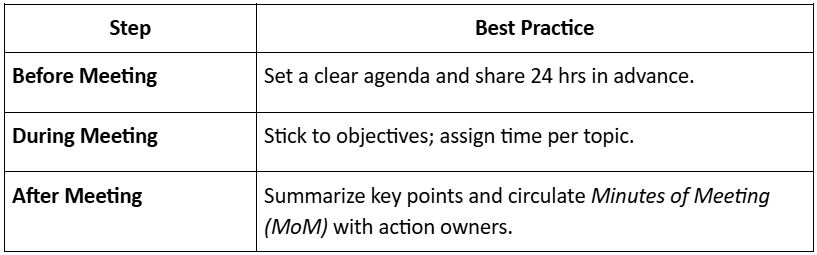
Conducting Effective Meetings

Golden Rule:

“No meeting without a decision or action plan.”

2. Report Writing Essentials
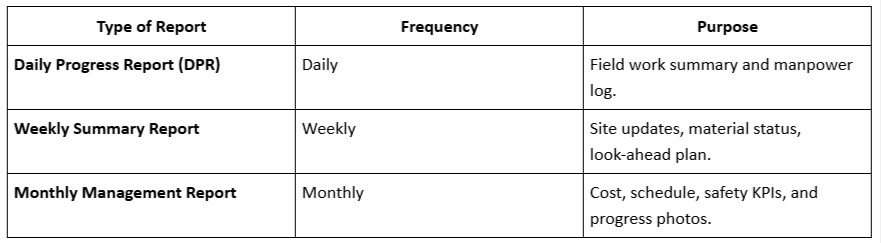
Report Writing Essentials

Report Writing Tips:

  • Use headings, tables, and visuals.
  • Be factual, concise, and solution-oriented.
  • Include summary and recommendations.
“A well-run meeting saves hours of confusion; a clear report saves weeks of rework.”
Effective Communication and Presentations

Communication drives coordination and success in multidisciplinary projects.

A project manager’s effectiveness is 80% dependent on communication skills.

1. Communication Essentials

  • Verbal: Meetings, instructions, presentations.
  • Written: Emails, reports, RFIs, memos.
  • Non-verbal: Body language, tone, eye contact.
  • Visual: Drawings, dashboards, charts.

2. 7C’s of Effective Communication

Clear, Concise, Correct, Complete, Concrete, Courteous, Considerate

3. Presentation Techniques

  • Structure: Introduction → Problem → Solution → Benefits → Call to Action.
  • Use visuals: site photos, charts, infographics.
  • Speak with confidence and empathy.
  • Practice storytelling — link data to people and impact.

4. Communication Pitfalls to Avoid

  • Overloading meetings with technical jargon.
  • Ignoring tone in emails or messages.
  • Poor listening or interrupting others.
  • Failing to confirm understanding or actions.
“Communication isn’t what you say — it’s what the other person understands.”

Human Behavior and Motivation

Understanding human behavior helps project leaders build trust, teamwork, and productivity.

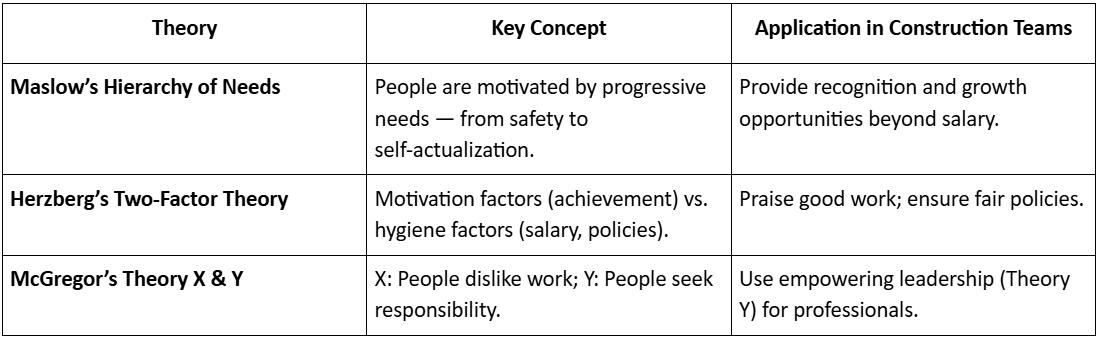
1. The Psychology of Motivation

Human Behavior and Motivation

2. Motivation Strategies for Project Teams

  • Set clear, achievable goals.
  • Recognize and reward effort and innovation.
  • Encourage ownership and autonomy.
  • Provide continuous feedback and development opportunities.
  • Celebrate milestones and team wins.
“People don’t work for companies — they work for leaders who value them.”

Time Management & Decision-Making

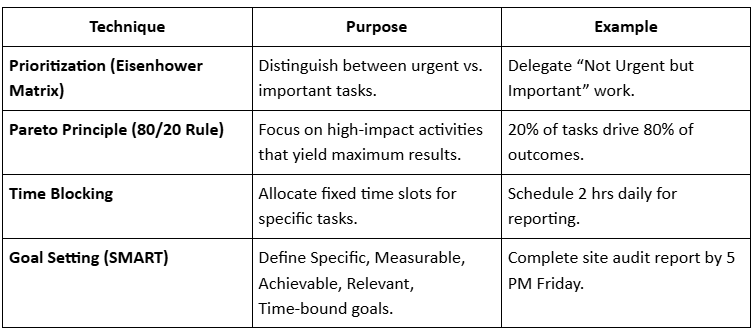
Time is the most critical yet limited resource for any project professional. Effective time management ensures productivity, focus, and goal achievement under tight deadlines.

1. Principles of Time Management

Time Management

“You can’t manage time, but you can manage priorities.”

2. Decision-Making in Project Environments

  • Rational Decision-Making Model: Define → Analyze → Evaluate → Decide → Act.
  • Intuitive Decision-Making: Based on experience and quick judgment (useful in emergencies).
  • Collaborative Decisions: Engage stakeholders for shared ownership.

Common Decision Barriers:

  • Information overload
  • Fear of failure
  • Groupthink or hierarchy pressure
  • Lack of accountability

Tools: Decision matrix, risk–benefit chart, sensitivity analysis.

“Good decisions are not always fast — but fast decisions must always be good.”

Owner Feedback & Facility Handover

The handover process marks the formal transfer of ownership, operation, and responsibility to the client.

1. Handover Steps

  • Pre-Handover Meeting – Final review of punch lists and documentation.
  • Demonstration & Training – Educate the owner’s staff on equipment operation and maintenance.
  • Formal Handover – Submission of keys, manuals, certificates, and warranty files.
  • Acceptance Sign-Off – Owner verifies readiness and issues final acceptance.
  • Defect Liability Period (DLP) – Contractor remains responsible for rectifying defects within the warranty duration.

2. Owner Feedback Process

  • Conduct structured handover surveys for satisfaction rating.
  • Record feedback on quality, responsiveness, and documentation.
  • Use findings to refine project management and client engagement practices.

3. Facility Transition

  • Develop a Facility Operations Manual (FOM) for the owner.
  • Ensure handover aligns with the FM team’s readiness and asset tagging.
  • Support the client for initial maintenance and troubleshooting.
“A smooth handover is not the end of construction — it’s the beginning of client trust.”

Module Summary

  • Testing and commissioning validate functionality and compliance.
  • Warranties and documentation secure performance assurance.
  • As-built drawings and records preserve project history.
  • Post-project evaluation drives continuous improvement.
  • Owner feedback and structured handover ensure client satisfaction and closure.

Post-Project Evaluation & Lessons Learned

A successful project is not just one that ends, but one that teaches.

Post-project evaluation (PPE) helps assess how the project performed against its objectives and how future performance can improve.

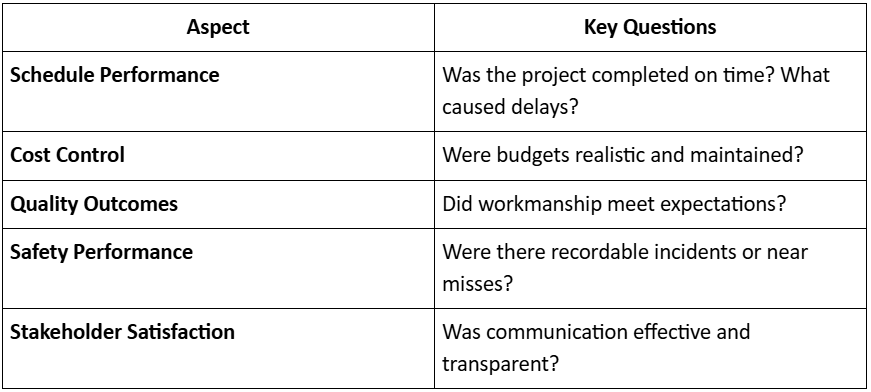
1. Evaluation Parameters

2. Post-Project Review Process

  • Conduct internal close-out meetings with the project team.
  • Collect data from project dashboards, reports, and audits.
  • Document key successes and bottlenecks.
  • Identify corrective actions for future projects.
  • Share findings organization-wide through a Lessons Learned Report.

3. Continuous Improvement

  • Maintain a Knowledge Repository of project insights.
  • Update standard procedures and templates.
  • Conduct training sessions to transfer learning to new teams.
“Projects end; learning continues.”

Category: Construction Academy

Subcategory: Budgeting and Planning

Subcategory: Construction Phase

Subcategory: Design Coordination

Subcategory: Estimation Techniques

Subcategory: Initiation and Feasibility

Subcategory: Introduction

Subcategory: Personal Management

Subcategory: Project Close-Out

Subcategory: Project Scheduling

Subcategory: Project Teams

Subcategory: Proposal Management

Subcategory: Total Quality Management

Subcategory: Tracking and Control

Subcategory: Work Breakdown

Category: Help Desk

Subcategory: Client

Subcategory: Construction 101

Subcategory: Contractor Management

Subcategory: Expense

Subcategory: Finance Budget

Subcategory: Inventory Management

Subcategory: My Approvals

Subcategory: Site Management

Subcategory: Vendor Management