As-Built Drawings and Record Management

As-built drawings are the definitive records of what was actually constructed — capturing all field modifications and deviations from design.

1. Purpose

  • Reflect real installation details and site conditions.
  • Aid maintenance, renovation, and future expansion.
  • Serve as a legal and technical reference for the owner.

2. As-Built Preparation Process

  • Record all changes from construction drawings during execution.
  • Mark revisions on drawings (dimensions, routing, material substitutions).
  • Validate by an engineer or consultant.
  • Digitize and compile into the final drawing set.
  • Submit for owner and authority approval.

3. Record Management

  • Maintain drawing logs with version and approval history.
  • Archive inspection reports, test results, and QA records.
  • Prepare a Project Record Book containing:
    • Contract documents
    • RFIs, NCRs, and MoMs
    • Safety and environmental compliance
    • Certificates and warranties
“As-built drawings are the memory of the project — preserve them meticulously.”
Warranties, Guarantees & Documentation

At project completion, the contractor must provide legal and technical assurances to ensure sustained performance after handover.

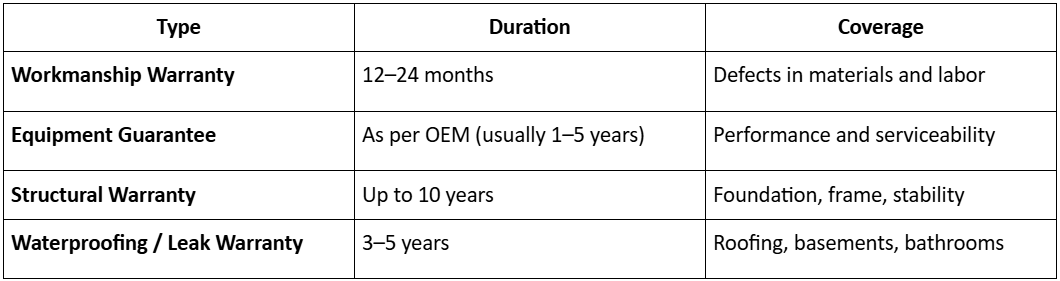
1. Warranties & Guarantees

Warranties & Guarantees

2. Key Close-Out Documents

  • Completion & Occupancy Certificates
  • Test Reports and Calibration Certificates
  • Operation & Maintenance (O&M) Manuals
  • Warranty and Guarantee Register
  • Asset Register and Handover Checklist
  • Final BOQ and Reconciliation Statement

3. Document Control Practices

  • Maintain all records in digital format (PDF/DWG/O&M).
  • Tag documents by WBS or system (e.g., HVAC-001, EL-002).
  • Store in project document management systems (DMS) like Orangescrum Docs, BIM 360, or Aconex.
  • Verify completeness through a Close-Out Documentation Matrix.
“A well-documented project remains auditable, maintainable, and trustable.”

Testing, Commissioning & Final Inspection

The testing and commissioning phase ensures that every system and component functions according to design intent before handover.

1. Testing & Commissioning (T&C) Objectives

  • Verify the mechanical, electrical, and plumbing (MEP) systems performance.
  • Ensure safety, quality, and compliance with design specifications.
  • Achieve operational readiness for occupancy and use.

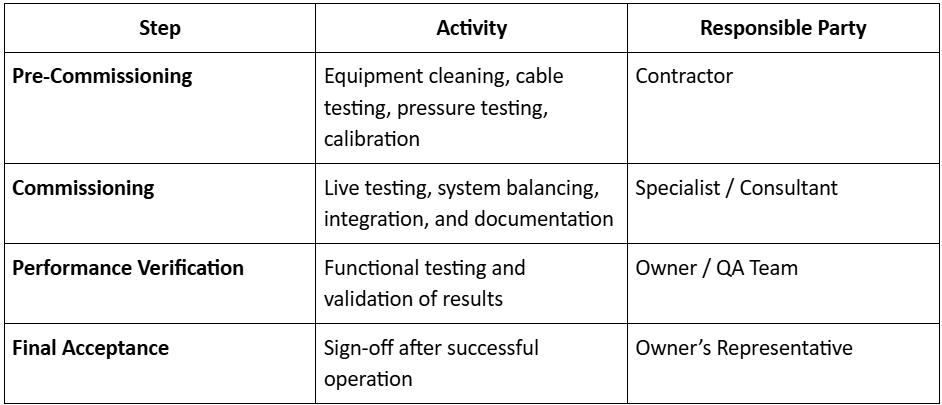
2. T&C Process

Testing & Commissioning (T&C) process

3. Final Inspection Checklist

  • Civil finishes and punch list completion.
  • Electrical, plumbing, and HVAC verification.
  • Life safety systems: fire alarms, sprinklers, access controls.
  • Site and landscape inspection.
  • Final walkthrough with owner and consultants.

Output:

  • Completion Certificate
  • Snag List & Rectification Report
  • Commissioning Report
“A project isn’t complete when it’s built — it’s complete when it performs.”

Managing Claims, Disputes & Change Orders

Even well-managed projects face deviations; the goal is to document, evaluate, and resolve them systematically.

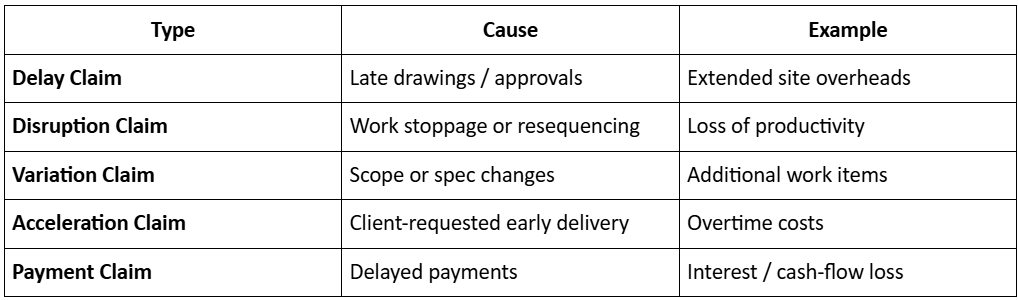
1. Common Claim Types

Managing Claims

2. Change Order Workflow

  1. Identify variation through RFI or Site Instruction.
  2. Quantify cost and time impact.
  3. Submit a formal Change Order Request (COR).
  4. Review & approval by PM / Client.
  5. Update contract value and schedule.

3. Dispute Resolution Mechanisms

  • Negotiation / Mediation: First level; informal and fast.
  • Dispute Review Board (DRB): Independent panel for large projects.
  • Arbitration: Binding resolution per contract clause.
  • Litigation: Last resort through courts.
“The best way to win a dispute is to avoid one — through clear documentation and timely communication.”

Module Summary

  • Delivery methods (DBB, DB, CM, EPC) define project structure and risk sharing.
  • Procurement and bidding require transparency and technical diligence.
  • Strong contractor communication ensures coordinated progress.
  • Scheduling and submittal control link planning with field execution.
  • Quality, safety, and resource management sustain on-site performance.

Structured claim and change-order processes protect project interests.

Quality, Safety, and Resource Control

1. Quality Management

  • Establish a Project Quality Plan (PQP) with inspection & test protocols.
  • Conduct Incoming Material Inspections and Field Quality Checks.
  • Maintain Inspection Test Records (ITRs) and Non-Conformance Reports (NCRs).
  • Perform regular Quality Audits and Mock-ups.

Key Principle: Plan → Do → Check → Act (PDCA) cycle.

2. Safety Management

  • Implement Safety Management Plan (SMP) and Job Hazard Analysis (JHA).
  • Conduct toolbox talks, induction, and safety drills.
  • Enforce PPE compliance, scaffolding checks, and permit-to-work systems.
  • Track safety KPIs — LTI Rate, Near-Misses, Audit Scores.
“Zero accidents is not a slogan — it’s a system.”

3. Resource Control

  • Use Resource Histograms to monitor manpower deployment.
  • Optimize equipment usage through preventive maintenance.
  • Track daily consumption of key materials vs. budget.
  • Use software-based dashboards for cost and productivity control.

Construction Scheduling & Submittal Management

Field execution demands constant synchronization between design updates, resource availability, and schedule commitments.

1. Construction Scheduling

  • Develop detailed activity-level schedules aligned with WBS and CPM.
  • Prepare look-ahead schedules (1–3 weeks) for field planning.
  • Track actual vs. planned progress through bar charts and dashboards.
  • Integrate subcontractor schedules into the master plan.

Tools: Primavera P6, MS Project, Orangescrum Planner, Excel Gantt charts.

2. Submittal Management

Submittals include drawings, samples, method statements, and material data that require approval before execution.

Workflow

  1. Contractor submits →
  2. Consultant reviews →
  3. Approve / Reject / Revise and Resubmit →
  4. Distribute approved versions to site teams.

Submittal Log Contents

  • Submittal ID
  • Description & Discipline
  • Date Submitted / Approved
  • Reviewer Name
  • Remarks & Revision History
“Efficient submittal control ensures what’s built matches what’s designed.”

Category: Construction Academy

Subcategory: Budgeting and Planning

Subcategory: Construction Phase

Subcategory: Design Coordination

Subcategory: Estimation Techniques

Subcategory: Initiation and Feasibility

Subcategory: Introduction

Subcategory: Personal Management

Subcategory: Project Close-Out

Subcategory: Project Scheduling

Subcategory: Project Teams

Subcategory: Proposal Management

Subcategory: Total Quality Management

Subcategory: Tracking and Control

Subcategory: Work Breakdown

Category: Help Desk

Subcategory: Client

Subcategory: Construction 101

Subcategory: Contractor Management

Subcategory: Expense

Subcategory: Finance Budget

Subcategory: Inventory Management

Subcategory: My Approvals

Subcategory: Site Management

Subcategory: Vendor Management