The construction industry is at a crossroads. Rising materials costs, labor shortages, climate pressures, and digital disruption are forcing firms to adapt — or fall behind. As we look ahead to 2026, several transformative trends are emerging that will reshape how projects are conceived, executed, and delivered.
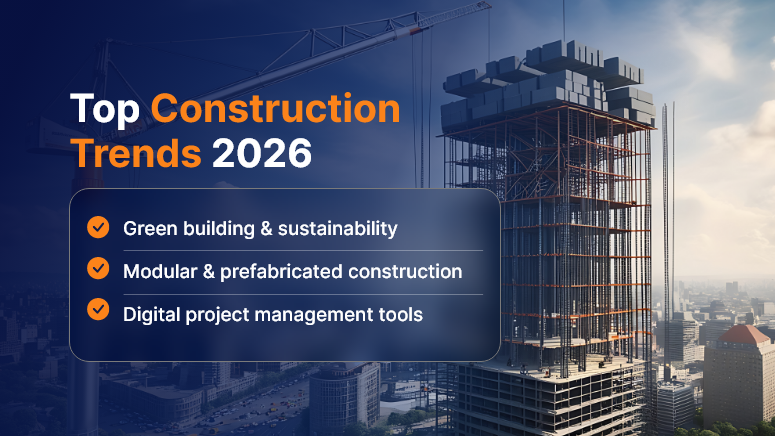
Here’s what contractors, developers, and industry leaders should keep a close eye on:
1. Modular, Prefab & Offsite Construction Become Mainstream
What was once a niche technique is rapidly becoming a standard for gains in speed, quality, and cost control. In 2026, many projects will lean heavily on modular components, volumetric units, bathroom pods, and pre-assembled MEP racks.
Why it matters:
- It reduces on-site labor needs and exposure to weather.
- Factory-controlled conditions improve quality and consistency.
- Logistics & site scheduling become critical differentiators.
What to watch for / do:
- Design for Manufacture & Assembly (DfMA) principles must be incorporated early.
- Plan logistics, staging, crane paths, and just-in-time sequencing carefully.
- Select repeatable scopes (e.g., restroom pods, corridor modules) as pilots.
2. AI & Generative Tools Becoming Ubiquitous (But Quietly)
AI is no longer buzz — it’s being embedded into estimating, scheduling, design optimizations, site monitoring, and compliance checks. In 2026, expect AI to operate in the background, offering suggestions, flagging risks, and enabling predictive insights.
Key applications:
- Generative design for layouts and structural elements.
- Predictive maintenance: sensor data alerts about potential failures.
- AI-driven project planning and scenario simulation.
What to do now:
- Clean and standardize your data (cost histories, productivity, supplier metrics).
- Pilot AI in small domains (e.g., equipment scheduling, clash detection).
- Build a framework to accept “nudges” rather than full automation overnight.
3. Robotics, Autonomy & Automation Fill the Labor Gap
With labor scarcity persisting, automation will shift from experimental to practical. Expect to see robotic bricklayers, autonomous grading machinery, 3D scanning drones, and multi-agent robotic systems co-working alongside human laborers.
Impact:
- Repetitive, high-fatigue tasks can be offloaded.
- Human roles shift toward monitoring, management, and quality assurance.
- Safety can be improved by reducing workers’ exposure to dangerous tasks
Implementation tips:
- Start with micro-tasks (rebar tying, repetitive layout, scanning).
- Assign a “robotics champion” within your team to monitor productivity metrics.
- Leverage multi-agent robotics for complex tasks (e.g., surveying using multiple drones).
4. Smart Materials, Adaptive & Living Construction
“Smart materials” will play a greater role in 2026: concrete with embedded sensors, self-healing polymers, dynamic glazing, bio-based composites, and even living building materials.
Trends to watch:
- Sensor-laced concrete to detect stress, cracks, or corrosion.
- Living building materials that self-regenerate or sequester carbon.
- Recycled, reclaimed, or low-carbon materials are becoming the default, not the premium.
Advice for contractors:
- Engage with material suppliers early to test performance.
- Capture necessary data for embodied carbon and EPD (Environmental Product Declarations).
- In bids, include performance warranties, not just specs.
5. Real-Time Safety, Health Monitoring & Motion Capture
Safety is evolving beyond checklists and helmets. In 2026, systems using wearables, motion capture (MoCap), computer vision, and real-time analytics will help prevent accidents before they occur.
How this trend manifests:
- Wearables that detect fatigue, improper posture, or dangerous zones.
- Site cameras linked to AI that flag PPE noncompliance or unsafe behavior.
- Motion capture systems to analyze worker movements and reduce musculoskeletal strain.
Getting started:
- Pilot wearable devices or sensor jackets in one high-risk zone.
- Utilize historical incident data to train motion analysis models.
- Shift KPIs from lagging (incident rate) to leading indicators you can act on (near-miss alerts).
6. Digital Twins & Lifecycle Integration
Smart construction is evolving into smart operations. The “digital twin” of a building or infrastructure will no longer be a post-handover novelty — it will be built from Day 0.
Why it matters:
- Facility management, maintenance, and performance tracking can tie into the same model.
- Real-time monitoring, energy optimization, and predictive upkeep become possible.
- Reduces risks in handover and operational phases.
Tips:
- Specify IoT and sensor systems early in design → integrate into BIM and the twin.
- Use common naming standards (Haystack, Brick, ASHRAE) for equipment point IDs.
- Offer clients ongoing performance contracts leveraging the twin you build.
7. Sustainability, Carbon Targets & Regulation Pressure
Regulatory pressure, client demands, and ESG (Environmental, Social, Governance) mandates will force greener construction. Low-carbon materials, net-zero targets, embodied carbon limits, and carbon accounting will become more common in 2026.
Key drivers:
- Developers and governments are demanding EPDs, carbon caps, or carbon offset plans.
- Incentives for green building, but penalties for noncompliance in some jurisdictions.
- Lifecycle analysis is becoming part of the bid criteria.
What contractors can do:
- Build carbon accounting into your estimating systems.
- Track embodied carbon & operational emissions per project.
- Partner with material suppliers that provide transparency and innovation.
8. Workforce Transformation: Hybrid Roles & Upskilling
The rise of tech in construction demands new skills. Skilled trades won’t disappear, but roles like “site technologist,” “robotics operator,” “data analyst,” or “digital foreman” will become common.
Trends:
- Continuous training and digital literacy will become the baseline.
- Recruiting will focus not only on trade skills, but also on adaptability and tech affinity.
- On-site workers may get handheld AR / VR tools or assistive exoskeletons.
Starting points:
- Develop internal training programs in BIM, robotics, and AI.
- Promote hybrid role ladders combining field and tech skills.
- Use VR/AR simulations to accelerate onboarding in high-risk tasks.
9. Infrastructure, Adaptive Reuse & Retrofit Boom
New construction is expensive and resource-intensive. In 2026, many markets will pivot toward retrofits, adaptive reuse, and infrastructure upgrades rather than purely greenfield builds.
Why this shift:
- Energy regulations are pushing upgrades to existing stock.
- Limited land in urban areas.
- Infrastructure stimulus from governments globally.
Opportunities:
- Specialize in retrofit technologies (insulation, envelope upgrades, facade systems).
- Combine smart sensors & building automation in upgrades.
- Use modular insertions or plug-and-play systems for retrofits.
10. Equipment & OEM Shifts: Digitalization + Lifecycle Services
Construction machinery is also transforming. OEMs are embedding telematics, predictive maintenance, autonomous features, and offering equipment as services rather than pure sales.
Implications:
- Contractors may lease “smart” equipment with usage-based contracts.
- Data from machinery feeds project analytics (productivity, idle times, fuel efficiency).
- OEMs may become long-term service partners rather than mere suppliers.
Challenges to Watch
No trend is without friction. Here are key challenges that will shape who succeeds:
- High upfront investment — Many technologies require capital; ROI needs careful forecasting.
- Interoperability & system silos — Different software, protocols, and vendors may not talk easily.
- Regulation lag — Building codes and approvals may struggle to catch up with new methods (e.g. 3D printing).
- Workforce resistance/skills gap — Older workers may resist digital change.
- Data security & privacy risks — Sensor networks and digital models carry cybersecurity exposure.
- Reliability & maintenance — Sensors, robots, networks can fail; redundancy is essential.
- Change management overhead — Organizational processes must evolve alongside tech.
How Contractors Can Prepare Now
To ride these waves rather than be overwhelmed:
- Run pilot projects: Pick one trend (e.g., modular bathroom pods, wearable safety) and test it.
- Build digital backbone: Use open standards (IFC, COBie) and APIs to ensure systems can integrate.
- Develop data culture: Collect, analyze, and feed insights back into operations.
- Invest in training: Upskill your workforce early to use, not fear, new tools.
- Partner strategically: Work with vendors, research labs, and material innovators.
- Track metrics & ROI: Measure time saved, rework avoided, safety events reduced, carbon improvements.
- Offer lifecycle services: Use the data and digital assets you build to provide value post-construction.
Conclusion
2026 will be a watershed year in construction. The trends we see now — modular building, embedded intelligence, robotics, smart materials, sustainability, digital twins, workforce shifts, and equipment digitalization — are converging to redefine what it means to build.
Contractors who embrace this transformation will gain speed, quality, differentiation, and long-term sustainability. Those who wait risk being disrupted. The next frontier in construction is not just harder or taller — it’s smarter.
FAQs
1. What is the biggest construction trend expected in 2026?
One of the biggest trends is modular and off-site construction becoming mainstream. Prefabricated and factory-built components will help projects reduce costs, accelerate timelines, and improve quality consistency.
2. How will AI impact the construction industry by 2026?
AI will be embedded into almost every phase — estimating, scheduling, site monitoring, and risk prediction. By 2026, contractors will rely on AI for real-time decision support, predictive analytics, and generative design rather than manual guesswork.
3. What role will robotics play in construction?
Robotics and autonomous machinery will fill the labor shortage gap. Expect robotic bricklayers, autonomous grading machines, surveying drones, and even robotic exoskeletons to assist workers in repetitive or dangerous tasks.
4. Are smart materials really practical in construction?
Yes. By 2026, smart materials like self-healing concrete, dynamic glass, and bio-based composites will be more accessible. These improve durability, sustainability, and efficiency while reducing lifecycle costs.
5. How will digital twins change project delivery?
Digital twins will no longer stop at construction — they’ll extend into facility operations. Contractors will hand over fully integrated twins with real-time IoT data for maintenance, energy optimization, and long-term performance monitoring.
6. Why is sustainability becoming such a big deal in construction?
Climate regulations, ESG requirements, and client expectations are making sustainability non-negotiable. In 2026, contractors will face stricter carbon caps, demand for Environmental Product Declarations (EPDs), and pressure to achieve net-zero goals.
7. How will workforce roles evolve with these trends?
Construction roles will blend traditional skills with digital literacy. New positions like digital foreman, robotics operator, or site technologist will emerge, requiring continuous upskilling and adaptability.
8. What challenges will contractors face when adopting these trends?
The main challenges include high upfront investment, interoperability issues between digital tools, workforce resistance, skills gaps, and data security concerns. Change management will be as important as the technology itself.
9. Is smart construction only for large firms?
No. Smaller contractors can start with targeted tools — like drones for site surveys, modular components for repetitive units, or wearable safety gear. Scaling can happen gradually as ROI becomes clearer.
10. How should contractors prepare for 2026 now?
Contractors should:
- Pilot emerging technologies on select projects
- Invest in training and upskilling teams
- Build a digital backbone with open standards
- Partner with vendors and innovators
- Track ROI through safety, cost, and productivity metrics