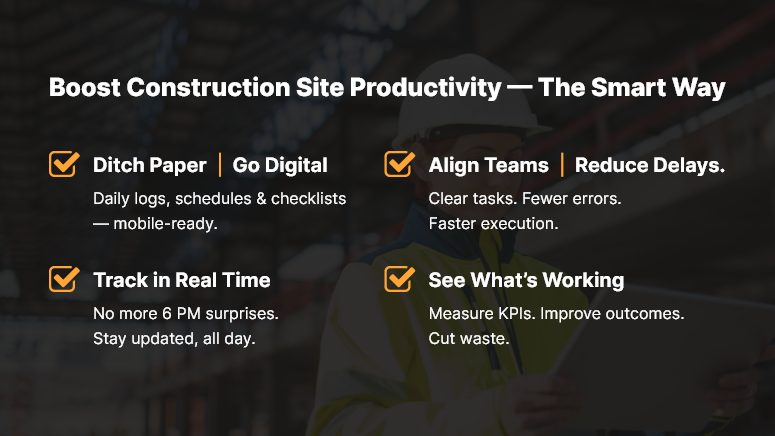
Every year, global construction projects lose over $1.6 trillion due to delays, cost overruns, and inefficient workflows. In fast-paced job sites, relying on whiteboards, WhatsApp groups, and siloed Excel sheets no longer cuts it.
The Future of Construction Scheduling: Automation & Predictive Analytics tackles these persistent challenges head-on, delivering real-time insights and proactive alerts that save time and money.
In this blog, you’ll learn how modern project managers, site engineers, and contractors can harness automation, predictive analytics, and OConstruction’s end-to-end platform to streamline planning, DPR automation, BOQ management, cost control, and site execution.
Why This Matters in Construction
Construction teams face mounting pressure to deliver projects on time and within budget. However, traditional, manual workflows create several avoidable challenges:
- Cost Overruns & Material Wastage
Inaccurate BOQs and delayed DPRs cause procurement errors. As a result, materials are over-ordered or underutilized — increasing costs by up to 15%.
- Rework & Quality Issues
Miscommunication between the field and office leads to corrective work. Rework alone can add 10–20% to project timelines and inflate labor budgets.
- Scattered Data & Delayed Decisions
Disjointed tools — logs, spreadsheets, and messaging apps — create blind spots. This leads teams to react rather than proactively prevent issues.
From real estate and commercial buildings to highways and EPC projects, these inefficiencies are universal.
A highway project, for instance, may see months of delays simply because field teams wait days for schedule updates — crippling resource coordination and cost tracking.
Modern digital workflows are no longer optional. With automation and predictive analytics, teams gain speed, accuracy, accountability — and real-time clarity.
OConstruction unifies scattered tools into one platform, replacing WhatsApp threads and manual logs with real-time field-to-office synchronization.
Best Practices, Frameworks & Actionable Steps
Implementing construction scheduling through automation and predictive analytics requires a structured approach. Below are proven workflows using OConstruction:
1. Detailed Project Planning & Scheduling
- Build Gantt charts with resource dependencies and automated alerts.
- OConstruction’s Project Planning & Schedule Tracking ensures accurate timelines.
- Stakeholders receive notifications instantly when milestones slip.
2. Robust BOQ & Estimate Management
- Standardize templates and apply version control.
- Using BOQ & Estimate Management, quantity take-offs remain accurate, and budgets stay aligned with project realities.
3. DPR Automation & Daily Logs
- Capture photos, safety reports, and progress data using your mobile device.
- With DPR Automation, reporting time reduces by up to 70%.
4. Material & Inventory Tracking
- Use barcode-enabled tracking for deliveries and consumption.
- Inventory & Purchase Handling prevents idle stock and shortages.
5. Labor & Resource Management
- Monitor attendance and productivity using geofencing.
- With Resource, Labor & Material Tracking, labor utilization stays optimized.
6. Cost Control & Budget Monitoring
- Align budgets with cost codes and update in real time.
- Cost Control & Budget Monitoring prevents end-of-month surprises.
7. Task & Workflow Management
- Centralize approvals, dependencies, and priority-based task planning.
- Nothing slips through the cracks with Task & Workflow Management.
8. Multi-Site Coordination
- Standardize templates and governance across all locations.
- OConstruction’s multi-project dashboard provides visibility for leaders.
9. Data-Driven Predictive Analytics
- Forecast risks like delays, resource conflicts, and overruns.
- OConstruction analyzes historical performance to identify early warning signals.
Common Mistakes to Avoid
- Relying on manual data entry → Use mobile data capture
- Skipping stakeholder training → Run quick, scenario-based onboarding
Construction Success Story
SkyHigh Infra adopted OConstruction’s DPR Automation & Daily Logs to eliminate reporting delays and data duplication.
Within just 8 weeks, they achieved:
- 40% faster DPR completion
- 25% reduction in rework
- 15% less material waste
Progress photos and checklists captured in the mobile app synced instantly to the central dashboard. Automated alerts flagged deviations early, preventing small issues from turning into major setbacks.
Key Takeaways
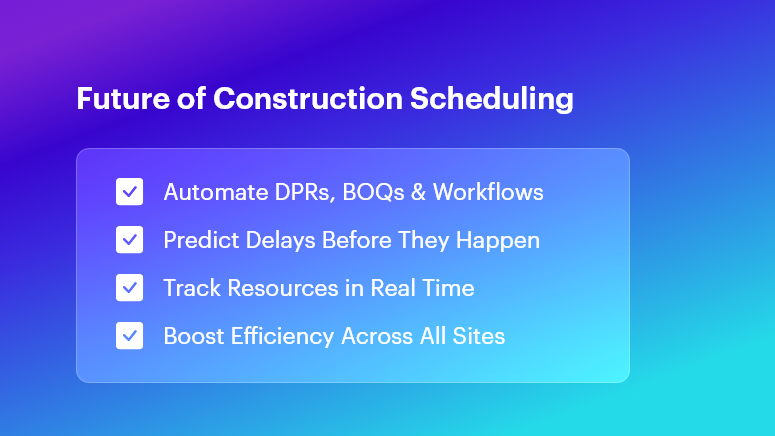
- Digitize & Automate: Replace manual logs and WhatsApp approvals with a unified platform.
- Use Predictive Analytics: Forecast risks before they become delays or overruns.
- Automate Core Workflows: DPRs, BOQs, and material tracking should be real-time and mobile-enabled.
- Gain Real-Time Visibility: Connect field teams and office teams instantly.
- Scale Confidently: Deploy consistent processes across multiple job sites.
FAQs
1. What is The Future of Construction Scheduling: Automation & Predictive Analytics?
It refers to the use of intelligent tools and data models to plan, track, and forecast project performance — reducing delays and cost overruns.
2. How does OConstruction enable automation in scheduling?
OConstruction automates resource leveling, task assignments, DPRs, and alerts — synced in real time.
3. Can predictive analytics reduce delays?
Yes — it identifies bottlenecks early and recommends corrective actions before they impact schedules.
4. Is DPR automation secure?
Absolutely — data is encrypted, role-based, and audit-logged.
5. How fast can teams adopt OConstruction?
Most teams fully transition within 2–4 weeks with quick onboarding.
6. What ROI can be expected?
Users report 15–25% material savings, 25% rework reduction, and 20–40% faster reporting cycles.
7. Can OConstruction integrate with external ERP or accounting systems?
Yes. APIs and middleware enable seamless integration.