BOQ Management in Construction Projects: From Estimation to Execution

In today’s construction industry, cost overruns account for nearly 70% of project failures, and in most cases, the root cause traces back to poor BOQ management in construction projects. Whether it is a residential tower, a highway package, or an EPC contract, even a minor mismatch between estimated quantities and actual execution can trigger budget leakage, rework, disputes, and delayed payments.

However, despite its strategic importance, BOQ management is still handled using Excel sheets, static PDFs, manual measurements, and fragmented site reports. As a result, project managers struggle with inaccurate quantities, delayed DPRs, uncontrolled material usage, and last-minute cost surprises.

This blog explains how BOQ management in construction projects must evolve—from estimation to execution. You will learn why traditional methods fail, what best practices modern construction teams follow, and how OConstruction enables real-time BOQ-driven execution, cost control, and site visibility.

This guide is written for project managers, contractors, EPC firms, QS teams, site engineers, and construction business owners who want predictability, profitability, and control across their projects.
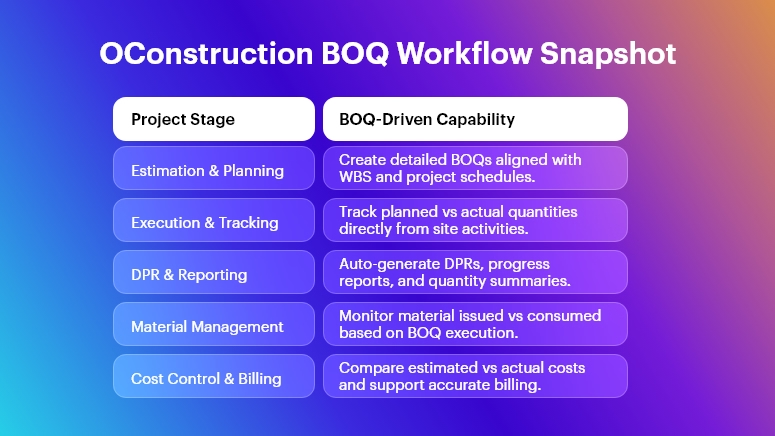
OConstruction BOQ Workflow Snapshot

Why BOQ Management in Construction Projects Matters More Than Ever

BOQ management in construction projects is not just a pre-construction activity—it is the financial backbone of the entire project lifecycle. When BOQs are disconnected from execution, organizations face cascading problems that compound over time.

  • Cost overruns become inevitable because estimated quantities are never reconciled with actual consumption, leading to uncontrolled expenses and shrinking margins.
  • Material wastage increases significantly when procurement decisions are made without real-time BOQ alignment, causing excess ordering or shortages.
  • Rework and disputes escalate due to mismatches between approved BOQs, site execution, and billing quantities.
  • Delayed DPRs and approvals slow down cash flow, especially in EPC and infrastructure projects where progress-linked billing is critical.

Real-World Construction Scenarios

Across different construction segments, BOQ mismanagement creates similar pain points:

  • Real estate projects suffer from cost overruns due to inaccurate item-wise tracking across multiple towers and phases.
  • Infrastructure and highway projects face quantity disputes during interim payment certificates because manual measurements lack traceability.
  • Residential and commercial projects struggle with coordination gaps between planning, site execution, and procurement.
  • EPC companies lose margin visibility when BOQs are managed separately from schedules, DPRs, and cost tracking systems.

Why Traditional Tools Fail on Construction Sites

Despite digital adoption elsewhere, many teams still rely on Excel sheets, WhatsApp updates, manual site registers, and isolated accounting tools. However, these methods fail because:

  • Excel-based BOQs are static, while construction sites are dynamic and change daily.
  • WhatsApp updates lack structure and auditability, making them unreliable for quantity tracking.
  • Manual logs delay reporting, leading to outdated decisions.
  • Disconnected tools break accountability, creating silos between site, planning, procurement, and finance teams.

Therefore, modern BOQ management in construction projects requires an integrated, execution-first digital workflow—and this is exactly where OConstruction delivers value.

Best Practices for BOQ Management in Construction Projects (From Estimation to Execution)

1. Create a BOQ That Is Execution-Ready, Not Just Tender-Ready

An effective BOQ must go beyond tendering and serve as a live control document throughout execution.

  • Break BOQ items down to site-operable levels, ensuring every item maps directly to work packages, tasks, and schedules.
  • Align BOQ structure with WBS, allowing quantities to flow naturally into planning and progress tracking.
  • Standardize item descriptions and units, eliminating ambiguity during site execution and billing.

With OConstruction’s BOQ & Estimate Management, BOQs are structured to integrate seamlessly with tasks, schedules, and DPRs, ensuring consistency from planning to execution.

2. Link BOQ Directly with Project Planning and Scheduling

BOQ management in construction projects fails when quantities exist separately from timelines.

  • Map BOQ items to project schedules, ensuring quantity consumption aligns with planned progress.
  • Track planned vs actual quantities, allowing early identification of slippages or overruns.
  • Use schedule-driven BOQ execution, especially for EPC and infrastructure projects with milestone-based billing.

OConstruction enables BOQ-linked planning and schedule tracking, giving project managers time–quantity–cost visibility in one dashboard.

3. Automate DPRs Using BOQ-Based Execution Data

Daily Progress Reports are the most critical link between site execution and BOQ control.

  • Capture daily quantities directly from site activities, eliminating manual data entry.
  • Auto-generate DPRs based on executed BOQ items, improving accuracy and speed.
  • Ensure DPR data feeds billing and cost reports, reducing reconciliation effort.

With DPR Automation & Daily Logs, OConstruction ensures that BOQ management in construction projects remains accurate, real-time, and auditable.

4. Control Materials Using BOQ-Driven Consumption

Material wastage is one of the biggest profit killers in construction projects.

  • Plan material requirements directly from BOQ quantities, avoiding over-ordering.
  • Track issued vs consumed materials, ensuring alignment with executed quantities.
  • Identify abnormal consumption patterns early, preventing leakage and pilferage.

OConstruction’s Inventory & Purchase Handling integrates material tracking with BOQ execution, ensuring every bag, bar, and batch is accounted for.

5. Monitor Costs in Real Time Against BOQ Budgets

Cost control becomes effective only when BOQ execution data feeds financial monitoring.

  • Track item-wise cost variance, comparing estimated vs actual costs.
  • Monitor committed, incurred, and remaining budgets, ensuring proactive decisions.
  • Enable early corrective actions, rather than post-project damage control.

Using Cost Control & Budget Monitoring, OConstruction transforms BOQ management in construction projects into a profit-protection mechanism.

6. Improve Multi-Site Coordination with Centralized BOQ Visibility

Managing BOQs across multiple sites is extremely complex without a centralized system.

  • Standardize BOQs across projects, enabling consistent execution practices.
  • Enable real-time field-to-office sync, reducing communication delays.
  • Provide leadership with portfolio-level BOQ insights, improving strategic decisions.

OConstruction delivers real-time, centralized BOQ dashboards, ensuring visibility across all construction sites.

7. Avoid Common BOQ Management Mistakes

Construction teams often repeat the same BOQ-related mistakes:

  • Treating BOQs as static documents, instead of live execution controls.
  • Delaying quantity updates, causing inaccurate cost tracking.
  • Relying on manual reconciliations, increasing errors and disputes.
  • Failing to integrate BOQs with DPRs, materials, and schedules.

By digitizing workflows end-to-end, OConstruction eliminates these risks entirely.

Construction Success Story

For example,a mid-sized EPC contractor executing highway and industrial projects, adopted OConstruction’s BOQ & DPR Automation to overcome chronic cost overruns and delayed reporting.

Before OConstruction, their teams relied on Excel BOQs and manual DPRs, leading to mismatched quantities, billing disputes, and delayed management reviews. Within three months of implementation, the transformation was evident.

They achieved 30% faster DPR completion, significantly improved BOQ accuracy, and reduced material wastage by over 20%. Site engineers began capturing quantities digitally, while project managers gained real-time visibility into planned vs actual execution.

Most importantly, leadership could now track project health daily, not monthly—turning BOQ management in construction projects into a competitive advantage.

Why BOQ Management Must Evolve Now

BOQ management in construction projects is no longer optional—it is mission-critical for survival and growth.

  • BOQs must move from static spreadsheets to dynamic execution systems.
  • Real-time integration with DPRs, materials, schedules, and costs is essential.
  • Digital workflows reduce errors, delays, and disputes significantly.
  • OConstruction enables complete visibility from estimation to execution.

Organizations that modernize BOQ management today will deliver projects faster, cheaper, and with higher confidence—while others will continue firefighting.

FAQs

1. What is BOQ management in construction projects?

BOQ management in construction projects involves planning, tracking, and controlling quantities, costs, and execution using BOQs throughout the project lifecycle.

2. Why is BOQ management critical during execution?

Without execution-level BOQ tracking, projects face cost overruns, rework, and billing disputes due to inaccurate quantities.

3. How does digital BOQ management improve project outcomes?

Digital BOQ management improves accuracy, real-time visibility, accountability, and cost control by eliminating manual errors.

4. Can BOQs be linked with DPRs and schedules?

Yes. Modern systems like OConstruction link BOQs directly with DPRs, schedules, and materials for end-to-end control.

5. How does OConstruction help with BOQ management in construction projects?

OConstruction integrates BOQ estimation, execution tracking, DPR automation, cost monitoring, and material management in one platform.

6. Is BOQ management useful for small and mid-sized contractors?

Absolutely. Structured BOQ management helps contractors protect margins and scale operations efficiently.

7. When should BOQ digitization start in a project?

Ideally, BOQ digitization should begin during estimation and continue seamlessly through execution and billing.

How to Improve Vendor Communication in Construction Projects

In construction, even one unclear message can create chaos. From material mix-ups to missed deadlines, poor vendor communication is one of the top causes of delays and cost overruns. According to the Project Management Institute, 56% of project failures happen due to bad communication.

That’s a huge problem — but it’s also avoidable.

In this post, we’ll show you exactly how to improve vendor communication across your construction projects. You’ll learn common mistakes, quick wins, and how a digital platform like OConstruction keeps everyone on the same page — from contractors to suppliers.

Why Vendor Communication Matters More Than Ever

Construction projects involve lots of moving parts: internal teams, subcontractors, material vendors, inspectors, and clients. And everyone needs accurate, timely updates — or things fall apart.

When vendor communication breaks down:

  • Materials arrive late or at the wrong site
  • Subcontractors miss crucial changes
  • Deadlines slip, and clients lose confidence
  • You waste money fixing problems that didn’t need to happen

So, why should you care?

Better vendor communication means smoother workflows, fewer mistakes, and more predictable outcomes. It also protects your time and budget.

Real Construction Challenges You Can Avoid

  • Late steel delivery because the supplier didn’t get the updated schedule
  • Wrong insulation was installed because the vendor used an outdated drawing
  • Unapproved materials shipped due to misaligned RFQs

With the right communication tools in place, these headaches disappear.

And with OConstruction, you’re not just sending updates — you’re building a system that tracks, confirms, and logs every vendor interaction in one place.

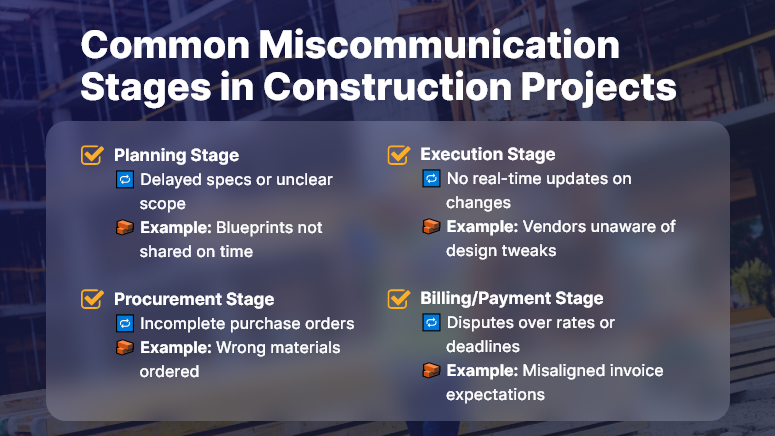
Common Miscommunication Stages in Construction Projects

Best Practices to Improve Vendor Communication

Here’s how to get it right — and keep projects moving without confusion.

Centralize All Conversations

  • Stop juggling emails, texts, and calls. Use one place for all communication with vendors.
  • With OConstruction, you can create shared task threads, tag vendors, and store every file in the cloud — so no one’s ever left out.

Standardize Workflows

Every vendor request should follow a consistent process. Use templates for:

  • RFQs
  • Change orders
  • Delivery instructions

This removes guesswork and ensures clear expectations across the board.

Give Role-Based Access

  • Not everyone needs everything. But vendors do need access to key documents, schedules, and status updates.
  • OConstruction lets you control what each vendor can see — ensuring clarity and data security.

Automate Notifications

  • Schedule changes? Approvals? Due dates?
  • Set up auto-notifications inside your construction platform. Vendors get real-time alerts, reducing the chance they’ll miss critical updates.

Track Every Change

  • Verbal updates fade. Written logs last.
  • Use digital records with timestamps to track who said what — and when.
  • This creates accountability and prevents finger-pointing later.

Don’t Leave Vendors Out of the Loop

  • You might think your internal team has it handled. But vendors are partners — and they need to be part of the conversation.
  • Make sure they know about updates as they happen, not after.

Don’t Assume They Read Every Email

  • Emails get buried. Attachments get missed.
  • Use built-in task comments, tagging, and push notifications to make sure vendors see what you send.

OConstruction Makes It Easy

With OConstruction, you can:

  • Set up shared vendor workspaces
  • Create task threads with comments
  • Use version-controlled documents
  • Automate alerts and due date reminders
  • Provide mobile access for field and vendor use

Everything happens in one place — reducing noise, avoiding confusion, and saving time.

Customer Story: Clear Communication That Delivered Results

For example, Hardline BuildCo, a regional construction firm, used OConstruction’s vendor access tools to streamline coordination with 8 suppliers and 10 subcontractors.

Before using the platform, they struggled with delayed materials and missed delivery windows — costing them thousands each month.

After switching:

  • On-time deliveries increased by 60%
  • Vendor-related errors dropped by 70%
  • Project managers gained back 10+ hours a week

With OConstruction, we finally had visibility and structure in our vendor communication,” said the company’s Senior PM.

Key Takeaways

  • Vendor communication is essential to project success — yet often overlooked
  • Poor communication leads to delays, rework, and missed deadlines

Using tools like OConstruction, you can:

  • Centralize updates
  • Track every interaction
  • Standardize workflows
  • Keep vendors aligned in real time

Clear communication isn’t just a productivity booster — it’s a risk reducer. By proactively keeping vendors in the loop and using digital tools to document every step, you minimize costly errors and maximize efficiency. With the right systems in place, your vendor relationships become stronger, your timelines more predictable, and your projects more profitable.

How to Manage Multiple Construction Projects Without Losing Control

Managing a single project is already a challenge — now multiply that by five, ten, or even twenty. According to a McKinsey report, large construction projects take 20% longer to finish than scheduled and are up to 80% over budget. When managing multiple construction sites, teams, and budgets at once, those risks multiply fast.

In today’s fast-paced construction world, staying in control of multiple projects isn’t just about spreadsheets and site visits anymore. It’s about having the right tools, workflows, and visibility to lead efficiently.

In this blog, we’ll walk you through how to master multi-project construction project management, avoid burnout, and use technology to gain real-time visibility — without losing your sanity.

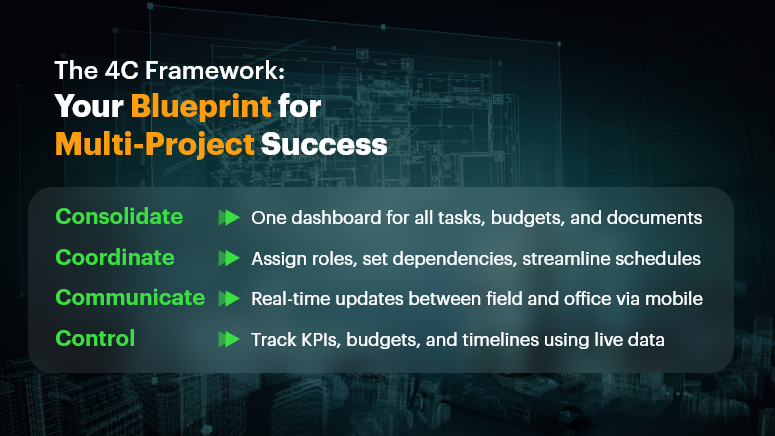
The 4C Framework Your Blueprint for Multi-Project Success

Why Multi-Project Management Matters in Construction

Managing multiple construction projects isn’t just a bigger workload — it’s a completely different operational challenge.

The Business Case

When running multiple sites simultaneously, you’re not just managing tasks — you’re managing people, materials, permits, vendors, inspections, and client expectations across geographies. One missed update or delayed decision can create a domino effect across every other project.

That’s why modern construction businesses — especially small and mid-sized firms — must rethink how they approach construction project management. The days of tracking everything in email threads and whiteboards are over.

Real-World Scenarios

  • A general contractor managing 12 residential sites loses track of which vendor was paid and who’s scheduled next on Site 7.
  • An EPC firm running industrial projects across regions struggles to align budgets with live progress reports from the field.
  • A design-build company tries to juggle stakeholder feedback on multiple projects but ends up reworking key deliverables due to version misalignment.

These aren’t just admin headaches. They impact your bottom line, brand reputation, and employee morale.

The solution? Centralized, real-time construction project management software that gives you clarity and control across everything you manage.

Best Practices to Manage Multiple Construction Projects Successfully

Let’s dive into proven strategies and practical frameworks that will help you gain control, reduce chaos, and make smarter decisions.

Do’s and Don’ts of Multi-Project Construction Management

  • Do use a centralized dashboard.

Managing multiple projects without a unified view is like flying blind. A centralized dashboard allows you to monitor timelines, budgets, milestones, and team progress — all in one place.

  • Don’t rely on manual coordination.

Emails, phone calls, and texts work until they don’t. Relying on manual updates leads to delays, miscommunication, and mistakes that cost money and trust.

  • Do standardize processes across sites.

Templates for reporting, procurement, QA/QC, and daily logs create consistency. This ensures every team follows the same quality and compliance standards.

  • Don’t ignore resource planning.

Overcommitting crews or duplicating material orders can cripple your schedule. Use real-time scheduling tools to balance people and inventory smartly.

Quick Wins to Regain Control

  • Use mobile-first field reporting tools.

Empower your site engineers to log updates, photos, and safety reports from their phones. This reduces paperwork and ensures instant communication.

  • Implement live budget tracking.

Keep track of your budget at all times. Flag overspending instantly. Tools like OConstruction help track estimates vs. actuals in real-time.

  • Set up automatic alerts and reminders.

Never miss a deadline again. From permit renewals to payment approvals, get notified before things slip.

  • Centralize vendor and contractor details.

Keep certifications, rates, and past performance in one place. This helps avoid repeated errors and manage accountability.

Framework: The 4C Model for Multi-Project Success

  • Consolidate – Bring all projects, tasks, schedules, and documents into one platform.
  • Coordinate – Assign responsibilities, dependencies, and workflows across teams.
  • Communicate – Enable instant updates between the office and the field via mobile apps.
  • Control – Use analytics, reports, and dashboards to monitor KPIs and correct courses fast.

This model aligns perfectly with how OConstruction structures its platform — helping teams stay connected, proactive, and accountable.

Customer Example: Real-World Success in Action

For example, FalconBuild Pvt. Ltd., a mid-sized commercial contractor, used OConstruction’s centralized dashboard and mobile reporting tools to manage 9 simultaneous projects across two states. With real-time visibility into site progress, resource allocation, and budget tracking, the team reduced reporting time by 40% and improved on-time project delivery by 30%. Here’s how…

  • Deployed a mobile app for on-site daily logs and inspection checklists
  • Used real-time dashboards to track material use and crew hours
  • Set up auto-notifications for permit expirations and change orders
  • Cut down email chains by 60% with built-in messaging and approvals

Result: More clarity, less chaos, and measurable ROI.

Regain Control, One Project at a Time

Managing multiple construction projects doesn’t have to feel like a high-stakes balancing act. With the right tools and workflows, you can reduce risk, increase productivity, and stay confidently in control.

  • Centralize your project data
  • Standardize your workflows
  • Empower your teams with mobile access
  • Use real-time dashboards to make informed decisions faster

Modern construction project management is about agility, visibility, and control — and that’s exactly what a platform like OConstruction delivers.

FAQs

1. What is multi-project construction management?
Multi-project construction management refers to overseeing several construction projects at once, ensuring timelines, budgets, resources, and teams are coordinated efficiently.

2. Why is managing multiple construction projects so challenging?
Because it involves coordinating tasks, crews, vendors, permits, and budgets across different sites. A small delay or miscommunication in one project can ripple across others.

3. How does construction project management software help with multi-project management?
It centralizes all projects into a single platform, offering real-time dashboards, resource planning, budget tracking, and communication tools that keep teams aligned.

4. What are the risks of managing multiple projects without software?
Common risks include cost overruns, delayed timelines, miscommunication between field and office, duplicate resource allocations, and low client satisfaction.

5. Can small and mid-sized construction companies benefit from multi-project management tools?
Yes. In fact, smaller firms benefit greatly since software reduces manual admin work, prevents mistakes, and helps them scale without needing large management teams.

Real-Time Reporting: A Game-Changer in Construction Management

Managing construction projects is complicated, managers need to handle numerous stakeholders, dependencies, and deadlines which can make managing construction projects a challenge.

This demands a more efficient and transparent approach to managing projects. Traditional project management methods just don’t cut it.

You need construction project management software with real-time reporting. This feature redefines how construction projects are managed.

In this blog, we will explore why real-time reporting is not just a choice but a necessity. This will enable you to stay ahead of the challenge and deliver projects successfully.

What Is Real-Time Reporting?

Real-time reporting is all about making project data and updates accessible across a centralized platform. It provides stakeholders with updated insights on each aspect of project development – all in real-time.

Instead of relying on spreadsheets or weekly reports, project managers and team members will be able to make informed decisions on the go.

Construction management software like OConstruction integrates with mobile apps, IoT devices, and cloud-based systems to deliver seamless actionable insights.

The Challenges of Traditional Reporting Methods

Before understanding the real value of real-time reporting, it’s essential to recognize the limitations of traditional reporting methods.

  • Delays in Information: Weekly or monthly reports result in outdated data which cannot provide an accurate forecast of strategies and plans. This can lead to delays in identifying and addressing issues.
  • Fragmented Data: When data is stored across multiple platforms or apps like spreadsheets it makes it difficult to get a comprehensive view of the project.
  • Communication Gaps: Manual reporting can cause miscommunication among stakeholders which can lead to errors and rework.
  • Increased Risk of Errors: Manual data entry increases the possibility of human errors which can disrupt the data and therefore the project itself.
  • Reactive Decision-Making: Without timely insights, project managers have to anticipate changes in the project and oftentimes react to problems instead of proactively addressing them.

Why Real-Time Reporting Is Essential for Construction Projects


Construction Management

1. Enhanced Decision-Making

Real-time reporting enables project managers with accurate and up-to-date data thereby enabling them to make informed decisions faster. It’s about reallocating resources, adjusting schedules, and addressing safety concerns faster.

2. Improved Transparency and Accountability

Construction project management software like OConstruction keeps all the stakeholders in the loop thereby fostering transparency and ensuring that everyone has access to the same information.

This reduces misunderstandings and keeps each party accountable for their responsibilities.

3. Faster Issue Resolution

It also facilitates faster problem solving such as equipment failures, material shortages, and design discrepancies. Real-time reporting ensures they are flagged immediately.

Faster identification enables team members to resolve issues before they escalate and minimize delays or cost overruns.

4. Accurate Progress Tracking

Real-time dashboards in Construction project management software like OConstruction can show real-time data on project milestones, task completion, and overall progress of the project.

This clarity ensures that projects stay on track and allow project managers to adjust timelines when needed.

5. Cost Control and Budget Management

Budget is yet another significant aspect of construction project management. Project managers get real-time updates on expenses, and can monitor budgets more effectively.

Early detection of cost overruns enables faster corrective action and facilitates the project to remain within the budget limits.

6. Better Collaboration Across Teams

Real-time reporting also breaks down silos which provide a centralized platform for sharing information.

Teams from different locations can collaborate more effectively and ensure that the project is aligned with the requirements thereby reducing redundancies.

7. Proactive Risk Management

Construction projects are inherently risky because of factors such as weather, supply chain disruptions, and labor costs.

Reporting and real-time metrics let you identify potential risks early. This allows managers to implement mitigation strategies before they impact the project.

Statistics That Prove the Value of Real-Time Reporting

According to McKinsey, large construction projects typically take 20% longer to finish and run up to 80% over budget due to poor planning and reporting.

Dodge Data & Analytics reports that 61% of contractors using real-time project management tools saw improved schedule adherence.

A survey by FMI revealed that companies leveraging real-time data improved labor productivity by 14% and reduced rework costs by up to 5%.

70% of project delays could be avoided with better real-time visibility and reporting (KPMG).

Case Study: Real-Time Reporting in Action

Project: A mid-sized infrastructure company managing a $50M highway construction project.

Challenge: The company faced frequent delays due to material shortages and poor communication between contractors and subcontractors. Reports were consolidated weekly, leading to delayed issue resolution.

Solution: The company implemented OConstruction’s real-time reporting software. Field teams updated progress directly from mobile devices, while IoT sensors tracked equipment usage. Automated alerts flagged potential material shortages in advance.

Results:

  • Reduced project delays by 25%.
  • Cost overruns cut by 15%.
  • Stakeholder satisfaction improved due to transparent communication.
  • The project was delivered three weeks earlier than scheduled.

Key Features of Real-Time Reporting Tools in Construction

To fully leverage the benefits of real-time reporting, construction project management software should include the following features.

  • Live Dashboards: Centralized dashboards can display key metrics such as project progress, budgets, and resource allocation to project managers.
  • Mobile Accessibility: Mobile-friendly platforms ensure that the on-site teams can input and access data from anywhere.
  • Integration with IoT Devices: IoT devices can use sensors to provide real-time updates on equipment usage, environmental conditions, and worker safety.
  • Automated Alerts and Notifications: Immediate alerts can create scheduled deviations, budget overruns, and compliance issues to keep stakeholders informed.
  • Customizable Reports: Customized reporting options let you meet the unique needs of different projects and stakeholders.
  • Cloud-Based Storage: Secure cloud-based systems also enable data to be accessed and shared in real-time across multiple locations.

How Real-Time Reporting Impacts Stakeholders

  • Project Managers: Real-time reporting enables project managers to keep control over every aspect of the project, thereby ensuring timely completion and optimal resource utilization.
  • Contractors and Subcontractors: Contracts and subcontractors can monitor task assignments, resource availability, and equipment usage in real-time, thereby reducing downtime and ensuring efficiency.
  • Clients: Clients get a transparent view of the project’s progress thereby fostering trust and reducing disputes.
  • Field Teams: On-site teams can easily report progress, flag issues, and access critical information instantly, thereby improving productivity and communication.
  • Compliance Officers: Real-time reporting ensures compliance with safety regulations and industry standards, which reduces risks and avoids penalties.

The Future of Real-Time Reporting in Construction

  • As technology continues to evolve, real-time reporting is becoming more comprehensive and simplified.
  • The integration of AI and predictive analytics enables forecasting potential risks and optimizing resource allocation.
  • Wearable devices and drones also enhance real-time data collection and can generate even the most minute insights into on-site conditions.
  • Moreover, 5G connectivity will revolutionize real-time reporting by enabling faster data transmission even in remote construction sites.
  • These advancements will further empower businesses to deliver projects faster and with greater efficiency.

Final Thoughts

Real-time reporting is no longer a choice but a necessity for modern-day projects. Providing instant access to critical data can empower the team to make informed decisions which can improve collaboration and ensure that the project is delivered on time and within budget.

Integrating construction project management software and other reporting tools is an investment in efficiency, transparency, and long-term success.

Are you ready to transform your construction projects with real-time reporting? Let’s start building the future, one data-driven decision at a time.

Frequently Asked Questions 

Q1. How does real-time reporting differ from traditional reporting?
Real-time reporting delivers instant updates and dashboards, unlike traditional weekly/monthly reports that often contain outdated data. It ensures decisions are made proactively, not reactively.

Q2. Is real-time reporting expensive to implement?
Not necessarily. Cloud-based construction management tools like OConstruction scale with your needs. The investment often pays off by reducing rework, avoiding penalties, and improving productivity.

Q3. How does it help with compliance and safety?
Real-time reporting integrates with IoT sensors and safety checklists, ensuring immediate alerts for compliance issues, worker safety breaches, or regulatory deviations.

Q4. Can small construction firms benefit from it?
Absolutely. Even small firms face risks like delays and cost overruns. Real-time reporting helps smaller teams manage resources effectively and stay competitive.

Q5. Does real-time reporting replace project managers?
No. It empowers them. The technology provides instant insights, but human judgment and leadership remain critical to project success.

Category: Construction Academy

Subcategory: Budgeting and Planning

Subcategory: Construction Phase

Subcategory: Design Coordination

Subcategory: Estimation Techniques

Subcategory: Initiation and Feasibility

Subcategory: Introduction

Subcategory: Personal Management

Subcategory: Project Close-Out

Subcategory: Project Scheduling

Subcategory: Project Teams

Subcategory: Proposal Management

Subcategory: Total Quality Management

Subcategory: Tracking and Control

Subcategory: Work Breakdown

Category: Help Desk

Subcategory: Client

Subcategory: Construction 101

Subcategory: Contractor Management

Subcategory: Expense

Subcategory: Finance Budget

Subcategory: Inventory Management

Subcategory: My Approvals

Subcategory: Site Management

Subcategory: Vendor Management