Construction remains one of the most high-risk industries globally, accounting for a significant share of workplace injuries, fatalities, and costly project delays. Despite advances in equipment and regulations, most construction incidents still occur due to poor planning, unclear task execution, and inadequate hazard identification.
This is precisely where Pre-Task Planning (PTP) in construction becomes indispensable.
Pre-Task Planning is a structured process that ensures every task is clearly understood, risks are identified in advance, controls are defined, and responsibilities are assigned before work begins. When implemented consistently, PTP transforms safety from a reactive activity into a proactive discipline.
In this blog, we explore best practices for Pre-Task Planning (PTP) to reduce incidents, improve workforce accountability, and strengthen overall construction risk management — and how modern platforms like OConstruction make PTP scalable, auditable, and effective across projects.
What Is Pre-Task Planning (PTP) in Construction?
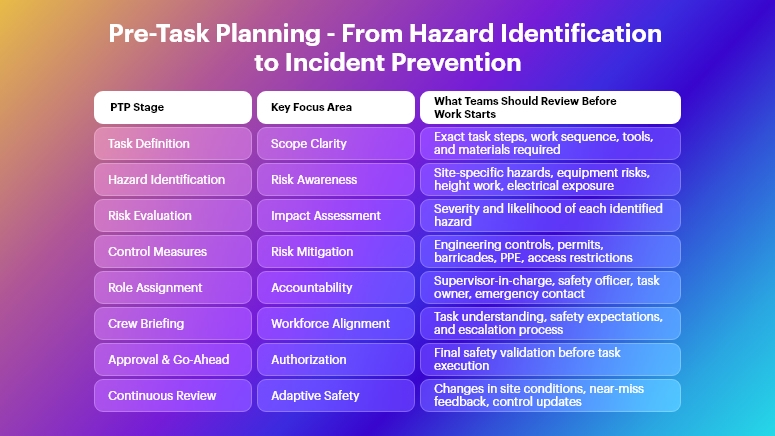
Pre-Task Planning (PTP) is a systematic approach where supervisors and crews evaluate a task before execution to determine:
- What work will be performed
- What hazards may exist
- What controls are required
- Who is responsible for each action
Unlike generic safety talks, PTP is task-specific, site-specific, and time-bound, ensuring that safety planning reflects real-world conditions.
When aligned with digital construction project management software, PTP becomes measurable, repeatable, and enforceable, not just a paper exercise.
Why Pre-Task Planning Reduces Construction Incidents
Effective Pre-Task Planning in construction directly impacts safety performance by:
- Eliminating ambiguity before work begins
- Identifying hazards early, not after incidents occur
- Improving worker awareness and engagement
- Reducing rework, downtime, and emergency stoppages
- Ensuring regulatory compliance and audit readiness
Most importantly, PTP ensures that safety decisions are made before exposure, when risks can still be controlled.
Pre-Task Planning (PTP) Best Practices to Reduce Incidents
1. Break Tasks into Clear, Actionable Steps
One of the most common PTP failures is planning at a high level instead of at the task level.
Best practice requires breaking work down into specific steps, such as:
- Equipment mobilization
- Material handling
- Installation activities
- Testing or commissioning
Each step should be reviewed individually for hazards. This approach significantly improves construction safety planning by preventing overlooked risks hidden within complex tasks.
2. Identify Hazards Specific to the Jobsite Conditions
Hazards are never static. Weather, access routes, manpower, and nearby activities can change daily.
Effective Pre-Task Planning (PTP) in construction must consider:
- Site congestion and overlapping trades
- Equipment movement and lifting zones
- Electrical, height, and confined space risks
- Environmental conditions such as rain, heat, or poor visibility
By identifying real-time hazards, teams reduce the likelihood of unexpected incidents.
3. Define Control Measures Before Work Starts
Hazard identification alone does not reduce incidents. The value of Pre-Task Planning lies in defining practical control measures, such as:
- Engineering controls (guardrails, barriers, isolation)
- Administrative controls (permits, sequencing, access control)
- PPE requirements aligned with the task
Documenting controls ensures that safety actions are implemented, not assumed.
4. Assign Clear Roles and Responsibilities
Many construction incidents occur because safety responsibilities are unclear or assumed.
A strong PTP process explicitly assigns:
- Who is responsible for safety supervision
- Who inspects tools and equipment
- Who authorizes task execution
- Who responds if conditions change
Using a construction project management platform like OConstruction, these responsibilities can be digitally tracked and audited.
5. Conduct Daily Pre-Task Meetings with Crew Involvement
Pre-Task Planning should never be a one-way instruction.
Best practices include:
- Conducting daily PTP meetings before work begins
- Encouraging workers to voice concerns
- Verifying understanding, not just attendance
When workers actively participate, PTP becomes a shared responsibility, leading to higher compliance and safer behavior.
6. Use Digital PTP Checklists Instead of Paper Forms
Paper-based PTP forms often fail due to:
- Incomplete data
- Poor traceability
- No real-time visibility for management
Digital PTP tools within construction project management software allow teams to:
- Standardize PTP checklists
- Capture photos and observations
- Track approvals and timestamps
- Maintain audit-ready records
This significantly strengthens construction risk management while reducing administrative overhead.
7. Monitor, Review, and Update PTP Continuously
Construction environments evolve rapidly. Therefore, Pre-Task Planning must be dynamic, not static.
Best practice includes:
- Revisiting PTP when task scope changes
- Updating controls if hazards increase
- Recording near-misses and lessons learned
Continuous improvement ensures that PTP remains relevant and effective throughout the project lifecycle.
How OConstruction Enables Effective Pre-Task Planning
OConstruction, a modern construction project management software, enables organizations to operationalize Pre-Task Planning (PTP) in construction by providing:
- Digital PTP workflows and checklists
- Centralized task-level risk documentation
- Real-time visibility for site and safety managers
- Integration with schedules, resources, and site activities
- Compliance-ready safety records
By embedding PTP directly into daily construction workflows, OConstruction helps teams reduce incidents, improve accountability, and build a culture of proactive safety.
Key Benefits of Strong Pre-Task Planning
When implemented correctly, Pre-Task Planning best practices deliver measurable outcomes:
- Reduced accidents and near-misses
- Lower project delays and stoppages
- Improved worker confidence and morale
- Better regulatory compliance
- Enhanced project predictability and cost control
Safety planning, when digitized and standardized, becomes a competitive advantage, not just a compliance requirement.
Conclusion
In today’s high-risk construction environment, Pre-Task Planning (PTP) is no longer optional. It is a foundational practice that protects workers, safeguards timelines, and preserves project profitability.
By adopting proven PTP best practices and leveraging digital platforms like OConstruction, construction organizations can move beyond reactive safety management and build a predictive, disciplined, and incident-resistant jobsite culture.
The safest projects are not accident-free by chance — they are planned that way before the first task begins.
Frequently Asked Questions (FAQs)
1. What is PTP in construction?
Pre-Task Planning is a structured process where construction teams identify task-specific hazards, controls, and responsibilities before starting work to reduce incidents.
2. How does Pre-Task Planning reduce construction incidents?
PTP reduces incidents by identifying risks early, defining control measures in advance, and ensuring all workers understand the task and associated hazards.
3. Is PTP mandatory for construction projects?
While regulations vary, many safety standards and clients require documented task-level safety planning, making PTP a best practice across projects.
4. How often should PTP be conducted?
PTP should be conducted daily or before any new task, and updated whenever site conditions or task scope changes.
5. Can Pre-Task Planning be digitized?
Yes. Using construction project management software like OConstruction, PTP can be digitized for better consistency, traceability, and compliance.
6. What is the difference between PTP and toolbox talks?
Toolbox talks are general safety discussions, while PTP is task-specific, hazard-focused, and action-oriented.