In today’s construction industry, cost overruns account for nearly 70% of project failures, and in most cases, the root cause traces back to poor BOQ management in construction projects. Whether it is a residential tower, a highway package, or an EPC contract, even a minor mismatch between estimated quantities and actual execution can trigger budget leakage, rework, disputes, and delayed payments.
However, despite its strategic importance, BOQ management is still handled using Excel sheets, static PDFs, manual measurements, and fragmented site reports. As a result, project managers struggle with inaccurate quantities, delayed DPRs, uncontrolled material usage, and last-minute cost surprises.
This blog explains how BOQ management in construction projects must evolve—from estimation to execution. You will learn why traditional methods fail, what best practices modern construction teams follow, and how OConstruction enables real-time BOQ-driven execution, cost control, and site visibility.
This guide is written for project managers, contractors, EPC firms, QS teams, site engineers, and construction business owners who want predictability, profitability, and control across their projects.
Why BOQ Management in Construction Projects Matters More Than Ever
BOQ management in construction projects is not just a pre-construction activity—it is the financial backbone of the entire project lifecycle. When BOQs are disconnected from execution, organizations face cascading problems that compound over time.
- Cost overruns become inevitable because estimated quantities are never reconciled with actual consumption, leading to uncontrolled expenses and shrinking margins.
- Material wastage increases significantly when procurement decisions are made without real-time BOQ alignment, causing excess ordering or shortages.
- Rework and disputes escalate due to mismatches between approved BOQs, site execution, and billing quantities.
- Delayed DPRs and approvals slow down cash flow, especially in EPC and infrastructure projects where progress-linked billing is critical.
Real-World Construction Scenarios
Across different construction segments, BOQ mismanagement creates similar pain points:
- Real estate projects suffer from cost overruns due to inaccurate item-wise tracking across multiple towers and phases.
- Infrastructure and highway projects face quantity disputes during interim payment certificates because manual measurements lack traceability.
- Residential and commercial projects struggle with coordination gaps between planning, site execution, and procurement.
- EPC companies lose margin visibility when BOQs are managed separately from schedules, DPRs, and cost tracking systems.
Why Traditional Tools Fail on Construction Sites
Despite digital adoption elsewhere, many teams still rely on Excel sheets, WhatsApp updates, manual site registers, and isolated accounting tools. However, these methods fail because:
- Excel-based BOQs are static, while construction sites are dynamic and change daily.
- WhatsApp updates lack structure and auditability, making them unreliable for quantity tracking.
- Manual logs delay reporting, leading to outdated decisions.
- Disconnected tools break accountability, creating silos between site, planning, procurement, and finance teams.
Therefore, modern BOQ management in construction projects requires an integrated, execution-first digital workflow—and this is exactly where OConstruction delivers value.
Best Practices for BOQ Management in Construction Projects (From Estimation to Execution)
1. Create a BOQ That Is Execution-Ready, Not Just Tender-Ready
An effective BOQ must go beyond tendering and serve as a live control document throughout execution.
- Break BOQ items down to site-operable levels, ensuring every item maps directly to work packages, tasks, and schedules.
- Align BOQ structure with WBS, allowing quantities to flow naturally into planning and progress tracking.
- Standardize item descriptions and units, eliminating ambiguity during site execution and billing.
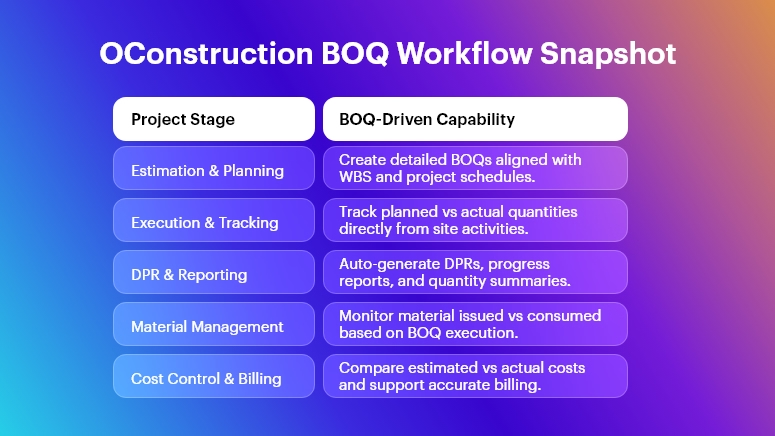
With OConstruction’s BOQ & Estimate Management, BOQs are structured to integrate seamlessly with tasks, schedules, and DPRs, ensuring consistency from planning to execution.
2. Link BOQ Directly with Project Planning and Scheduling
BOQ management in construction projects fails when quantities exist separately from timelines.
- Map BOQ items to project schedules, ensuring quantity consumption aligns with planned progress.
- Track planned vs actual quantities, allowing early identification of slippages or overruns.
- Use schedule-driven BOQ execution, especially for EPC and infrastructure projects with milestone-based billing.
OConstruction enables BOQ-linked planning and schedule tracking, giving project managers time–quantity–cost visibility in one dashboard.
3. Automate DPRs Using BOQ-Based Execution Data
Daily Progress Reports are the most critical link between site execution and BOQ control.
- Capture daily quantities directly from site activities, eliminating manual data entry.
- Auto-generate DPRs based on executed BOQ items, improving accuracy and speed.
- Ensure DPR data feeds billing and cost reports, reducing reconciliation effort.
With DPR Automation & Daily Logs, OConstruction ensures that BOQ management in construction projects remains accurate, real-time, and auditable.
4. Control Materials Using BOQ-Driven Consumption
Material wastage is one of the biggest profit killers in construction projects.
- Plan material requirements directly from BOQ quantities, avoiding over-ordering.
- Track issued vs consumed materials, ensuring alignment with executed quantities.
- Identify abnormal consumption patterns early, preventing leakage and pilferage.
OConstruction’s Inventory & Purchase Handling integrates material tracking with BOQ execution, ensuring every bag, bar, and batch is accounted for.
5. Monitor Costs in Real Time Against BOQ Budgets
Cost control becomes effective only when BOQ execution data feeds financial monitoring.
- Track item-wise cost variance, comparing estimated vs actual costs.
- Monitor committed, incurred, and remaining budgets, ensuring proactive decisions.
- Enable early corrective actions, rather than post-project damage control.
Using Cost Control & Budget Monitoring, OConstruction transforms BOQ management in construction projects into a profit-protection mechanism.
6. Improve Multi-Site Coordination with Centralized BOQ Visibility
Managing BOQs across multiple sites is extremely complex without a centralized system.
- Standardize BOQs across projects, enabling consistent execution practices.
- Enable real-time field-to-office sync, reducing communication delays.
- Provide leadership with portfolio-level BOQ insights, improving strategic decisions.
OConstruction delivers real-time, centralized BOQ dashboards, ensuring visibility across all construction sites.
7. Avoid Common BOQ Management Mistakes
Construction teams often repeat the same BOQ-related mistakes:
- Treating BOQs as static documents, instead of live execution controls.
- Delaying quantity updates, causing inaccurate cost tracking.
- Relying on manual reconciliations, increasing errors and disputes.
- Failing to integrate BOQs with DPRs, materials, and schedules.
By digitizing workflows end-to-end, OConstruction eliminates these risks entirely.
Construction Success Story
For example,a mid-sized EPC contractor executing highway and industrial projects, adopted OConstruction’s BOQ & DPR Automation to overcome chronic cost overruns and delayed reporting.
Before OConstruction, their teams relied on Excel BOQs and manual DPRs, leading to mismatched quantities, billing disputes, and delayed management reviews. Within three months of implementation, the transformation was evident.
They achieved 30% faster DPR completion, significantly improved BOQ accuracy, and reduced material wastage by over 20%. Site engineers began capturing quantities digitally, while project managers gained real-time visibility into planned vs actual execution.
Most importantly, leadership could now track project health daily, not monthly—turning BOQ management in construction projects into a competitive advantage.
Why BOQ Management Must Evolve Now
BOQ management in construction projects is no longer optional—it is mission-critical for survival and growth.
- BOQs must move from static spreadsheets to dynamic execution systems.
- Real-time integration with DPRs, materials, schedules, and costs is essential.
- Digital workflows reduce errors, delays, and disputes significantly.
- OConstruction enables complete visibility from estimation to execution.
Organizations that modernize BOQ management today will deliver projects faster, cheaper, and with higher confidence—while others will continue firefighting.
FAQs
1. What is BOQ management in construction projects?
BOQ management in construction projects involves planning, tracking, and controlling quantities, costs, and execution using BOQs throughout the project lifecycle.
2. Why is BOQ management critical during execution?
Without execution-level BOQ tracking, projects face cost overruns, rework, and billing disputes due to inaccurate quantities.
3. How does digital BOQ management improve project outcomes?
Digital BOQ management improves accuracy, real-time visibility, accountability, and cost control by eliminating manual errors.
4. Can BOQs be linked with DPRs and schedules?
Yes. Modern systems like OConstruction link BOQs directly with DPRs, schedules, and materials for end-to-end control.
5. How does OConstruction help with BOQ management in construction projects?
OConstruction integrates BOQ estimation, execution tracking, DPR automation, cost monitoring, and material management in one platform.
6. Is BOQ management useful for small and mid-sized contractors?
Absolutely. Structured BOQ management helps contractors protect margins and scale operations efficiently.
7. When should BOQ digitization start in a project?
Ideally, BOQ digitization should begin during estimation and continue seamlessly through execution and billing.