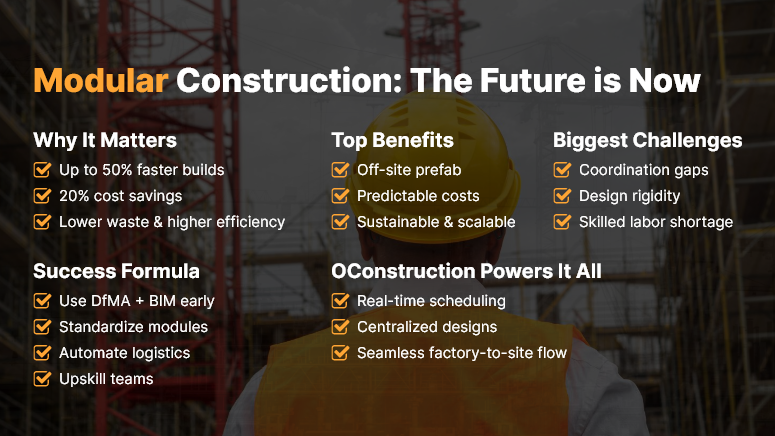
In the ever-evolving world of construction, modular construction is no longer a futuristic buzzword — it’s a present-day game-changer. According to McKinsey, modular construction can speed up build times by up to 50% and reduce costs by 20%. That’s not just innovation — that’s impact.
Yet, despite the promising numbers, many construction leaders still hesitate. Why? Because every new method brings both exciting opportunities and real-world challenges.
In this post, we’ll break down the business case for modular construction, unpack its major benefits and hurdles, and show how integrated digital platforms like OConstruction can help companies transition smoothly into this modern construction paradigm.
Why Modular Construction Matters for the Industry
The construction industry is facing pressure from all sides: rising labor shortages, tighter deadlines, increasing material costs, and a demand for greener, faster builds. Enter modular construction — a method where building components are manufactured off-site, then assembled on location like a LEGO set.
Key Business Drivers Behind the Shift:
- Speed-to-market: Modular methods can shave weeks (or months) off traditional timelines.
- Labor efficiency: Skilled labor is centralized in factories rather than scattered across field sites.
- Cost predictability: Prefabrication enables better control over budgets and timelines.
- Sustainability: Waste reduction and better energy performance make modular a green-friendly option.
Real-World Challenges Construction Firms Face:
- Coordination complexity – Off-site production requires exact alignment between factory and field teams.
- Design rigidity – Upfront planning must be airtight, with minimal room for late-stage changes.
- Limited experience – Many firms still lack the expertise or tools to manage modular workflows efficiently.
This is where a digital platform like OConstruction comes in — bridging the gap between planning, design, manufacturing, and assembly with real-time visibility, scheduling, and collaboration tools.
Best Practices for Modular Construction Success
To get the most out of modular construction, businesses need a strategic roadmap. Here’s a practical guide covering the dos, don’ts, and best practices for implementation.
DO: Embrace Design for Manufacturing and Assembly (DfMA)
- Align design teams and manufacturers early using a collaborative platform. This ensures modules are designed with factory assembly in mind.
- Use 3D BIM tools integrated with your project management system to visualize dependencies and constraints.
DON’T: Rely on Manual Coordination
- Avoid spreadsheets and disconnected tools that create version confusion and miscommunication.
- Instead, use a cloud-based construction platform like OConstruction to align all stakeholders in real time.
DO: Standardize Where Possible
- Modular thrives on repeatable, scalable designs. Use pre-approved module templates to streamline planning.
- Store and manage these templates in a centralized document library that’s accessible to every team.
DON’T: Ignore Logistics Planning
- Transport and site assembly are just as critical as module production.
- Use automated scheduling and tracking to ensure just-in-time delivery and assembly sequencing.
DO: Train Teams and Upskill Workers
- Modular isn’t “plug-and-play” — it requires specialized knowledge and workflow adjustments.
- Offer role-based training modules within your construction software to reduce friction.
DO: Use Integrated Analytics
- Track KPIs such as factory output rate, delivery timing, cost per module, and on-site assembly speed.
- Build custom dashboards inside OConstruction to make data-driven decisions throughout the lifecycle.
Use Case Example
For example, SkyCore Developments, a mid-sized commercial real estate firm, shifted to modular construction for its new hotel chain. By using OConstruction’s scheduling and document control features, they reduced project duration by 34% and cut waste by nearly 40%.
Here’s how:
- Their design team used BIM integration to coordinate specs with the prefab factory.
- Project managers tracked module production status remotely.
- On-site crews received just-in-time delivery notifications and visual assembly instructions.
Key Takeaways & Closing Thoughts
Modular construction is shaping the future of how we build — faster, greener, and smarter. But success isn’t guaranteed unless companies have the tools to manage the added complexity.
Main insights:
- Modular construction reduces timelines and increases cost predictability.
- It introduces coordination, logistics, and design challenges that demand digital support.
- An integrated platform like OConstruction enables seamless planning, scheduling, and team collaboration across the modular lifecycle.
In short:
If you want to capitalize on modular construction’s potential, the right technology is your foundation. With digital tools that sync design, manufacturing, and assembly, you move from potential to performance.
FAQs
Q1. What is modular construction?
Modular construction is a method where building components (modules) are prefabricated off-site in a controlled factory environment, then transported and assembled on the construction site. Think of it like building with LEGO blocks — each module is precision-made to fit together seamlessly.
Q2. Why is modular construction gaining popularity in the industry?
The construction sector faces rising labor shortages, increasing material costs, tighter deadlines, and demand for greener building methods. Modular construction addresses these pressures by:
- Speeding up project timelines (up to 50% faster than traditional methods).
- Reducing costs (McKinsey reports up to 20% savings).
- Improving labor efficiency by centralizing skilled work in factories.
- Enhancing sustainability through waste reduction and energy-efficient builds.
Q3. How does modular construction reduce project timelines?
Since modules are built off-site while site preparation occurs simultaneously, multiple phases overlap instead of running sequentially. This parallel workflow can shave weeks or months off traditional construction schedules.
Q4. How does it improve cost predictability?
Prefabrication allows for precise budgeting because factory-controlled processes reduce material waste, labor variation, and unexpected delays. This makes overall project costs more predictable compared to on-site construction.
Q5. How is modular construction more sustainable?
Factory-based production minimizes material waste, optimizes energy usage, and reduces site disturbance. Fewer on-site deliveries also mean lower carbon emissions from transportation.
Q6. What are the main challenges of modular construction?
While modular offers efficiency, it introduces new complexities:
- Coordination Complexity: Off-site manufacturing requires exact alignment between factory teams and on-site crews.
- Design Rigidity: Modules must be carefully designed in advance; late-stage changes are difficult.
- Limited Experience: Many firms lack the expertise or digital tools to manage modular workflows efficiently.
Q7. Why is logistics planning critical in modular construction?
Modules need just-in-time delivery and precise sequencing for on-site assembly. Poor logistics planning can delay projects, increase costs, and negate the speed advantage of modular methods.
Q8. How does design rigidity affect projects?
Because modules are pre-manufactured, design changes late in the project can be expensive or impossible. Upfront planning and integration with tools like BIM and DfMA principles are essential to avoid costly redesigns.
Q9. How can construction firms succeed with modular construction?
- Key practices include: Embrace DfMA (Design for Manufacturing & Assembly): Align design and manufacturing teams early.
- Standardize modules: Use repeatable templates for efficiency and scalability.
- Use integrated digital platforms: Cloud-based tools like OConstruction help coordinate all stakeholders in real time.
- Train teams and upskill workers: Modular workflows require specialized knowledge and processes.
- Leverage analytics: Track KPIs like production rates, delivery timing, cost per module, and on-site assembly speed.
Q10. How does technology help with modular construction?
Integrated platforms bridge the gap between planning, design, manufacturing, and assembly. Benefits include:
- Real-time progress tracking.
- Automated scheduling and delivery notifications.
- Centralized document and template management.
- Visualization through BIM integration.
Q11. Are there real-life examples of successful modular construction projects?
Yes. For example, SkyCore Developments implemented modular methods for a new hotel chain.
Using OConstruction:
- Project duration was reduced by 34%.
- Waste was cut by 40%.
- Design, production, and assembly were synchronized using digital tools for scheduling, document control, and just-in-time delivery.
Q12. Can modular construction be applied to commercial and residential projects?
Absolutely. Modular methods are versatile and can be used for:
- Hotels, offices, and schools.
- Multi-story residential buildings.
- Temporary or semi-permanent structures.